
Yes, time tracking software is legal for hourly employees in Austria in 2026, and employers covered by the Austrian Working Time Act must keep working-time records. That obligation does not authorize unrestricted surveillance: your system must comply with data-protection rules, and monitoring features can require works council approval or, where no works council exists, individual employee consent.
- Time tracking software is legal for hourly employees in Austria; attendance recording does not authorize unrestricted employee monitoring.
- Austria’s Working Time Act requires working-time records; project timers alone do not necessarily satisfy that obligation.
- Mesh App offers time tracking for SMEs; assess its configuration separately against Austrian employment and data-protection requirements.
- Check works council requirements before introducing monitoring, not after employees start using it.
Why this matters
For hourly employees, recorded time affects pay, overtime calculations and evidence of working-time compliance. A system that captures only billable project hours leaves a different question unanswered: how long did the employee actually work?
Choose a recording process first and software second. Your process needs to distinguish work, breaks and project allocation without treating every moment away from a keyboard as unpaid time. For a sector-specific operational perspective, see the guide to time tracking for metal construction firms.
This 2026 guide addresses ordinary adult employment within the relevant Austrian working-time framework. Special rules apply to particular employee groups and activities; collective agreements also affect how you classify and pay recorded hours. The software does not replace those rules.
Is time tracking software legal for hourly employees in Austria?
Yes. Austrian law permits electronic working-time records; legality depends on what you collect and how you use it. Paying someone hourly does not create a separate prohibition on digital time tracking.
For Austrian workplaces in 2026, the main legal framework includes Section 26 of the Working Time Act, or Arbeitszeitgesetz (AZG), the GDPR, and Austrian employee-participation rules. Sections 96 and 96a of the Labour Constitution Act, or Arbeitsverfassungsgesetz (ArbVG), become relevant when a system introduces monitoring or processes employee data beyond the applicable exceptions.
Use this sequence before introducing a system:
- Identify the recording obligation. Establish which working-time rules cover the employees and what records those rules require. Do not assume that every employee has the same recording arrangement.
- Define the data purpose. Separate statutory attendance records, payroll calculations and project costing. Each purpose needs an appropriate legal basis and a clear explanation to employees.
- Assess monitoring features. Review GPS, screenshots, activity measurement and similar functions independently from ordinary start-and-stop recording.
- Resolve employee participation. Determine whether the configuration requires a works agreement or another form of approval before activation.
- Document the operating process. Explain entries, corrections, access rights, retention and employee information. Keep the employer responsible for checking the records even when employees enter their own time.
A purchase contract is not legal approval. Nor does a checkbox accepting a privacy policy settle Austrian works council requirements.
Which recording approach fits your needs?
These approaches serve different purposes. None removes the employer’s responsibility to maintain appropriate records.
| Approach | Best for | Main advantage | Main limitation |
|---|---|---|---|
| Manual attendance entries | Teams that can reliably enter and review actual hours | Records working time without continuous activity observation | Missed entries and corrections need a defined review process |
| Start-and-stop time tracking | Employees recording work as it happens | Makes the recording action part of the work routine | Forgotten timers and incorrect break handling still need correction |
| Project time allocation | Businesses allocating labour to jobs or clients | Connects recorded effort to project costing | Billable project time is not necessarily total working time |
| Passive activity monitoring | A separately justified monitoring purpose | Captures the specific activity being measured | Computer activity is not a reliable substitute for working-time records and raises additional privacy issues |
For ordinary attendance recording, prefer the least intrusive approach that captures the required facts. Add project allocation where it serves a real business purpose; do not add surveillance simply because the software includes it.
What must your working-time records show?
Under Section 26 AZG, employers must maintain working-time records for employees within its scope. The appropriate detail depends on the working arrangement and any statutory simplifications that apply.
For an ordinary attendance-based setup, configure records around actual work starts, work ends and breaks. Preserve the distinction between a planned schedule and the time actually worked. A calendar entry saying an employee was scheduled is not, by itself, evidence that the employee worked that period.
Your review should answer these questions:
- Does the record reflect actual hours rather than only scheduled hours?
- Are breaks recorded or handled through a legally valid alternative arrangement?
- Can an employee report a missed entry or an incorrect deduction?
- Can payroll distinguish ordinary hours from hours requiring separate treatment?
- Can you explain a correction without losing sight of the original entry?
Under the ordinary adult AZG framework, work lasting more than 6 hours generally requires a total rest break of 30 minutes. Under the ordinary adult daily-rest framework, employees generally receive 11 consecutive hours of rest; statutory and sector-specific exceptions require separate assessment.
Those figures describe legal rules, not suggested timer settings. An automatic deduction does not establish that a break actually occurred, and software cannot make an interrupted break compliant merely by labelling it unpaid.
For a 2026 implementation, test break handling with real work patterns. A technician answering work calls during a supposed break needs a correction process, not a record that silently treats the entire period as rest.
When does time tracking become employee monitoring?
Recording when work begins and ends is different from continuously recording where an employee goes or what appears on their screen. The legal assessment follows the system’s actual functions and use, not its name.
Section 96(1)(3) ArbVG addresses control measures and technical systems for employee monitoring that affect human dignity. Where that provision applies and a works council exists, the required works council consent must precede introduction. Section 96a also addresses certain automated employee-data systems, subject to its statutory exceptions.
Where there is no works council, Section 10 of the Employment Contract Law Adaptation Act, or AVRAG, requires individual consent for control measures and technical monitoring systems affecting human dignity. That specific employment-law requirement is separate from choosing a GDPR legal basis.
Do not treat consent as a universal shortcut. Employee consent under the GDPR raises questions about whether the choice is genuinely voluntary in an employment relationship. Necessary statutory working-time recording generally rests on the relevant legal obligation, rather than an employee’s optional permission.
Before enabling additional monitoring, ask what the feature proves. A screenshot shows screen content, not necessarily hours worked; a location record shows a device’s location, not automatically a payable work period. Collecting more data does not resolve those distinctions.
Employee information should explain the purposes, recipients, retention arrangements and relevant rights. Restrict access to people whose duties require it, and examine the provider’s processing agreement, subprocessors and any international data transfers.
Why the legal requirements vary
The basic answer remains yes, but the implementation requirements change with the employment arrangement and system configuration. These are the main drivers:
- Employee coverage: The applicable working-time regime determines the recording obligation. Ordinary adult rules cannot be applied unchanged to every employee group.
- Working arrangement: Fixed schedules, flexible hours and work away from the office require different recording procedures. Use a statutory simplification only when its conditions are satisfied.
- Monitoring intensity: Attendance entries and continuous location or screen tracking are not equivalent. Assess additional observation separately.
- Works council status: A workplace with a works council follows the relevant participation requirements. Without one, individual consent requirements still apply to covered monitoring measures.
- Data purpose: Payroll, statutory compliance and project costing need distinct explanations. A lawful attendance purpose does not automatically justify unrelated performance analysis.
- Collective agreements: The applicable agreement affects working-time and pay treatment. Configure the system against the agreement that actually covers the employee.
Avoid creating a single company-wide rule that ignores these differences. A consultant allocating time to projects and a trades employee moving between sites can use the same platform while needing different entry instructions.
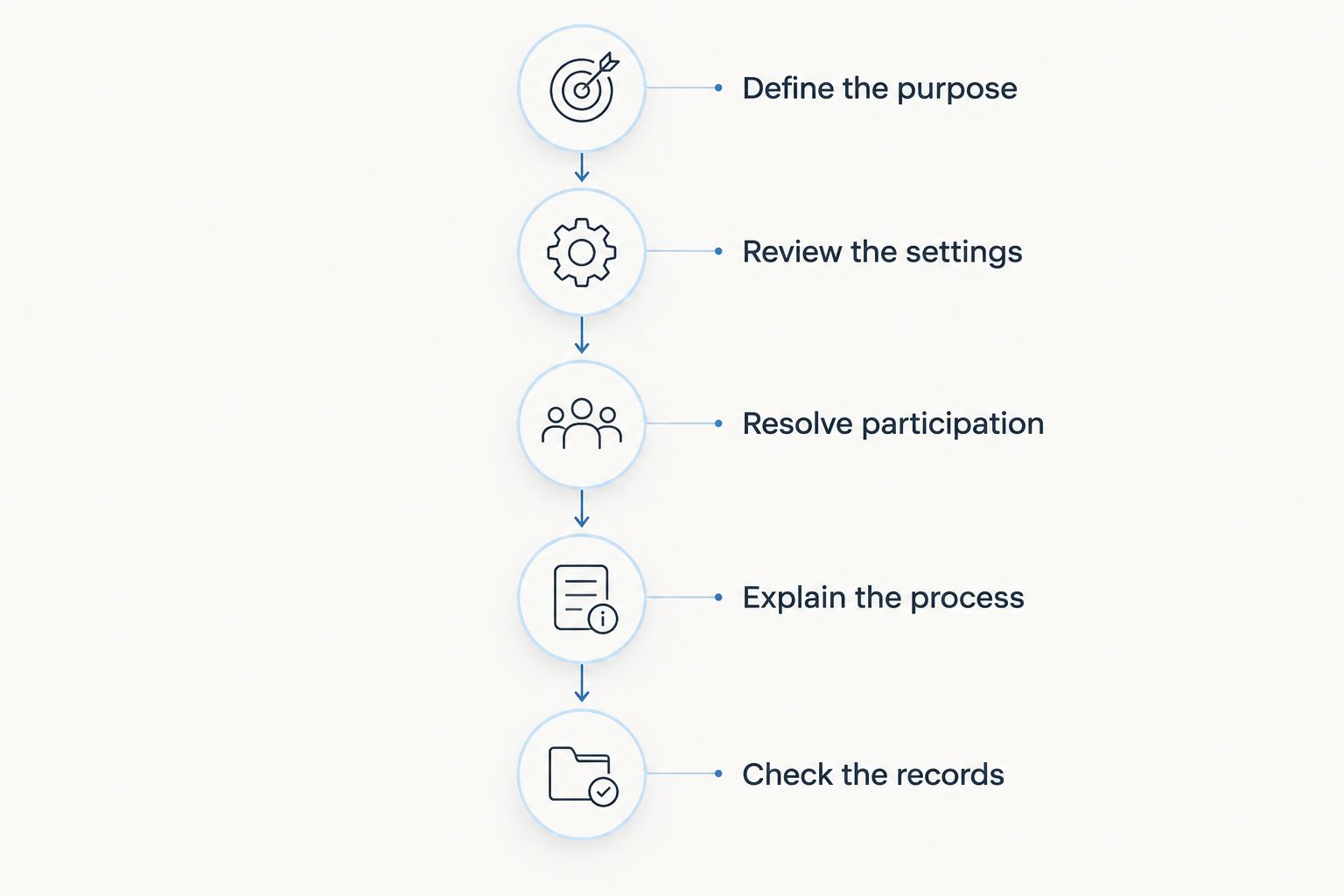
How should you introduce time tracking in 2026?
A lawful rollout needs an understandable procedure, not just enabled accounts. Start with a documented path from employee entry to payroll review, then check that the software supports it.
Define the purpose
Write down why you collect each field. Start and end times serve attendance recording; project codes serve allocation. If a field has no defined purpose, leave it out rather than collecting it for unspecified future use.
Review the settings
Inspect defaults before employees begin. Check break deductions, edit permissions, location collection, manager visibility and exports. Disable unnecessary monitoring and confirm how the provider handles employee data.
Resolve participation
Complete the applicable works council process or other required approval before introducing the relevant functions. Provide a description of the actual configuration, including any features that remain disabled.
Explain the process
Tell employees what to record, when to record it and how to correct an error. Explain who sees attendance records and whether project reporting has a separate audience. Make the instructions usable during a normal working day.
Check the records
Review missing entries, inconsistent breaks and corrections before payroll uses the data. Set a retention schedule based on the applicable recordkeeping, tax and employment requirements, rather than keeping everything indefinitely.
The sequence matters: decide the purpose before selecting fields, and resolve participation before activation. A technically functioning timer is not evidence that the surrounding employment process is lawful.
Where does Mesh App fit?
Mesh App is a time-tracking option for small and medium-sized businesses seeking a modular CRM/ERP platform. Its stated modules include contact management, project management, time tracking, invoicing and finance.
The advantage is its stated breadth: time tracking sits within a platform covering several business functions. The limitation is equally important: that module list does not establish Austrian legal compliance, specific monitoring controls or a particular payroll connection.
Evaluate Mesh App against your documented recording process. Ask how the proposed setup handles breaks, corrections, access and data processing; assess the actual answers rather than assuming that a time-tracking module settles those questions.
Can you require hourly employees to record their own time?
Yes, employers can arrange for employees to enter their working time, but the employer remains responsible for the required records and oversight. Give employees clear instructions and a practical correction route rather than shifting the entire compliance responsibility onto them.
Do billable hours count as complete attendance records?
No, billable hours do not necessarily include all working time. Internal meetings, administration and other work can fall outside client billing, so keep attendance recording distinct from the decision about what to invoice.
Is GPS necessary for employees working away from the office?
No, mobile work does not automatically require continuous GPS tracking. Determine whether location data is necessary for a specific purpose and assess its proportionality and participation requirements separately from recording hours.
FAQ
Is time tracking software legal for hourly employees in Austria in 2026?
Yes, time tracking software is legal for hourly employees in Austria in 2026. Employers must satisfy the applicable working-time recording, data-protection and employee-participation requirements; permission to record hours does not authorize unrestricted monitoring.
Do Austrian hourly employees have to consent to ordinary time recording?
Consent is not the default GDPR basis for working-time records required by law. Separate consent or works council requirements apply to certain monitoring measures, so assess the actual functions rather than treating all time tracking alike.
Can my employer automatically deduct a lunch break?
An automatic deduction does not prove that you took a break. Under the ordinary adult AZG framework, work exceeding 6 hours generally requires a total break of 30 minutes, and the recording process must handle missed or interrupted breaks correctly.
Does a works council have to approve every time-tracking app?
Not every time-tracking app has the same approval requirements. Monitoring affecting human dignity and certain automated employee-data systems trigger specific ArbVG provisions, subject to the relevant conditions and exceptions.
Can an Austrian employer use screenshots to verify my hours?
Screenshots require a separate monitoring and data-protection assessment; they are not automatically lawful because attendance recording is required. Screen content also does not establish the full amount of time worked.
Is Mesh App automatically compliant with Austrian time-tracking law?
Mesh App’s stated time-tracking module does not by itself establish Austrian legal compliance. Assess the configuration, employee information, participation requirements and processing arrangements before rollout.
Can project timers replace working-time records?
Project timers replace working-time records only if the resulting process captures the legally required information. A record limited to billable tasks leaves out other working time and cannot be treated as complete attendance evidence.
One last thing
Test the correction process before you test the reporting dashboard. Ask how an employee fixes a forgotten stop time, reports work during a deducted break or challenges an incorrect entry. Then check who approves the change and what explanation remains with the record.
For your 2026 rollout, that exercise tests whether the system reflects actual work rather than merely producing tidy totals. A record that looks precise can still be wrong; your operating procedure needs to make correction possible without concealing what changed.
This guide provides general information, not advice on an individual employment arrangement. Have an Austrian employment-law adviser assess disputed monitoring features and special working-time arrangements before introduction.