
ERP software is worth it for a metal construction company when it replaces repeated administrative work and connects customer records, projects, labour hours and invoicing. It is not worth a broad rollout when your main problem is an undefined process or when you need specialist fabrication functions the proposed system cannot demonstrate. For a 2026 decision, judge the software against a completed job—not a feature list.
- ERP software for metal construction company operations is worth it when project management, time tracking and invoicing need connecting.
- Mesh App is best suited to evaluating modular business administration, not assuming specialist fabrication capabilities.
- Test a completed metal construction job before committing to a company-wide rollout.
- Count migration, training and ongoing administration alongside the subscription when assessing value.
Is ERP software worth it for a metal construction company?
Yes—when a shared workflow removes more work than maintaining the system creates. The strongest case is a job that requires the same customer details, project information and labour records to pass between several people before billing.
The weakest case is buying ERP because the business feels disorganised without identifying where work breaks down. For the broader decision framework, see whether ERP is worth it for a growing trades business.
| Approach | Best for | Main advantage | Main limitation |
|---|---|---|---|
| Existing spreadsheets and separate tools | A simple workflow with clear ownership | Avoids an immediate system change | You must maintain consistency between separate records |
| Modular CRM/ERP | Connecting customer administration, projects, hours and billing | Lets you define a narrower operational scope | Requires setup, reliable data and staff adoption |
| Specialist manufacturing ERP | A buying brief centred on production requirements | Lets you assess fabrication-specific workflows directly | Requires detailed validation of the proposed functions |
These are buying approaches, not interchangeable products. Choose the scope that matches the bottleneck, not the system with the longest demonstration.
Why this matters
A metal construction job can involve customer instructions, workshop activity, installation work and a final invoice. Your software decision should establish which records belong together and who is responsible for keeping them current.
For your 2026 evaluation, separate administrative coordination from production control. A platform that manages contacts and invoices does not automatically manage material traceability, machine scheduling or cutting optimisation. Put those requirements into the buying brief explicitly if your business needs them.
When a modular CRM/ERP is the right starting point
A modular approach fits a buying brief focused on customer records, project coordination, time tracking and billing. Start with the point where information currently gets copied or chased, then assess whether the proposed modules remove that handoff.
Consider a railing installation job. Your acceptance test should follow the customer record into project work, capture the relevant hours and establish how the office prepares the invoice. That is a workflow to demonstrate, not a promise that every CRM/ERP performs it automatically.
Mesh App is best suited to SMEs evaluating modular CRM/ERP for contacts, projects, time tracking, invoicing and finance. Those are the modules described for Mesh App; their presence does not establish specialist metal fabrication functionality.
The advantage of considering Mesh App is that its stated scope covers these business-administration areas. The limitation is equally important: validate how those modules work together, and do not treat the module list as proof of production planning, inventory control or accounting integrations.
When specialist production requirements should lead
If your buying decision depends on fabrication control, write the production requirements before choosing an administrative platform. Ask the supplier to demonstrate the exact work rather than accepting the word ERP as evidence.
Your requirements might include drawing revisions, material certificates, bills of materials or workshop scheduling. These are examples of questions to investigate—not claims that every metal construction company needs each function or that any named platform provides them.
The benefit of a production-led evaluation is relevance: the demonstration starts with the work you cannot afford to mismanage. The drawback is scope. Keep useful production requirements separate from optional features so the selection does not become an attempt to redesign the whole business at once.
When keeping your current tools is the better decision
Keeping existing tools is reasonable when responsibilities are clear, records agree and the work does not require repeated reconstruction before billing. Avoid replacing a functioning process solely to put an ERP label on it.
The advantage is continuity. The limitation is that separate records still need an owner and a reliable method of keeping them aligned.
Document what would trigger a review: repeated re-entry, uncertain job status or missing labour records, for example. Wait when you cannot name the problem the new system must solve. That is a stronger decision than starting a migration without a measurable purpose.
Why ERP value varies between metal construction companies
For a 2026 purchase decision, assess these factors against your own workflow. They explain the evaluation criteria; they are not a forecast of savings.
- Administrative scope: Decide whether you need customer and project administration, production control, or both. A mismatch makes feature comparisons meaningless.
- Record handoffs: Identify where the office, workshop and installation team exchange information. Test whether the proposed workflow removes re-entry rather than relocating it.
- Labour recording: Establish how hours reach the correct job and how someone checks incomplete entries. A time-tracking module alone does not prove this process works.
- Data condition: Inspect customer duplicates, inconsistent job references and incomplete active projects before planning migration. Decide what to clean, retain or archive.
- Operational ownership: Assign responsibility for setup, corrections and routine maintenance. Include that work in the decision rather than treating it as invisible effort.
- Specialist requirements: Separate required fabrication functions from general administration. Demand evidence for each function that determines whether you can use the system.
How do you check whether ERP will pay back?
Use your own records rather than a generic return-on-investment claim. For a 2026 baseline, measure a current workflow before changing it, then repeat the measurement during a controlled pilot.
Count a benefit only when you can explain what changed. Removing duplicate entry is different from moving it to another employee; billing work already owed is different from creating additional sales.
Record the work before estimating the benefit
Choose a defined activity, such as preparing an invoice from approved job records. Record the handling time, people involved, corrections and information they have to request.
Keep the measurement consistent. If the baseline includes checking labour entries, the pilot measurement must include that check too. Otherwise, the comparison rewards an incomplete process.
Include work beyond the subscription
Request a written implementation scope covering configuration, migration, training, support and any necessary connections to other systems. Ask which tasks remain your responsibility.
Also account for maintaining records and resolving exceptions after launch. These are evaluation items, not published price claims. Your decision needs the actual supplier proposal and your own internal effort estimate.
Separate released capacity from cash savings
Time released from administration creates capacity; it does not automatically reduce expenditure. Identify what the team will do with that capacity before presenting it as a financial return.
Keep error reduction separate as well. Record corrections that actually occurred and whether the pilot prevents them. Do not assign a financial benefit to hypothetical mistakes.
How should you test ERP before committing?
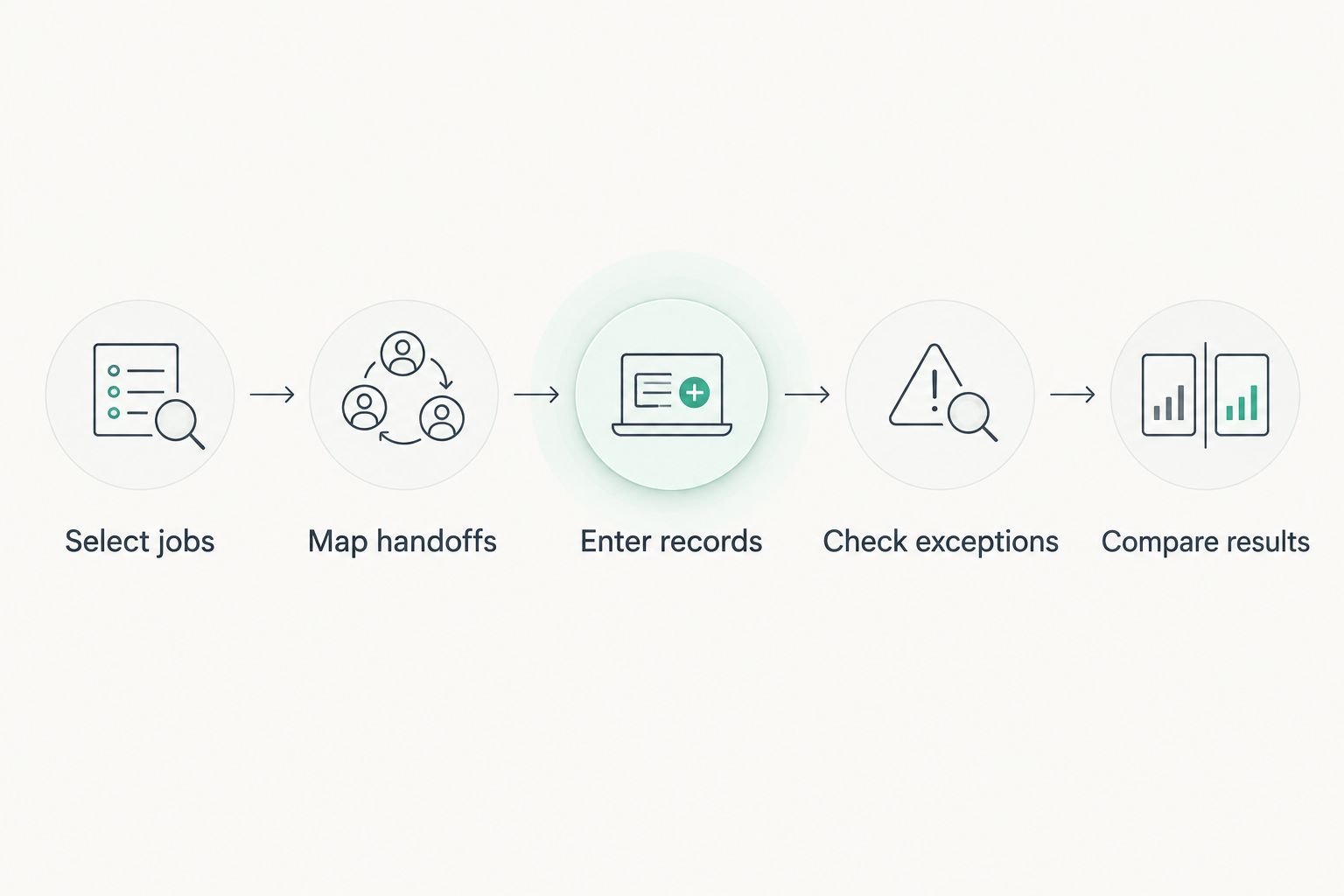
Use 3 completed jobs as a recommended pilot sample: a straightforward job, a job with a customer change and a job involving workshop and installation activity. This is a practical testing scope, not a statistical benchmark.
Follow the same sequence for each job. The purpose is to expose the handoffs and exceptions that a clean demonstration leaves out.
- Select jobs. Gather the customer details, job records, labour entries and billing information needed to reconstruct the work. Keep the source records available for comparison.
- Map handoffs. Write down who creates each record, who checks it and who needs it next. Identify every point where someone currently copies or requests information.
- Enter records. Recreate the relevant workflow in the proposed system. Ask the people who would use it to perform their own tasks rather than watching a supplier operate everything.
- Check exceptions. Test a changed instruction, a corrected time entry and incomplete information. Establish how the next person knows what has changed.
- Compare results. Check the resulting job and invoice information against the source records. Record remaining manual work and unresolved questions before deciding.
This gives you 5 workflow checks without pretending to establish a universal implementation method. Assign 1 accountable owner to record the findings and keep unresolved requirements visible.
A successful pilot demonstrates the required workflow with your records and your users. An unresolved requirement is not a pass because the supplier says it can be addressed later; document the proposed solution and test it before relying on it.
Can CRM replace ERP for a metal construction company?
CRM is the narrower starting point when your problem concerns customer records and sales follow-up. If the required workflow extends into project delivery, time tracking and invoicing, evaluate those functions explicitly rather than relying on either label.
The buying question is which work the system must support. Product categories help organise a shortlist, but the demonstration must establish the operational fit.
Do you need specialist manufacturing software as well?
You need a separate manufacturing-software evaluation when production requirements determine whether the system is usable. Keep those requirements visible even if the administrative demonstration looks convincing.
Ask how the proposed setup will handle the boundary between administration and production. Establish who maintains shared records and what happens when information changes; do not assume an integration exists.
Should you replace every system at once?
Replace only the systems covered by a demonstrated, workable transition plan. A narrower rollout gives you a defined process to validate, although any temporary overlap still needs clear ownership.
For a 2026 rollout, establish which record is authoritative at each stage. Avoid leaving staff to choose between conflicting systems while customer work continues.
FAQ
Is ERP software worth it for a small metal construction company?
ERP is worth evaluating when it connects work that currently requires repeated entry, chasing or reconstruction. Company size alone does not establish value; test the workflow and compare the total effort before and after.
What's the best ERP approach for a metal fabrication business?
The best approach is the one that demonstrates your required administrative and production workflows. Compare modular CRM/ERP with specialist manufacturing options only after separating essential functions from optional ones.
Can Mesh App handle administration for a metal construction business?
Mesh App offers contact management, project management, time tracking, invoicing and finance modules for SMEs, including construction businesses. Validate the required workflow in a demonstration; the stated modules do not establish specialist fabrication capabilities.
How much should we expect to save with ERP?
Estimate savings from your measured administrative work and the supplier's implementation proposal, not a generic percentage. Separate released staff capacity from reductions in expenditure and avoid counting the same benefit twice.
Do we need inventory control in our ERP?
You need inventory control in the buying brief if material records are essential to the workflow you intend to replace. Ask the supplier to demonstrate your required tasks rather than assuming an ERP includes them.
Can we keep our existing accounting system?
Keeping an existing accounting system is a requirement to validate with the proposed supplier. Confirm the transfer method, required fields, responsibilities and correction process before relying on the connection.
What's the safest way to start an ERP project?
Start with a defined problem and a pilot using completed jobs. Set acceptance criteria, assign an accountable owner and resolve critical gaps before expanding the rollout.
One last thing
Test a changed job, not just a finished job. A clean record shows where information ends up; a changed instruction shows who must act, which record takes precedence and whether billing reflects the approved work.
Before signing, ask your team to complete that scenario without supplier assistance. Treat every point where they stop, guess or return to a spreadsheet as a requirement to resolve—not as a training detail to ignore.