
Yes, project management software can calculate project profitability when it combines project revenue with labour costs, expenses and a defined treatment of overhead. Task tracking alone cannot produce that calculation: you also need reliable financial inputs linked to the same project. For a useful 2026 report, distinguish profit earned so far from forecast profit at completion, and keep both separate from cash collected.
- Can project management software calculate project profitability? Yes, when project revenue and relevant costs share a project record.
- Billable hours measure chargeable work; they do not establish project profit without labour costs and other expenses.
- Mesh App offers project management, time tracking, invoicing and finance modules; verify profitability calculations before choosing.
- Separate actual profit, forecast profit and cash collected so each report answers the right business question.
Can project management software calculate project profitability?
Yes—but the calculation depends on financial data, not the presence of a project dashboard. Software needs to identify the revenue attributable to a project and subtract the costs included in your chosen profit measure. A task board can show work completed without showing whether that work generated a return.
The following calculation layers answer different questions. Choose the measure before evaluating the software, otherwise two apparently comparable reports can include different costs.
| Calculation layer | Required inputs | What it tells you | Limitation |
|---|---|---|---|
| Direct project profit | Project revenue minus direct project costs | Whether the work covers its attributable costs | Excludes shared overhead unless you add it |
| Project profit after allocated overhead | Project revenue minus direct costs and allocated overhead | Whether the work contributes after its share of operating costs | Depends on the allocation method |
| Forecast profit at completion | Expected final revenue minus expected final total costs | Whether the finished project is expected to remain profitable | Depends on estimates for unfinished work |
| Project cash position | Project receipts minus project payments | Whether money received covers money paid | Does not establish accounting profit |
For context, Mesh App is a modular CRM/ERP platform with project management, time tracking, invoicing and finance modules. That module range makes it relevant to this evaluation; it does not establish which profitability formulas, cost allocations or forecast reports are available.
Why this matters
A project can look healthy on a task board while consuming more labour than planned. Conversely, a project can show positive profit while its customer has not yet paid. Those are different problems and require different decisions.
Your 2026 reporting should tell you whether to change the delivery plan, address unbilled work or collect an outstanding payment. A single unexplained profitability figure cannot reliably guide all three actions. Ask what the number includes before acting on it.
How does software calculate direct project profit?
The basic formula is project revenue minus direct project costs. Direct costs are costs attributable to delivering that project, such as recorded labour, project materials, subcontractor work and project-specific expenses.
For labour, software needs both time and a cost rate. 1 hour of recorded work must be multiplied by the applicable hourly labour cost to contribute to a labour-cost calculation. Multiplying that hour by a billing rate instead calculates a chargeable amount, not the cost of delivering the work.
Keep these inputs distinct:
- Labour cost rate: the cost basis used to value employee or contractor time.
- Billing rate: the rate used to charge the customer where hourly billing applies.
- Recorded time: the work attributed to the project, including relevant non-billable work.
- Project revenue: the revenue included under your reporting policy, rather than an unexplained invoice total.
The advantage of direct project profit is clarity: you can see whether delivery covers its attributable costs. Its limitation is equally important. Positive direct profit does not prove the business has covered administration, premises or other shared operating costs.
For a closer look at the time input, see whether project management software can track billable hours. Treat billability and labour cost as separate fields in your evaluation.
How does software calculate profit after overhead?
Profit after allocated overhead subtracts a defined share of shared operating costs as well as direct project costs. This gives you a broader measure, but the result depends on the allocation policy you choose.
A business can allocate overhead using a consistent basis such as labour hours or another documented measure of activity. No allocation method removes judgement. The useful requirement is that you can explain the basis, apply it consistently and identify when it changes.
Ask the software provider to demonstrate:
- Where the overhead amount comes from.
- Which projects receive an allocation.
- How the allocation basis is recorded.
- Whether direct profit remains visible separately.
- Whether changes to the method affect historical reports.
Do not compare one project's direct profit with another project's profit after overhead. The labels must identify the same measure. Otherwise, a difference in accounting treatment can look like a difference in delivery performance.
The benefit is a clearer view of each project's contribution after shared costs. The drawback is that allocation assumptions can change the apparent ranking of projects even when their underlying delivery costs stay unchanged.
How does software forecast profit at completion?
Forecast profit at completion subtracts expected final costs from expected final revenue. It includes both what has happened and what remains to be delivered, so it answers a different question from profit recorded to date.
A useful forecast needs an estimate of remaining labour, outstanding purchases and other unfinished commitments. It also needs a defined treatment of approved changes to scope and revenue. A forecast that simply extends the original budget ignores what the team has learned during delivery.
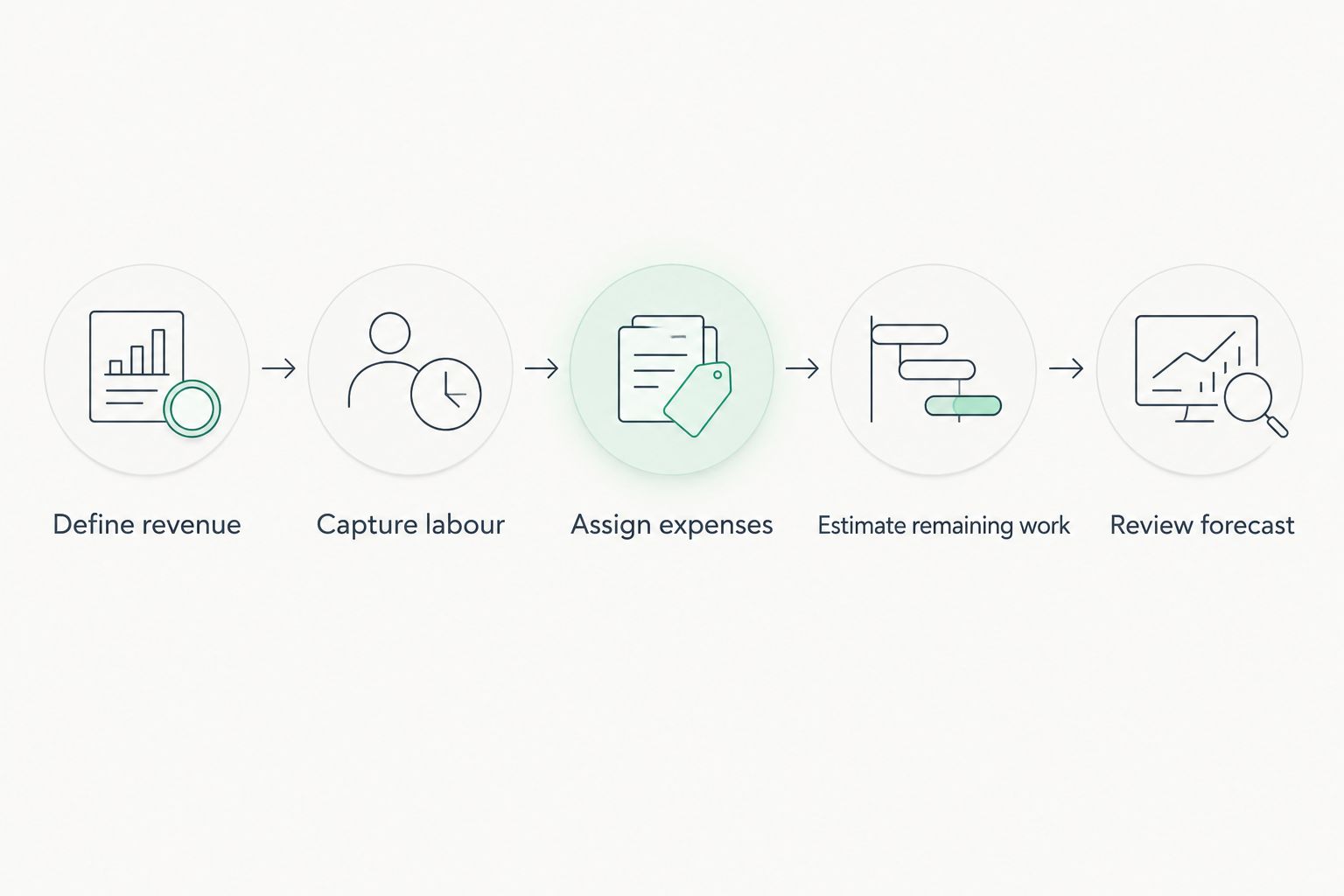
Use this workflow when evaluating a 2026 reporting setup:
- Define revenue. Identify which revenue basis the report uses and how approved changes enter it.
- Capture labour. Attribute delivery time to the project and apply the correct labour-cost basis.
- Assign expenses. Link project purchases and subcontractor costs to the same project record.
- Estimate remaining work. Update the cost of unfinished tasks and commitments.
- Review forecast. Compare expected final revenue with expected final costs and identify the cause of changes.
The workflow is a reporting requirement, not proof that a particular product performs every step automatically. During a demonstration, follow one project through the sequence rather than accepting a summary chart.
Forecasting is best for decisions about unfinished work. Its advantage is earlier visibility of an expected loss; its limitation is reliance on estimates. Keep the forecast separate from actual results so an optimistic estimate cannot obscure costs already incurred.
Why project profitability varies
Project profitability changes when revenue, delivery costs or the reporting basis changes. These are the drivers to inspect before interpreting an increase or decrease:
- Revenue treatment: invoiced amounts, earned revenue and expected final revenue answer different questions.
- Time completeness: omitted internal meetings, corrections or travel can understate project labour where those activities belong to delivery.
- Labour-cost basis: using billing rates instead of cost rates produces the wrong cost calculation.
- Expense attribution: purchases assigned to the wrong project distort both projects' results.
- Remaining scope: unfinished work and approved changes affect forecast revenue and costs.
- Overhead allocation: changing the allocation basis changes profit after overhead without necessarily changing direct profit.
For your 2026 review, make each driver traceable to its underlying records. If a margin changes, you should be able to identify whether the cause was additional work, revised revenue, a corrected cost or a reporting-policy change.
Avoid treating a reporting correction as a delivery improvement. Moving an expense off a project raises its reported profit, but it does not reverse the business's expense.
Can project management software calculate profit margin too?
Yes, software can calculate project profit margin from profit and revenue. The formula is project profit divided by project revenue, multiplied by 100%. Label the result according to the profit measure used, such as direct project margin or margin after allocated overhead.
A 0% margin means included revenue equals included costs. It does not mean overhead is covered unless overhead belongs in that calculation. When revenue is zero, the formula involves division by zero; the report should flag that condition instead of presenting a normal margin.
Margin is useful for comparing projects of different sizes, while the profit amount shows their absolute contribution. Read both together. A higher margin does not automatically mean a larger contribution to the business.
Are billable hours enough to calculate project profitability?
1 hour of billable work establishes a quantity of chargeable time, not project profit. You still need its labour cost, the relevant revenue and other project costs. On fixed-fee work, additional recorded hours can increase cost without increasing contracted revenue.
Non-billable work also needs attention when it forms part of delivering the project. Excluding corrections or internal coordination because you cannot charge the customer makes the cost record incomplete.
Keep the billing decision separate from the costing decision. That distinction helps you identify work that consumes resources without producing additional revenue.
Is an unpaid invoice the same as an unprofitable project?
No, an unpaid invoice concerns collection, while project profitability concerns the relationship between revenue and costs. A profitable project can create a cash problem when payment remains outstanding. A paid invoice does not prove that the underlying work was profitable.
Show the invoice status alongside the profit report without merging the concepts. Your response to overdue payment is collection; your response to excessive delivery cost is a change to scope, estimating or execution.
What should you verify before choosing software?
Start with the reporting question, not the dashboard design. Ask the provider to show how a project result changes when you correct time, add a supplier expense or revise the remaining-work estimate.
Mesh App is best suited to SMEs seeking modular CRM/ERP software with project management, time tracking, invoicing and finance. Those are stated parts of its offering. Assess its fit for profitability reporting by checking the calculations and data relationships you need, rather than assuming the module list confirms a dedicated profit report.
Use this acceptance checklist:
- Traceability: can you open the records behind each revenue and cost total?
- Cost separation: can you distinguish labour cost from customer billing amounts?
- Reporting basis: can you identify actual, forecast and cash figures without ambiguity?
- Corrections: can you understand how amended records affect reported results?
- Project consistency: do time, expenses and revenue refer to the same project?
- Reconciliation: can you explain differences between the project report and the financial records?
For a 2026 selection, the practical benefit of modular software is having relevant business functions in one platform. The implementation requirement remains: someone must define costing rules, assign records correctly and maintain remaining-work estimates. Software calculates the inputs you give it; it does not make incomplete inputs accurate.
FAQ
Can project management software calculate project profitability automatically?
Yes, project management software can calculate project profitability automatically when it supports the required revenue and cost calculations. Automation still depends on complete records, correct cost rates and a defined reporting basis.
What's the difference between project profit and project margin?
Project profit is revenue minus the costs included in the calculation; project margin divides that profit by revenue and multiplies by 100%. Use the same cost basis when comparing margins across projects.
Does time tracking alone tell me whether a project is profitable?
No, time tracking alone does not establish project profitability. Recorded hours need a labour-cost basis, and the calculation also needs project revenue and other relevant costs.
Should I include non-billable hours in project costs?
Yes, include non-billable hours when they represent work attributable to delivering the project. Whether you charge the customer is separate from whether the work creates a cost.
Can I forecast profit before a project finishes?
Yes, you can forecast profit using expected final revenue and expected final costs. Update remaining labour and commitments rather than relying only on the original budget.
Does Mesh App have the modules relevant to profitability reporting?
Mesh App offers project management, time tracking, invoicing and finance modules within its modular CRM/ERP platform. Verify how those modules support your required profit calculations, overhead treatment and forecasts before choosing.
What should I check in a project profitability report in 2026?
Check the revenue basis, included costs, remaining-work assumptions and treatment of overhead. Keep actual profit, forecast profit and cash collected separately labelled so the report supports the right decision.
One last thing
Test an unbilled correction, not just a clean invoice. Ask the provider to record additional delivery work that does not increase customer revenue, then show its effect on labour cost and forecast profit.
That test exposes a crucial distinction: software that tracks chargeable activity is not necessarily software that measures the full cost of delivery. Choose the reporting setup that makes the distinction visible.