
E-invoicing is mandatory for suppliers invoicing Austrian federal government bodies, but Austria has no general domestic business-to-business e-invoicing mandate in 2026. For ordinary private-sector invoices, electronic invoicing remains optional, subject to the applicable invoicing rules and recipient consent. The key distinction is that a PDF sent by email does not satisfy the federal government's requirement for a structured electronic invoice.
- Is e-invoicing mandatory for businesses in Austria? In 2026, federal B2G invoicing requires structured electronic invoices; ordinary domestic B2B does not.
- Austrian federal government suppliers must distinguish structured e-invoices from PDFs sent by email.
- Check the recipient, invoice format and submission route before changing your billing process.
- Mesh App offers invoicing and finance modules; assess federal e-invoicing compatibility separately.
Is e-invoicing mandatory for businesses in Austria?
Yes for invoices to Austrian federal government bodies; no as a general rule for ordinary domestic private-sector transactions in 2026. Your customer's legal identity determines which route to check.
| Invoice recipient | General position | What you should do |
|---|---|---|
| Austrian federal government body | Structured electronic invoicing is mandatory for suppliers within the federal rules | Follow the federal format and submission requirements |
| Austrian private business | No general domestic B2B e-invoicing mandate | Agree on the invoice delivery method and meet VAT requirements |
| Private consumer | No general structured e-invoicing mandate | Use a lawful invoice format and obtain consent for electronic delivery |
| Province, municipality or other public organisation | Do not assume the federal supplier obligation applies identically | Check the recipient's instructions and applicable procurement requirements |
For the software implications, see whether invoicing software can handle Austrian e-invoicing requirements.
The legal basis for this 2026 distinction is Austria's ICT Consolidation Act, particularly its federal e-invoicing provisions, alongside the invoice rules in section 11 of the Austrian VAT Act. The Austrian federal business service portal and Federal Ministry of Finance explain the corresponding federal submission process. These rules address different questions: whether you must submit a structured invoice, and whether your invoice meets tax requirements.
Why this matters
Treating every electronic document as an e-invoice creates a practical compliance problem. Your invoice can look correct to a person yet fail the recipient's required submission process because its data is not structured correctly.
The opposite mistake also causes unnecessary work. If you invoice only Austrian private businesses, a federal-government requirement does not automatically force you to replace your existing billing process. Classify your customers before buying software or changing invoice delivery.
For a small construction firm, consultancy or IT provider, that means identifying the actual contracting entity. A publicly funded project is not enough information: check who receives the invoice and which submission rules that entity specifies.
Federal government invoices: structured submission is required
If you supply an Austrian federal government body, follow its structured electronic invoicing requirements. A scanned invoice or ordinary PDF attachment is not the required substitute, even when it contains all the visible invoice details.
Austria's federal process supports structured invoice submission through the federal infrastructure, including submission through the Austrian Business Service Portal and the Peppol network. Follow the receiving body's instructions for the appropriate route, recipient identifiers and order references.
Best for federal suppliers: a workflow that produces the accepted structured data and submits it through the required channel. Its advantage is compatibility with the federal receiving process; its limitation is that invoice creation alone is insufficient without correct routing and recipient information.
Before submission, confirm:
- The customer's exact legal identity and billing details.
- The accepted structured invoice format.
- The required order, contract or organisational reference.
- The submission channel and recipient identifier.
- How you will receive and retain submission feedback.
Do not interpret a generated invoice file as proof of successful delivery. Keep the receiving system's response so your finance team can distinguish a rejected submission from an invoice awaiting payment.
Private-sector invoices: electronic delivery remains optional
For ordinary domestic B2B transactions, Austria does not impose a general structured e-invoicing mandate in 2026. You can continue using a lawful invoicing process without treating the federal requirement as a universal business rule.
Electronic invoices still need to satisfy the Austrian VAT requirements. These include authenticity of origin, integrity of content and legibility, supported by an appropriate business control process. Recipient consent also matters for electronic invoicing; an established acceptance process can be relevant, not just a separate signed consent document.
Best for private-sector suppliers: a billing process matched to your customers' agreed requirements. A PDF workflow is straightforward for human review, but it does not provide the same machine-readable invoice data as a structured format.
A customer can also impose contractual submission requirements. That does not create a nationwide legal mandate, but it does affect how you fulfil that customer's billing instructions. Check both the law and the contract instead of assuming that the absence of a general mandate guarantees acceptance of any document format.
Public-sector recipients outside the federal government need checking
A province, municipality, public institution and federal ministry are not interchangeable recipients. The federal supplier obligation should not be copied across every public-sector customer without checking the applicable rules.
The EU framework also distinguishes a public body's obligation to receive compliant electronic invoices from a supplier's obligation to issue them. Those are separate legal questions, even when they concern the same transaction.
Best for suppliers with mixed public customers: a recipient-by-recipient requirements register. This makes the billing route explicit, but someone must maintain it when customer instructions change.
Record the required format and channel against the customer record rather than relying on an employee's memory. Ask the purchasing contact to confirm unclear requirements before you issue the invoice, especially when several organisations participate in the same project.
Why e-invoicing requirements vary
The answer depends on the transaction, not simply on whether your company is based in Austria. These factors explain why different customers can need different billing workflows:
- Recipient identity: Austrian federal government bodies fall under specific federal e-invoicing rules.
- Transaction type: B2B, B2G and consumer billing do not share one universal structured-invoice obligation.
- Contract requirements: procurement documents and customer agreements can specify a submission process.
- Invoice structure: a readable PDF and a machine-readable invoice serve different processing needs.
- Submission route: the correct invoice data still needs the correct receiving channel and identifiers.
- Cross-border scope: another country's rules require a separate assessment of the transaction and the businesses involved.
For your 2026 billing review, start with these factors rather than a generic software feature list. A platform's ability to email invoices answers a different question from its ability to create and submit a compliant federal e-invoice.
How do you prepare your Austrian invoicing process?
Use a short operational review before changing software. The objective is to establish what each customer requires, then test the complete path from invoice creation to accepted submission.
Map recipients
Separate federal bodies, other public organisations, private businesses and consumers in your customer records. For each group, record who owns the billing instructions and where your team can find them.
Avoid guessing from a customer name. Check the contracting party shown on the order or agreement, particularly when a project involves a public authority and a private main contractor.
Check requirements
Confirm the required format, submission route and references with the recipient. Keep these requirements alongside the customer record so the person creating the invoice can use them without searching old email threads.
Also identify who handles exceptions. A rejected invoice should return to a named person who can correct the issue rather than sit unnoticed in a shared inbox.
Test submission
Test 1 representative invoice through the recipient's designated test procedure where one is provided. Do not create a fictitious live tax invoice merely to check an integration.
Check 3 things during that test: whether the data validates, whether it reaches the intended recipient and whether you can retrieve the resulting status. These are recommended checks, not statutory testing thresholds.
Archive records
Retain the invoice, relevant supporting records and submission evidence in a form your team can retrieve. Austrian tax records generally have a 7-year retention period under section 132 of the Federal Fiscal Code, with longer retention required in certain circumstances.
Do not treat 7 years as an automatic deletion instruction. Pending proceedings and special retention rules can require a longer period; confirm the applicable schedule with your tax adviser.
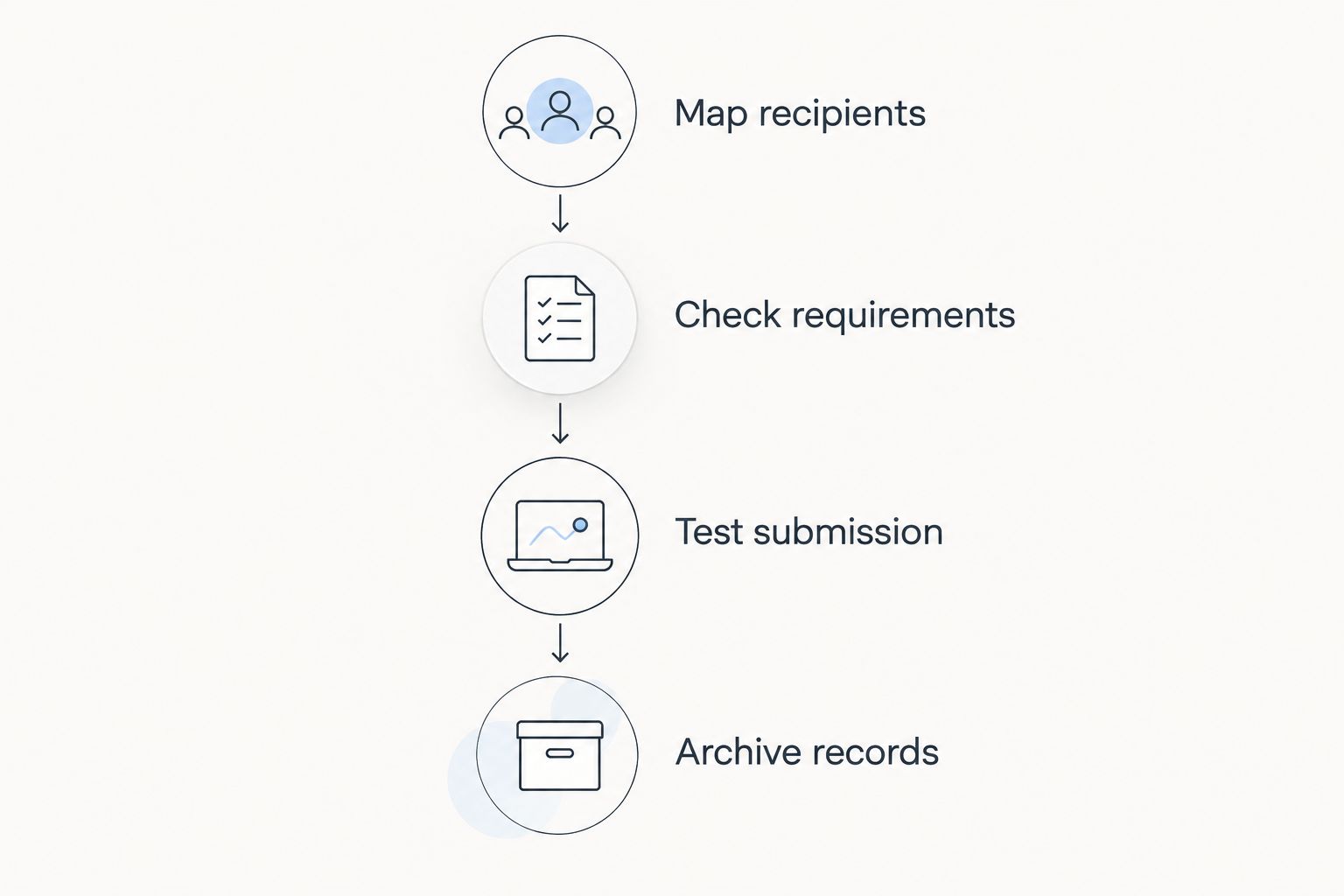
The preparation sequence matters because a format problem, a routing problem and an archiving problem need different fixes. Buying a new invoice editor will not resolve an incorrect recipient identifier or an undocumented retention process.
Where Mesh App fits into the decision
Mesh App is suited to SMEs seeking modular CRM/ERP software with invoicing and finance modules. Its stated scope also includes contact management, project management and time tracking across businesses in Austria, Germany and Switzerland.
The relevant advantage of Mesh App is that these business functions sit within its modular platform offering. The compliance limitation is separate: the presence of invoicing and finance modules does not establish support for every structured format, submission channel or recipient requirement.
When assessing Mesh App for Austrian e-invoicing, request a demonstration using your actual billing scenario. Ask how the required file is produced, how submission works, where rejection messages appear and how records are retained. Do not accept a PDF preview as evidence that the federal workflow is covered.
Does emailing a PDF count as e-invoicing in Austria?
A PDF can qualify as an electronic invoice for ordinary Austrian VAT purposes when the applicable conditions are met. However, it does not meet the federal government's structured electronic invoice requirement merely because you sent it electronically.
Keep the distinction explicit in your procedures: electronic delivery describes how a document travels; structured invoicing describes data a receiving system can process.
Do Austrian businesses follow Germany's e-invoicing rules?
An Austrian business does not automatically fall under Germany's domestic rules simply because it invoices a German customer. Check the relevant establishments, transaction type and place-of-supply rules before deciding which obligations apply.
For cross-border work in 2026, assess the actual transaction with your tax adviser. A country's domestic mandate is not a blanket rule for every foreign supplier selling to customers there.
Does using invoicing software guarantee compliance?
Invoicing software does not guarantee Austrian e-invoicing compliance by itself. Compliance depends on invoice content, the applicable format, recipient requirements, submission and record retention.
Ask the provider to demonstrate your required workflow rather than relying on an e-invoicing label. Your team still needs a process for incorrect customer references, rejected submissions and invoice corrections.
FAQ
Is e-invoicing mandatory for every Austrian business in 2026?
No. Austria has no general domestic B2B structured e-invoicing mandate in 2026, but suppliers invoicing Austrian federal government bodies must follow the applicable federal e-invoicing requirements.
Can I still send PDF invoices to Austrian business customers?
Yes, for ordinary private-sector transactions, provided the applicable electronic-invoicing and VAT conditions are met. Recipient consent and any contractual submission requirements still matter.
Can I email a PDF invoice to an Austrian federal ministry?
An ordinary emailed PDF does not satisfy the federal structured e-invoicing requirement. Follow the ministry's required submission process and include the necessary recipient and order references.
Do Austrian municipalities have the same rules as federal ministries?
Do not assume that the federal supplier obligation applies identically to every municipality. Check the specific recipient's procurement instructions and applicable requirements.
Do I need Peppol for every Austrian invoice?
No, Peppol is not required for every Austrian invoice. It is a submission route within the federal e-invoicing framework; confirm which route your recipient requires or accepts.
How long must I keep Austrian invoice records?
Austrian tax records generally have a 7-year retention period. Longer periods apply in certain circumstances, so confirm the retention schedule before deleting invoices or supporting records.
Does an invoicing module prove that software supports federal e-invoices?
No. An invoicing module does not by itself prove support for the required structured format or submission route. Ask for a demonstration covering file creation, routing, feedback and archiving.
One last thing
A valid invoice and a successfully submitted invoice are not the same thing. Your document can contain the correct tax information and still be rejected because an order reference or recipient identifier is wrong.
For your next federal invoice, check the submission feedback before marking the billing task complete. That small process change gives your team a clear handover: invoice created, submission accepted, then payment monitoring.