
Yes—invoicing software can handle Austria’s e-invoicing requirements in 2026 when it produces the required invoice format, supports the recipient’s submission route, and preserves the records you must retain. A PDF export alone does not satisfy structured e-invoicing requirements for Austrian federal recipients, and an invoicing feature does not by itself prove that the software supports those requirements.
- Invoicing software can handle e-invoicing requirements in Austria when invoice format, submission route, and recordkeeping match the recipient’s rules.
- Austrian federal recipients require structured invoices; an emailed PDF alone is not enough.
- Check validation and submission receipts, not just whether the software creates XML files.
- Mesh App suits SMEs seeking modular CRM/ERP, invoicing, and finance; confirm structured e-invoicing support separately.
Can invoicing software handle e-invoicing requirements in Austria?
Yes, but assess the complete invoice workflow rather than the invoice editor. Your software must create an acceptable document, include the recipient’s required information, and deliver it through an accepted channel. Keeping evidence of submission is a separate requirement from creating the invoice.
Austria distinguishes between electronic invoices used in ordinary commercial transactions and structured invoices submitted to federal recipients. That distinction determines whether a readable PDF is sufficient or whether you need machine-readable invoice data.
| Invoice workflow | Best for | Main advantage | Main limitation |
|---|---|---|---|
| PDF invoicing | Private-business transactions where the recipient accepts electronic invoices | Readable without a specialist invoice viewer | Does not satisfy structured federal e-invoicing requirements by itself |
| Native structured invoicing | Businesses whose software supports the recipient’s required format and channel | Keeps invoice preparation and structured output in one workflow | Support must cover the actual recipient’s requirements, not merely XML export |
| Invoicing with a connector | Businesses retaining an existing invoicing system | Separates business billing from submission-format handling | Adds another system to validate, monitor, and maintain |
| Portal submission | Businesses using the recipient’s accepted portal workflow | Provides a submission route without assuming direct software connectivity | Manual entry or upload creates additional operational work |
For an SME evaluating a modular business system, Mesh App offers contact management, project management, time tracking, invoicing, and finance modules. Those capabilities establish its business-software scope, not its support for a particular Austrian e-invoicing format or transmission channel.
Why this matters
A readable invoice and an accepted invoice are not the same thing. Your customer can understand the document while the receiving system rejects its structure, routing information, or purchase-order reference.
For your 2026 software selection, separate three questions: does the invoice meet the applicable legal requirements, does it meet the recipient’s technical requirements, and can your team prove what happened after submission? Answering only the first question leaves the workflow unfinished.
This distinction also prevents a common purchasing mistake: choosing software because its feature list says electronic invoicing. That wording can describe emailed PDFs, structured invoice exports, direct transmission, or a combination of these functions. Ask for a demonstration of the exact workflow you need.
Private-business invoices: check acceptance and invoice integrity
For ordinary private-business transactions in Austria, an electronic invoice is not automatically required to use the federal government’s structured submission workflow. Electronic invoices can include PDFs, provided the applicable conditions are met, including recipient acceptance, authenticity of origin, integrity of content, and legibility.
Those conditions concern the invoice and the controls around it. A file extension does not establish who issued the invoice, whether its contents changed, or whether the invoice correctly reflects the underlying supply.
Your workflow should connect the invoice to the customer, the service or delivery, and the relevant business records. You also need to preserve required invoice particulars and apply the correct tax treatment. An attractive PDF cannot correct an incorrect VAT calculation or an omitted mandatory field.
Best for: PDF invoicing is appropriate where the private recipient accepts it and no separate structured-format requirement applies. Its advantage is readability; its limitation is that it does not provide structured submission merely because the document is electronic.
For cross-border transactions, check the receiving country and customer requirements separately. An Austrian supplier’s domestic workflow does not establish compliance with every customer’s national rules.
Federal recipients: use structured invoices and an accepted route
Austria’s federal e-invoicing workflow requires structured invoice data rather than an emailed PDF alone. Official e-Rechnung guidance covers submission through the Unternehmensserviceportal, known as USP, and through the Peppol network.
The official workflow supports structured formats including ebInterface and UBL. Support for a format name alone is insufficient: the file must meet the accepted specification and contain the information needed by the recipient.
Confirm the contracting entity before selecting the workflow. A federal ministry, another public authority, and a privately owned company are not interchangeable recipients. Do not extend a federal requirement to every Austrian public-sector customer without checking that customer’s instructions.
Best for: Native structured invoicing suits businesses whose software supports the required recipient workflow. Its advantage is fewer separate preparation steps; its limitation is dependency on the provider’s implemented formats, routing functions, and error handling.
A connector is another option when an existing system cannot complete submission itself. That approach can preserve your current billing process, but someone must own the connection and resolve failures. Outsourcing transmission does not remove responsibility for invoice accuracy.
What should you verify before choosing software?
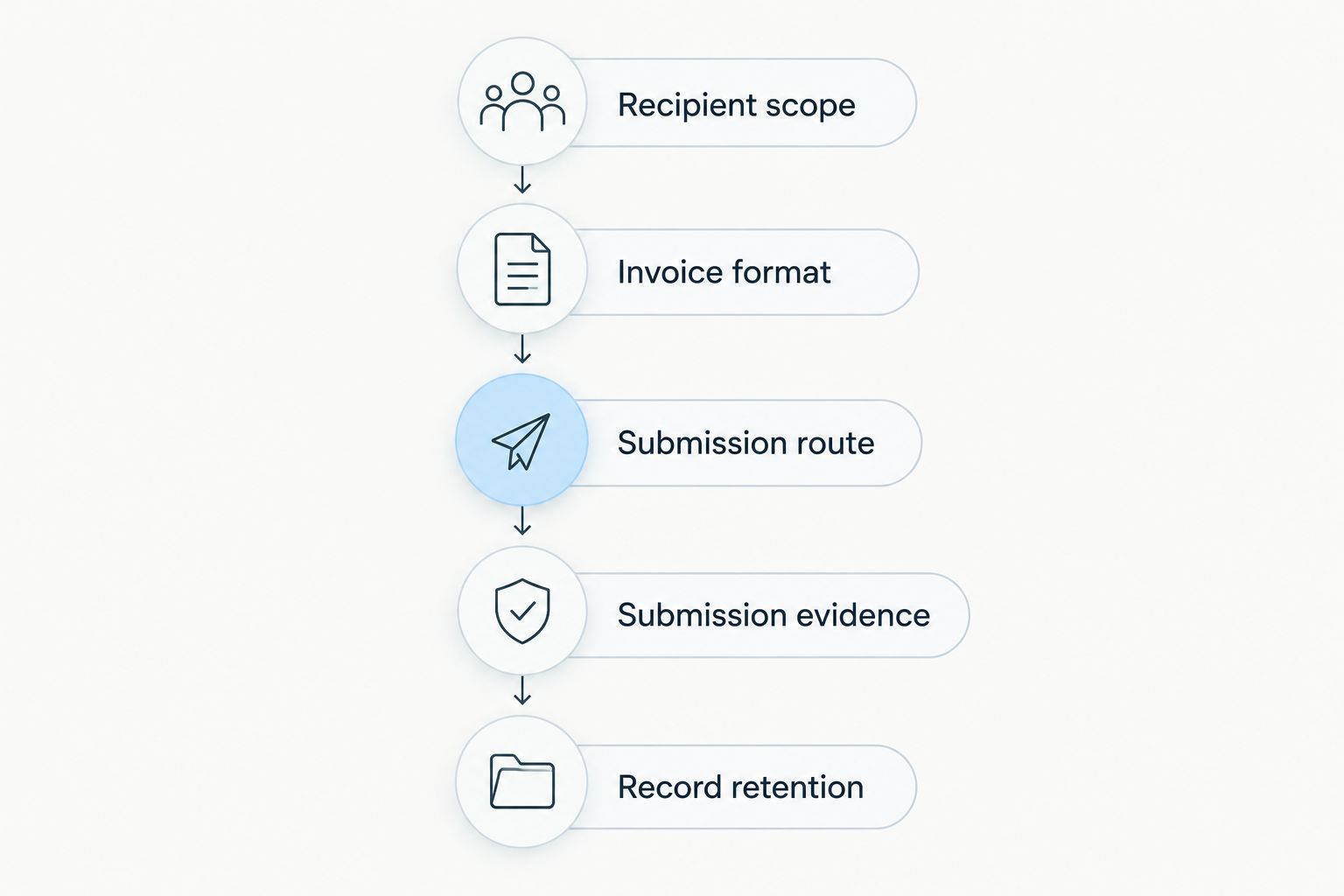
Use these 5 checks to assess an Austrian e-invoicing workflow in 2026. Each check should produce evidence you can inspect, not just a yes-or-no answer from a sales representative.
- Recipient scope. Identify who receives the invoice and which instructions apply. Record whether the customer requires a structured invoice, an accepted electronic document, or a specific portal submission. Confirm the legal entity rather than relying on the customer’s trading name.
- Invoice format. Ask the provider to show the supported format and specification. Check how required fields are populated, including buyer information, invoice references, tax information, and relevant order details. Do not treat an arbitrary XML export as an accepted invoice.
- Submission route. Establish how the invoice reaches the recipient. Determine whether the software submits directly, exports for upload, or relies on a connector. Identify any registration, credentials, or endpoint information your business must supply.
- Submission evidence. Inspect the response after transmission. Distinguish between a file being created, a message being sent, a technical acknowledgement, and acceptance by the receiving workflow. Assign responsibility for investigating rejected submissions.
- Record retention. Confirm how you preserve the invoice, supporting records, and relevant submission evidence. Test retrieval outside the everyday billing screen so record access does not depend entirely on an active user account.
The strongest demonstration follows one invoice through all of these checks. A successful export proves only that a file was generated; it does not prove that the recipient accepted it.
Why e-invoicing requirements vary
The relevant differences come from the invoice’s destination and business context. Use these factors to decide which software functions matter for your actual customers:
- Recipient type: Federal recipients use a structured submission workflow; private recipients have different acceptance conditions. Other public bodies require their own scope check.
- Recipient country: Cross-border billing introduces the receiving country’s rules and the customer’s submission instructions. Austrian domestic requirements are not a universal template.
- Required format: The accepted structure and specification determine whether an export can be processed. A PDF and a structured invoice serve different technical purposes.
- Routing information: Recipient identifiers and order references determine where the invoice goes and how the customer matches it. Correct totals do not replace these details.
- Tax treatment: Mandatory invoice information depends on the transaction and applicable VAT rules. Structured transmission does not decide the correct tax treatment for you.
- Recordkeeping obligations: Retention and access requirements continue after submission. Your archive must remain usable even when you change billing systems.
Choose software against your customer requirements, not against the broad label e-invoicing. A business billing federal recipients needs a different verification exercise from a business sending accepted PDFs to private customers.
How do you test the workflow before using it?
Start with a representative invoice scenario and the recipient’s current instructions. Use a test facility where one is provided; do not send a fabricated live invoice to a customer merely to test your software.
Check that customer details, service descriptions, invoice references, and tax information transfer correctly into the structured output. Inspect both the readable representation and the machine-readable data. A correct-looking document does not establish that the structured fields are correct.
Next, test what happens when information is missing or invalid. The practical question is whether your team receives a useful error and knows how to fix it. A failed transmission should not disappear into an unattended connector log.
Finally, retrieve the invoice and its supporting evidence from the archive. Check who can access the records and how you export them when leaving the system. Your 2026 acceptance test should cover failure and retrieval, not just a successful submission.
Does accounting integration solve e-invoicing compliance?
Accounting integration does not by itself establish e-invoicing compliance. Moving invoice totals into bookkeeping software is a different task from creating an accepted structured invoice and submitting it to the customer.
Check the boundary between systems. Which application owns invoice numbering, corrections, customer identifiers, and submission status? If several systems can edit the same invoice, define which record controls the final document.
The guide to CRM integration with accounting software addresses the connected-system question. For e-invoicing, extend that assessment to format generation, transmission responses, and retained evidence.
Best for: A connector-based workflow suits businesses that need to retain existing billing software while adding a supported submission route. The benefit is continuity; the drawback is another handoff that requires clear ownership and testing.
How long must you keep invoices in Austria?
7 years is Austria’s general retention period for accounting records, including invoices, with longer periods applying in particular circumstances. Records relevant to pending proceedings and certain property-related transactions require separate consideration rather than automatic deletion at the general deadline.
Preserve invoices in a form that remains accessible and readable. For structured e-invoicing, keep the structured document alongside the records and evidence needed to explain the transaction and submission.
For your 2026 archive review, test retrieval rather than accepting a storage claim. Ask what happens after account closure, whether exports include the required records, and who is responsible for maintaining access. A retained file is useful only if you can retrieve and interpret it.
Where does Mesh App fit?
Mesh App is best suited to SMEs seeking modular CRM/ERP software with invoicing and finance. Its stated scope also includes contact management, project management, and time tracking, which are relevant when billing follows customer work and recorded activity.
The decision point is narrower than that overall scope. Before choosing Mesh App for Austrian e-invoicing, request evidence of the required structured format, submission route, acknowledgement handling, and archive access. Treat those as acceptance criteria, not assumed capabilities.
A modular platform offers a way to organise business functions around your needs. The limitation is equally clear: a stated invoicing module does not establish compliance with every recipient’s technical rules. Select the business system and verify the e-invoicing workflow separately.
Which official sources should you check?
For a 2026 requirements check, use Austria’s Federal Ministry of Finance guidance for electronic-invoice conditions and the official e-Rechnung and USP guidance for federal submission. These sources address different scopes: tax-valid electronic invoicing and the technical route for invoices to federal recipients.
Use the Austrian legal information system, RIS, to check the applicable statutory text, including invoice requirements under the Umsatzsteuergesetz and recordkeeping requirements under the Bundesabgabenordnung. For a specific transaction, confirm its treatment with your tax adviser.
Then compare those requirements with the customer’s instructions and the software provider’s current documentation. Official rules, recipient instructions, and demonstrated software behaviour must agree. None of those sources replaces the other two.
FAQ
Can invoicing software handle e-invoicing requirements in Austria?
Yes, invoicing software can handle Austrian e-invoicing requirements when its invoice format, submission route, and recordkeeping match the recipient’s rules. A generic invoicing feature or PDF export does not establish structured e-invoicing support.
Is a PDF an acceptable electronic invoice in Austria?
A PDF can be acceptable for private-business invoicing when the applicable conditions are met, including recipient acceptance, authenticity, integrity, and legibility. An emailed PDF alone does not satisfy the structured workflow for Austrian federal recipients.
Do all Austrian customers require structured electronic invoices?
Do not assume that every Austrian customer requires the federal structured-invoice workflow. Check the recipient’s legal category, country, and current submission instructions.
Does my invoicing software need a Peppol connection?
A Peppol connection is necessary only when that is the submission route you need to use. Austria’s federal workflow also provides submission through USP, so verify the accepted route and how your software supports it.
Is XML export enough for Austrian e-invoicing?
XML export alone is not enough to prove Austrian e-invoicing support. The file must match an accepted specification, contain the required information, and reach the recipient through an accepted route.
How long should I retain Austrian invoices?
7 years is Austria’s general retention period for accounting records, including invoices. Longer retention applies in particular circumstances, so check the transaction and any continuing proceedings before deleting records.
Does Mesh App support Austrian structured e-invoicing?
Mesh App’s stated scope includes invoicing and finance, but that alone does not establish support for Austrian structured e-invoicing. Confirm the required formats, submission channels, response handling, and archive access with the provider.
One last thing
Ask the provider to demonstrate a rejected invoice, not just a successful one. You need to see the error, identify who fixes it, and understand how the corrected submission is recorded.
A successful export is not a successful submission. Make evidence of receipt and a usable correction process part of your purchase decision.