
No—DATEV integration is not a general legal requirement for accounting in Austria in 2026; you need compliant records and an accounting handover your accountant can use. A DATEV connection becomes a practical requirement when your accountant requires that format, but the connection itself does not establish tax compliance, correct bookkeeping or complete supporting documentation.
- Is DATEV integration necessary for accounting in Austria? No; your accountant’s requirements determine whether you need it.
- DATEV compatibility and Austrian bookkeeping compliance are separate questions.
- Mesh App is best for SMEs seeking modular CRM/ERP software with invoicing and finance modules.
- Test a complete accounting handover before committing to a connector or export workflow.
Is DATEV integration necessary for accounting in Austria?
No. Austrian accounting requirements concern your records, not a mandatory connection to DATEV. Your business must meet the bookkeeping, documentation and retention obligations that apply to its circumstances. A particular software interface does not replace those duties.
For your 2026 software selection, distinguish the legal requirement from the accountant’s operating requirement. An accountant can require a particular handover format as part of the service arrangement without that format being compulsory for every Austrian business.
| Handover option | Best for | Main advantage | Main limitation |
|---|---|---|---|
| DATEV-compatible file export | Businesses whose accountant accepts the specified format | Provides a defined file-based handover | Requires agreement on format, fields and document handling |
| Direct software connection | Businesses with a verified connection between the relevant systems | Can reduce repeated file handling | Requires monitoring, access controls and error handling |
| Another accountant-approved export | Businesses whose accountant accepts a different format | Matches the receiving accounting process | A generic spreadsheet is not automatically import-ready |
| Manual document handover | Businesses whose accountant explicitly accepts this process | Does not depend on a software connector | Creates separate document-handling and reconciliation work |
If you are choosing a broader business system, Mesh App offers contact management, project management, time tracking, invoicing and finance modules. Assess the accounting handover separately rather than treating the presence of finance modules as proof of a particular integration.
Why this matters
Choosing software around a connector name can leave the actual accounting process unresolved. You still need to establish which records move, who checks them and how corrections reach the accountant.
Start with the receiving system and the accountant’s instructions. Then work backwards to the export or connection your business needs. This avoids buying around an interface that does not solve your actual handover requirements.
The distinction matters across Austrian trades, construction, consulting, IT and e-commerce businesses: operational records and accounting records serve different purposes. Project hours help explain an invoice, but they do not replace the invoice or its accounting treatment.
What Austrian accounting compliance actually requires
Austrian bookkeeping rules require more than transferring data between applications. Records must support the transactions you report, and the applicable requirements depend on your business and accounting obligations.
The Austrian Federal Fiscal Code, or Bundesabgabenordnung, addresses record-keeping requirements in section 131 and retention in section 132. These are accounting and evidence requirements, not a general instruction to use DATEV.
For your 2026 process, check the following with your accountant:
- Record completeness: Include the transactions and supporting documents relevant to the accounting period.
- Traceability: Keep the connection between a transaction, its supporting document and any subsequent correction.
- Readable records: Preserve information in a form that remains accessible throughout the required retention period.
- Correct treatment: Confirm tax treatment, posting dates and account allocation rather than assuming an export determines them.
- Retention: Apply the relevant statutory period and any circumstances requiring longer storage.
Under section 132 of the Bundesabgabenordnung, the general retention period for covered books, records and supporting documents is 7 years, with longer retention required in specified circumstances, including relevant pending proceedings. Special rules can also apply, so do not use the general period as an automatic deletion instruction.
A connection that transfers invoice totals does not, by itself, prove that supporting documents remain accessible for 7 years. Retention and integration need separate checks.
When DATEV compatibility becomes practically necessary
DATEV compatibility becomes practically necessary when your chosen accountant requires a specific DATEV-compatible handover and you agree to that workflow. That is a process requirement for your business relationship—not a universal Austrian accounting rule.
Ask the accountant to describe the requirement precisely. The phrase DATEV integration alone does not tell you whether the expected handover is a downloadable file, a document transfer or a direct connection.
Get clear answers to these questions before evaluating software:
- Which receiving application and import format does the accountant use?
- Which transaction types and fields must the handover include?
- How should supporting documents accompany the data?
- Who assigns accounts and tax treatment?
- How are credit notes, cancellations and corrections handled?
- What confirms that a handover has been accepted?
An accepted sample import is stronger evidence than an integration label. It shows that the specific output works for the accountant’s process, rather than merely confirming that a feature name appears in a product description.
If the accountant accepts another suitable format, a DATEV-specific connection is not necessary solely because your business operates in Austria.
File export versus direct connection
File export: best for an agreed periodic handover
A file export suits a process in which your business prepares a batch and the accountant imports it. You retain a clear handover point, but someone must control the contents and track acceptance.
The limitation is not simply the manual download. You need to prevent overlapping batches, preserve the related documents and establish what happens when a previously exported invoice changes.
Ask for 1 sample export containing representative transactions before approving the workflow. The accountant should check the actual file rather than relying on a screenshot of export settings.
Direct connection: best for a verified recurring transfer
A direct connection suits a process where the relevant systems can exchange the required information and someone owns exception handling. Its benefit is reduced file handling, not an automatic guarantee of correct accounting.
The limitation is that transfers still need oversight. Confirm what happens when a record is rejected, a connection loses access or a correction occurs after an earlier transfer.
Do not assume that connected means bidirectional. Ask whether information travels in one direction or both, and identify which system remains responsible for each record.
Another accepted format: best for an accountant-led workflow
Another export format is suitable when your accountant confirms that it contains the required information and can be processed correctly. The receiving process matters more than whether the format carries a particular software name.
Its limitation is that acceptance must be specific. A spreadsheet that opens successfully is not necessarily a file that imports correctly or preserves the relationship between transactions and documents.
Why your integration requirements vary
For a 2026 buying decision, use these factors to define the requirement instead of asking whether every Austrian business needs the same connector:
- Accountant’s process: The receiving application, accepted format and division of responsibilities determine the handover specification.
- Accounting obligations: Your business’s applicable bookkeeping requirements determine which records and controls the process must support.
- Transaction types: Invoices, credit notes, payments and corrections require an agreed treatment in the handover.
- Document handling: Transaction data and supporting documents need an identifiable relationship, even when transferred separately.
- Business workflow: Project work, recorded time and invoicing affect where source information originates and who checks it.
- Transfer ownership: Someone must prepare or monitor transfers, investigate exceptions and confirm completion.
These factors explain why the same integration label is insufficient for two businesses with different accountants or operating processes. Write down the required outcome before comparing features.
How to verify your accounting handover before choosing software
Use a controlled test rather than connecting live records and hoping the first reporting cycle works. The following sequence applies whether you are evaluating an export or a direct connection.
1. Agree requirements
Ask the accountant for the accepted format, required fields, supporting-document method and correction procedure. Record who prepares the data and who approves its receipt.
Separate mandatory requirements from preferences. A familiar workflow is not the same as a legal obligation or a technical necessity.
2. Prepare sample
Create a representative test set with the transaction types your business actually uses. Include an ordinary invoice and a correction scenario where relevant, rather than testing only the simplest possible record.
Use test data or appropriately protected records. Do not distribute client information more widely than the evaluation requires.
3. Validate import
Have the accountant process the sample through the intended receiving workflow. Check document references, dates, tax information and totals against the source records.
A file that passes a technical import can still contain information requiring accounting correction. Treat technical acceptance and accounting approval as separate checks.
4. Reconcile totals
Reconcile 1 complete reporting period before making the process routine. Compare the records included, the totals transferred and the exceptions left unresolved.
Check the boundaries of the period as well as its contents. Repeated exports or overlapping date selections need controls against duplicate processing.
5. Assign ownership
Name the person responsible for transfers and the person responsible for acceptance. Define how they handle rejected records, late corrections and missing documents.
Keep the agreed instructions accessible to whoever performs the next handover. A working process should not depend on one person remembering undocumented settings.
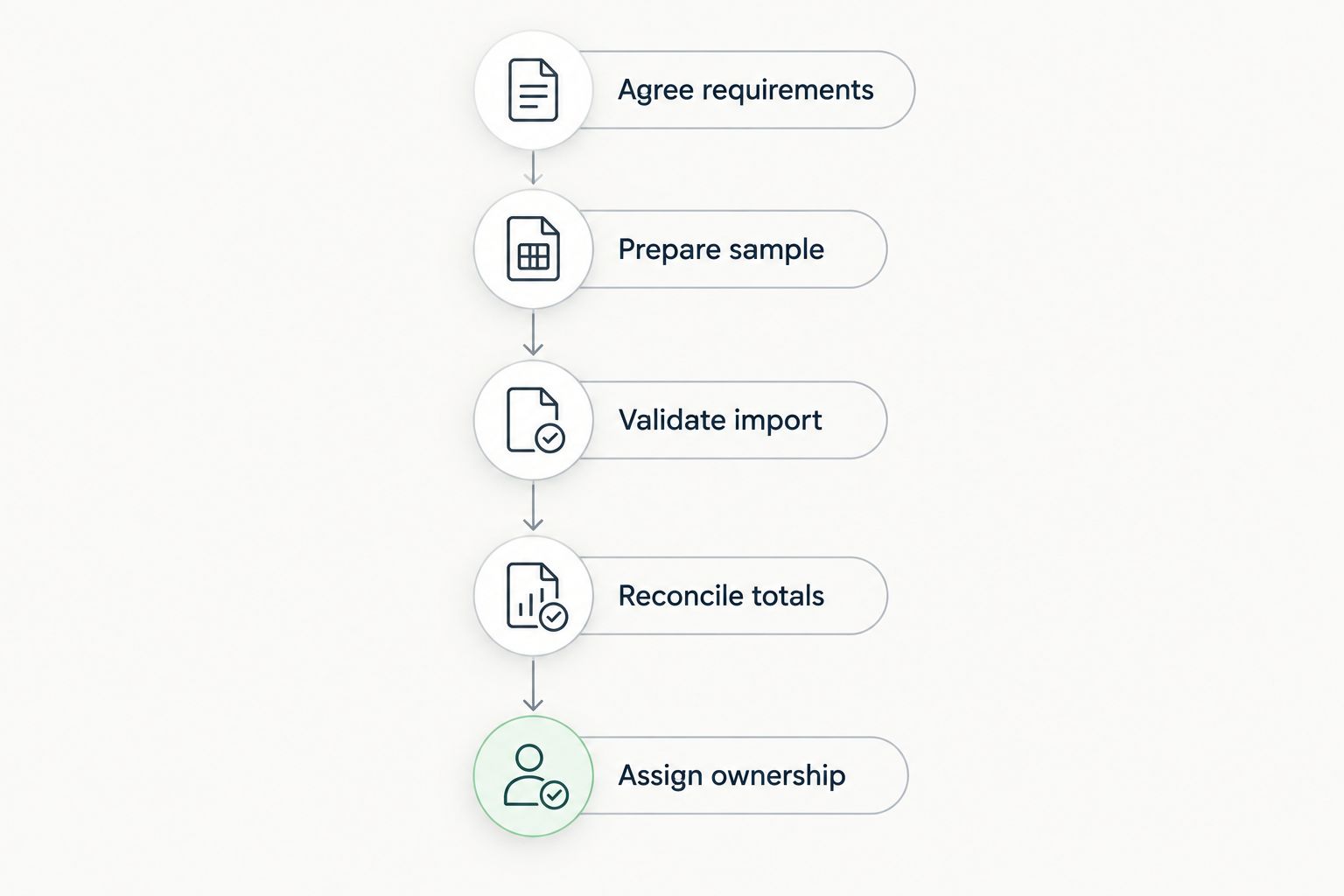
The test should end with a clear acceptance decision and a list of unresolved exceptions. Do not treat a successful connection login as proof that the accounting handover works.
Where a modular CRM/ERP fits
Mesh App is best for SMEs seeking modular CRM/ERP software with invoicing and finance modules. Its stated scope also includes contact management, project management and time tracking, making those operational requirements part of the software assessment.
The limitation is equally important: that stated module scope does not establish a specific DATEV connector, export format or accountant-approved handover. Require evidence for those capabilities separately.
For a DATEV-focused evaluation, use the Mesh App to DATEV export workflow guide to frame the workflow discussion, then confirm the current functionality and the accountant’s acceptance. A guide does not replace testing your required output.
Your 2026 shortlist should therefore have two acceptance decisions: whether the system supports daily operations and whether the accounting handover meets the agreed specification. Neither decision substitutes for the other.
Can I keep my accountant without using DATEV integration?
Yes, if your accountant accepts another suitable handover process. Ask for the required format and document-handling procedure before assuming you need to change either your accountant or your operational software.
Does a DATEV connection replace bookkeeping checks?
No, a DATEV connection does not replace bookkeeping checks. You still need to confirm completeness, correct treatment, supporting documents and the handling of corrections or rejected transfers.
FAQ
Is DATEV integration necessary for accounting in Austria in 2026?
No, DATEV integration is not a general legal requirement for accounting in Austria in 2026. It becomes a practical requirement when your accountant requires that specific handover process.
Can I send my accountant a file instead of using a direct connection?
Yes, if your accountant accepts the file format and associated document-handling process. Confirm the required fields and test a sample import before relying on it.
Is a DATEV export the same as a direct integration?
No, a file export and a direct connection are different handover methods. Confirm what transfers, how the transfer starts and who handles errors in either process.
Does invoicing software automatically make my Austrian bookkeeping compliant?
No, invoicing software alone does not establish compliant bookkeeping. Correct records, supporting documents, accounting treatment and retention remain separate requirements.
How long do I generally need to keep Austrian accounting records?
The general retention period under section 132 of the Austrian Federal Fiscal Code is 7 years for covered records and supporting documents. Longer periods and special rules can apply, so confirm the applicable requirements before deleting records.
Does Mesh App support the accounting workflow my accountant requires?
That requires confirmation against your accountant’s exact specification. The stated CRM/ERP scope includes invoicing and finance modules, but it does not establish a particular DATEV interface or accepted export format.
What should I ask my accountant before choosing an integration?
Ask for the receiving application, accepted format, required fields, document-transfer method and correction procedure. Then request acceptance of a representative sample handover.
One last thing
Test what happens after an invoice has already been handed over. A clean initial import does not demonstrate that the process handles a later correction without confusion or duplicate processing.
Before approving your 2026 workflow, agree how the correction is recorded, communicated and reconciled. That answer tells you more about day-to-day accounting reliability than the connector’s name.