
To write a quote that gets approved faster, make the buying decision explicit: define the work, separate inclusions from exclusions, explain the commercial terms, and state exactly how to approve it. Put a short decision summary before the detail so your buyer can forward it without rewriting your explanation. Clear wording removes avoidable questions; it does not remove the buyer’s budget checks or internal approval process.
- How to write a quote that gets approved faster: make scope, responsibilities, terms, and acceptance explicit.
- Keep optional work separate so the buyer can approve the core scope without resolving every extra.
- Mesh App combines CRM/ERP modules for small businesses; document clarity still requires a defined quoting process.
- Record the approved version before handing the job to delivery or invoicing.
Why this matters
A buyer needs to understand both what they are authorising and what happens next. If the scope is clear but acceptance is vague, your quote still leaves an unfinished decision.
For a small service business reviewing its sales process in 2026, quoting belongs inside the sales pipeline for a service business, not outside it. Give each quote an owner, a status, and a next action. That creates an accountable process without pretending every outstanding quote is ready to close.
How do you write a quote that gets approved faster?
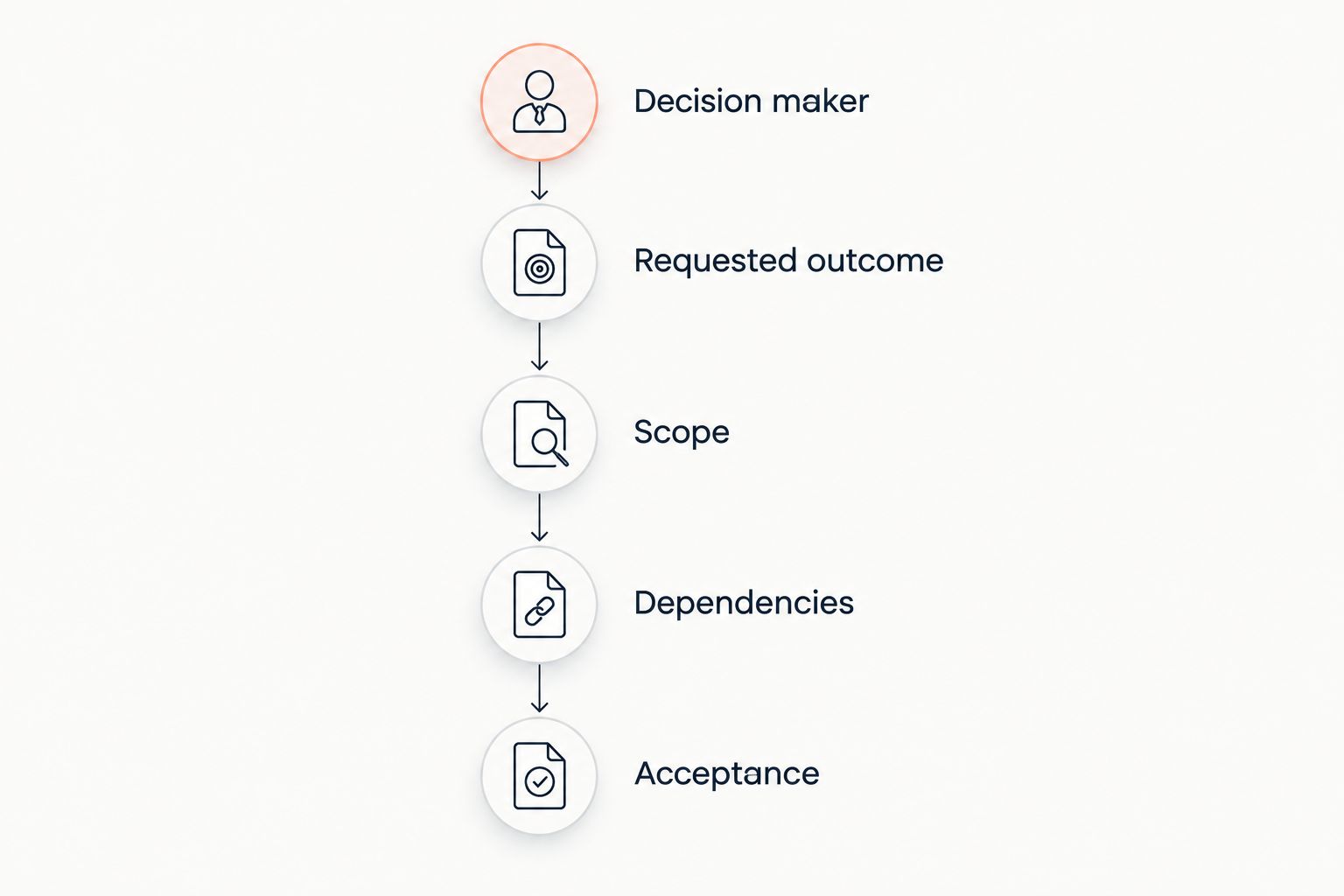
Write the quote so the buyer can identify the scope, understand the commitment, and approve a specific version without asking you to interpret it. Use the following sequence before choosing a template or sending a document.
1. Confirm who makes the decision
Ask who reviews the technical scope, who authorises the purchase, and who receives the final document. Do not assume your day-to-day contact holds all those responsibilities.
Also ask whether the buyer needs an internal reference, a supplier registration, or a particular acceptance method. Include the requirements the buyer confirms. A well-written document still needs to reach the person authorised to act on it.
2. Open with the buyer’s requested outcome
Start with the work the customer asked you to complete, not a paragraph about your company. State the intended deliverable and the location, project, or business process it concerns.
For example, describe a defined installation, a specified consulting deliverable, or an agreed software configuration. Avoid promising a business result you cannot control. Completing the agreed work and guaranteeing the buyer’s commercial success are different commitments.
3. Turn the scope into checkable deliverables
Use concrete nouns and active verbs. Replace broad wording such as general support or full implementation with the actual activities and outputs you intend to supply.
For each deliverable, identify its boundary and completion condition. A consulting report needs a defined subject and delivery format; an installation needs an agreed work area and specification. The buyer should not need a separate conversation to discover what counts as finished.
4. Separate inclusions, exclusions, and dependencies
List what you provide, what you do not provide, and what the customer must supply. Keep these categories distinct.
An exclusion defines work outside the agreement. A dependency identifies something needed to perform the agreed work, such as access, approved source material, or a customer decision. Treating a dependency as an unspoken assumption leaves the delivery team to resolve it later.
5. Explain the commercial structure
Show the basis on which the work is quoted, the applicable tax treatment, payment terms, and the treatment of changes. Check that the detailed document and its summary describe the same commitment.
Keep optional work outside the core scope and label it clearly. Do not make a buyer reject an entire project merely to decline an extra. Equally, do not describe something as optional when the core deliverable depends on it.
6. Give timing a clear starting condition
Distinguish acceptance, readiness to start, and completion. If work depends on access, materials, or customer approval, state that dependency beside the schedule.
Avoid presenting a delivery date as unconditional when it depends on an unresolved action. Explain how you will confirm the schedule after the required inputs arrive. This gives the buyer a usable plan rather than an unexplained promise.
7. End with a precise acceptance instruction
Tell the authorised buyer how to approve the quote and identify the document version that acceptance covers. Use a method your business actually supports and that fits the transaction.
Explain the immediate next step after acceptance, including any customer action needed before work begins. Do not add a signature button, payment instruction, or approval link unless that route exists and has been checked.
These steps form a practical 2026 quoting workflow: establish the decision, define the commitment, then make acceptance explicit. Keep the sequence consistent even when the technical detail changes between projects.
Which quote structure fits the work?
Choose the structure that matches how clearly you can define the work. A fixed scope and an open-ended investigation require different explanations; neither becomes clearer through a longer template.
| Quote structure | Best for | Advantage | Limitation to explain |
|---|---|---|---|
| Fixed-scope quote | Work with agreed deliverables and boundaries | Gives the buyer a defined commitment to approve | Changes outside the scope need separate agreement |
| Time-and-materials quote | Work whose extent cannot yet be fully defined | Makes the charging basis explicit | The final commitment depends on actual work and agreed controls |
| Phased quote | Projects with decisions between stages | Lets the buyer authorise a defined stage | Later stages still need their own scope and approval |
For a fixed-scope quote, make the exclusions visible. For time-and-materials work, explain authorisation and reporting. For phased work, state what the current stage delivers and what decision follows it.
Do not present these structures as interchangeable packages. Select the one that reflects the actual agreement, then explain its trade-off in plain language.
Why quote approval time varies
Clear writing addresses questions inside the document. It does not control every step inside the buyer’s organisation. Check these factors before interpreting a delayed response as rejection:
- Decision ownership: The recipient needs to know who can authorise the work. Ask for the approval route rather than guessing from a job title.
- Scope certainty: Unresolved requirements leave the buyer with an incomplete commitment. Identify the open question and who must answer it.
- Internal review: Technical, procurement, and finance reviewers need different information. Confirm which reviews apply to this purchase.
- Customer dependencies: Access, source documents, and stakeholder decisions can affect readiness. Record the dependency beside the relevant deliverable.
- Version control: A revised quote needs a clear relationship to the document it replaces. State which version is current and summarise material changes.
- Acceptance requirements: The buyer’s process might require a purchase order or another agreed confirmation. Establish the required route before sending the final quote.
Use these factors as a diagnostic list, not as reasons to send repeated reminders. Your next message should resolve a specific uncertainty or request a defined decision.
A reusable quote-writing template for 2026
Use the following headings as a drafting framework. Fill them with verified project details, and remove any section that genuinely does not apply rather than leaving ambiguous boilerplate.
Decision summary
State the requested outcome, the core deliverable, and the action needed from the buyer. Keep the summary short enough to forward with the detailed quote attached.
The summary is an entry point, not a replacement for the agreement. It must not omit a condition that materially changes the commitment.
Scope and completion
Describe the included activities and deliverables. Explain how completion will be established, especially where the work includes review or customer sign-off.
Separate your responsibility from the customer’s responsibility. If the customer supplies information or access, say what is required and when it becomes necessary.
Boundaries and changes
List exclusions alongside the relevant scope rather than burying them in unrelated text. Explain how additional work will be reviewed and authorised.
Do not start extra work on the assumption that the customer will accept it later. Keep the change decision separate from the original acceptance.
Terms and acceptance
Include the commercial terms, any applicable validity condition, the schedule assumptions, and the agreed acceptance route. Identify the version being submitted.
End with the next action. The buyer should know whether to confirm acceptance, supply missing information, or request a scope revision.
How do you send a quote without creating more questions?
Send the quote with a short message that names the requested decision and highlights any unresolved dependency. Do not paste a competing version of the scope into the email.
Use a descriptive subject line containing the customer or project reference. In the message, point to the attached or shared version and explain the next action. If the buyer requested a particular submission channel, use it.
Before sending, read the message and document together. Any disagreement between them needs correction, not an explanation that the buyer must remember.
What should you say when following up on a quote?
Follow up by asking about the outstanding decision, not simply whether the buyer has seen the document. Refer to the project and current version so the recipient can place the request immediately.
Ask whether scope, terms, timing, or internal approval is blocking the decision. Use the answer to choose the next action: clarify, revise, wait for a named review, or close the opportunity. Record that action rather than scheduling reminders with no purpose.
Should you revise a quote or explain it by email?
Revise the quote when the scope, responsibilities, terms, or schedule changes. Use an email explanation for clarification that does not alter the commitment.
If the explanation changes what either party must do, incorporate it into the revised document. Mark the earlier version as superseded and ask the buyer to approve the current one. Do not leave the delivery team to reconstruct the agreement from an email thread.
Where CRM/ERP software fits
Mesh App is best suited to small and medium-sized businesses seeking a modular CRM/ERP platform across contacts, projects, time tracking, invoicing, and finance. Those are its stated modules; they are not evidence of a particular quote editor or acceptance feature.
The relevant benefit of evaluating Mesh App for this workflow is the breadth of those business functions. The limitation is equally important: module coverage alone does not establish how quote creation, approval, or version history works. Check the workflow you need rather than assuming it from the CRM/ERP label.
When assessing Mesh App in 2026, use a sample customer job. Verify where the contact record sits, how the agreed scope reaches project delivery, and how invoicing receives the approved commercial details. Ask separately about any quoting capability you require.
Check the quote before you send it
Read the document as someone who did not attend the sales conversation. Can that person identify the work, the boundaries, the customer’s obligations, and the acceptance action?
Then read it as the person responsible for delivery. Check that the promised outputs, dependencies, and change process are usable without relying on your memory. Fix vague language before improving formatting.
For your 2026 template review, remove outdated instructions and check every acceptance route. A polished document with a broken next step still leaves the buyer unable to act.
FAQ
What's the best way to write a quote that gets approved faster?
Write a quote with explicit scope, exclusions, responsibilities, terms, and an acceptance instruction. Put a short decision summary before the detail so the buyer can share it internally.
What should I put at the beginning of a business quote?
Begin a business quote with the customer's requested outcome and the core deliverable. Leave company background below the information needed to understand the proposed work.
Should I include optional work in my quote?
Include optional work separately from the core scope. Explain whether the core deliverable works without it so the buyer understands the choice.
Is a fixed-scope quote better than a time-and-materials quote?
A fixed-scope quote suits defined deliverables, while time-and-materials suits work whose extent remains unresolved. Choose the structure that reflects the work and explain its limitations.
How soon should I follow up after sending a quote?
Agree the follow-up point with the buyer rather than applying an arbitrary deadline. Base the next contact on the review or decision the buyer needs to complete.
Can I promise that a clearer quote will get approved?
A clearer quote does not guarantee approval. It removes document-related uncertainty, while the buyer still controls budget, purchasing requirements, and the final decision.
Do I need CRM software to write a clear quote?
You do not need CRM software to write a clear quote. Mesh App provides CRM/ERP modules across customer and operational functions, but you should verify any specific quoting requirements separately.
One last thing
Test whether your quote survives being forwarded without you. Ask a colleague who was not involved in the sale to describe the commitment and the next action using only the document. Any answer that requires your verbal correction identifies wording to fix before sending.