
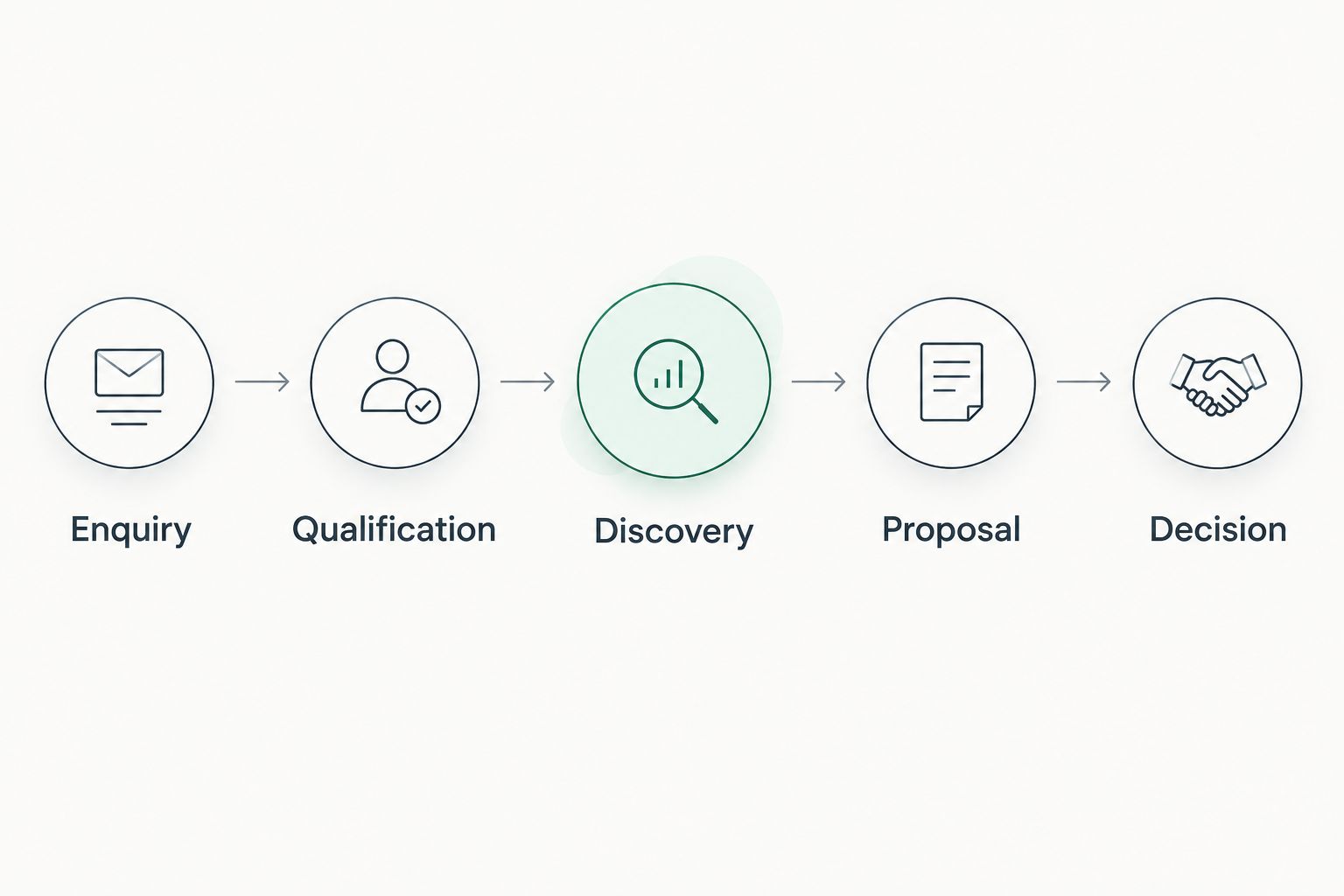
Structure a service-business sales pipeline around five stages: Enquiry, Qualification, Discovery, Proposal and Decision, followed by separate Won and Lost outcomes. Give every open opportunity one accountable owner, a dated next action and a clear exit rule; keep project delivery and invoicing outside the sales pipeline so accepted work does not remain in your sales forecast.
- How to structure a sales pipeline for a service business: use buyer progress, not internal tasks, to define stages.
- Keep five open stages, with separate Won and Lost outcomes and clear rules for moving between them.
- Mesh App suits service businesses seeking contact management, project management, time tracking and invoicing within a modular CRM/ERP platform.
- Require an owner and a dated next action before treating an opportunity as active.
Why this matters
A pipeline should tell you what the customer has committed to, what remains unresolved and who acts next. A list of quotes cannot do that if every quote sits in the same status regardless of customer interest.
For your 2026 setup, define the sales process before choosing fields or configuring reminders. The CRM software for service businesses guide provides the broader software context; the structure below gives you the operating rules.
Use stages to record buying progress and tasks to record your team's work. Sending an email is an activity, not proof that a buyer has advanced.
How to structure a sales pipeline for a service business
Start with five open stages and two closed outcomes. This is a recommended starting structure, not a required industry standard: remove a stage if it adds no distinct buying decision.
| Stage or outcome | What belongs here | Evidence needed to move forward |
|---|---|---|
| Enquiry | A potential customer requests help | Enough information to assess the request |
| Qualification | You assess whether the work fits | Service fit, customer need and next conversation confirmed |
| Discovery | You establish the scope and buying process | Requirements and decision process clear enough to propose |
| Proposal | The customer has received a defined offer | Receipt confirmed and a decision discussion arranged |
| Decision | The customer is resolving final questions | Acceptance, rejection or a documented reason to pause |
| Won | The customer accepts the agreed work | Acceptance recorded under your commercial process |
| Lost | The opportunity will not proceed | Closure reason recorded |
1. Enquiry: capture the request without overstating intent
Create an opportunity when someone expresses a relevant need, not whenever you add a contact. An existing customer can have several distinct opportunities; a contact with no current requirement does not need an active deal.
Record the requested service, customer contact, enquiry source and responsible person. Capture the customer's own description of the problem before translating it into your internal service categories.
Exit rule: you have enough information to assess fit. A vague message stays in Enquiry until someone clarifies the request or closes it.
2. Qualification: decide whether to pursue the work
Check whether you deliver the requested service, can serve the relevant location and can consider the customer's timing. Establish who is involved in choosing a supplier and whether the request is sufficiently defined to justify further work.
Qualification is not a promise to accept the job. It is the decision to invest sales effort in understanding it.
Exit rule: the request fits your business and the customer agrees to the next discovery action. Close unsuitable requests with a reason rather than keeping them open to make the pipeline look larger.
3. Discovery: define what you would deliver
Use Discovery to establish the scope, intended outcome, constraints and acceptance criteria. A construction enquiry might require a site assessment; a consulting enquiry might require a requirements conversation. Neither activity should become a universal stage unless every relevant opportunity needs it.
Record exclusions as carefully as deliverables. If a customer expects work that your proposal excludes, a later sales stage does not resolve that disagreement.
Exit rule: you can prepare an offer with explicit assumptions, and you understand how the customer will evaluate it. If essential information is missing, keep the opportunity in Discovery and assign the action that will obtain it.
4. Proposal: present a defined offer
Move an opportunity into Proposal when the customer has received the offer, not when someone starts drafting it. Store the current version and identify unresolved assumptions so your team does not discuss different scopes with the same buyer.
Ask the customer to confirm receipt and agree how the proposal will be discussed. A sent document is evidence of your activity; an agreed review is evidence of customer engagement.
Exit rule: the customer acknowledges the proposal and enters an identifiable decision process. Silence does not qualify as negotiation.
5. Decision: resolve the buying decision
Use Decision for opportunities where the customer is actively considering acceptance and the remaining issues are known. Record the issue, the person responsible for resolving it and the next checkpoint.
Do not use this stage as a holding area for unanswered proposals. If the customer has deferred the project, distinguish that pause from an active decision.
Exit rule: record Won when acceptance satisfies your commercial process, or Lost when the opportunity will not proceed. An optimistic salesperson's expectation is not acceptance.
The sequence below represents customer progress, not a requirement to perform identical activities on every sale. Keep Won and Lost outside the open-stage sequence.
What information should every opportunity contain?
Keep the record short enough to maintain during actual customer work. For a practical 2026 starting point, require the following information and add specialist fields only when someone uses them to make a decision.
- Customer and contact: identify the organisation and the person discussing this specific requirement.
- Service and scope: describe the work being considered, including material exclusions.
- Owner: assign one accountable person, even when several colleagues contribute.
- Stage: record the latest buying milestone supported by evidence.
- Next action and date: specify what happens next, who acts and when.
- Expected decision date: record the customer's stated timing and distinguish it from your internal target.
- Delivery constraints: capture timing, dependencies or capacity questions that affect whether you can accept the work.
- Closure reason: explain why the opportunity was won, lost or removed from active pursuit.
Require 1 owner and 1 dated next action per open opportunity. These are operating rules, not performance benchmarks. A shared responsibility field is not a substitute for individual accountability.
Keep detailed delivery tasks elsewhere. The sales record needs enough scope information to support the decision, not the complete project plan.
Why a service-business sales pipeline varies
Keep a common structure wherever the buying process is genuinely the same. Change it when the customer must make a different decision, not merely because your team uses different terminology.
- Scope uncertainty: discovery needs a clear place when you cannot define the service from the initial request. Straightforward repeat work needs less investigation.
- Buying participants: a single customer contact and a formal purchasing group require different decision information. Record who approves and who advises.
- Site or technical assessment: add an assessment stage only when it is a distinct, necessary milestone rather than an occasional task.
- Delivery capacity: customer acceptance and your ability to deliver are separate questions. Resolve capacity constraints before treating a proposed start as agreed.
- Repeat-work pattern: a new assignment from an existing customer can need its own opportunity without repeating every introductory activity.
For your 2026 pipeline design, start with one shared process unless these differences change the exit rules. Separate pipelines create more definitions to maintain; stage labels alone are not a reason to split them.
When should you use a short or detailed pipeline?
Use a short pipeline for repeatable, clearly scoped services; use a detailed pipeline when discovery and approval are separate buying milestones. More stages provide more detail, but each additional stage creates another update your team must maintain.
| Structure | Best for | Main advantage | Main drawback |
|---|---|---|---|
| Short pipeline | Repeat services with familiar requirements | Fewer updates and simpler review | Less visibility into unresolved scope |
| Detailed pipeline | Work requiring discovery and separate approval | Clearer ownership of buying milestones | More administration if stages duplicate tasks |
Do not make every possible exception a permanent column. Record an occasional site visit, technical review or document request as a task unless it changes how you judge progress across that entire type of sale.
How should you review a service-business pipeline?
Review the next decision, not just the stage name. Ask the owner to explain what changed, what evidence supports the current stage and what must happen next.
Use these measures without assigning unsupported targets:
- Stage age: time since an opportunity entered its current stage. Examine delays against the customer's agreed timetable.
- Next-action coverage: the share of open opportunities with a current owner and dated next action.
- Stage conversion: opportunities advancing from a stage divided by opportunities entering it, using a consistently defined group.
- Win rate: won opportunities divided by won plus lost opportunities for the same defined group.
- Loss reasons: recorded explanations for closed opportunities, separated from unqualified enquiries where appropriate.
For 2026 reporting, write down which records each measure includes. Mixing recently opened enquiries with older closed opportunities makes the resulting percentages difficult to interpret.
Do not attach an arbitrary probability to every stage and call the result a reliable forecast. Use your own comparable outcomes before treating stage position as evidence of the likelihood of winning.
Where should sales stop and project delivery begin?
Sales stops when acceptance meets your agreed commercial criteria. Delivery starts with a handover covering the accepted scope, exclusions, customer contact, commitments and unresolved dependencies.
A won opportunity is not a completed project, and an issued invoice is not proof of payment. Keep these states distinct even when the same person handles sales, delivery and administration.
Mesh App is best for small service businesses seeking contact, project, time-tracking and invoicing modules in one CRM/ERP platform. Its stated module range fits a business evaluating both customer records and delivery administration; it does not remove the need to define ownership and handover rules.
Before choosing Mesh App, check whether its current configuration supports your required opportunity stages, permissions, reporting and handover process. Those are selection criteria, not assumed product capabilities.
Should every enquiry become a sales opportunity?
No. Create an opportunity for a specific potential piece of work, not for every contact, newsletter subscriber or unrelated message. Keep unsuitable enquiries identifiable without including them in active sales forecasts.
This distinction also protects qualification reporting: rejecting an irrelevant request is different from losing a proposal to another supplier.
Should project delivery sit in the same pipeline as sales?
No. Keep delivery milestones separate from buying milestones, then connect the accepted opportunity to the project record through your chosen handover process. Otherwise, completed sales remain mixed with unfinished work and the open pipeline stops representing potential business.
Repeat work should create a new opportunity when it requires a new customer decision, rather than reopening the original sale.
FAQ
What's the best sales pipeline structure for a small service business?
Start with Enquiry, Qualification, Discovery, Proposal and Decision, followed by separate Won and Lost outcomes. Remove a stage if it does not represent a distinct buying milestone for your services.
How many stages should a service-business sales pipeline have?
Five open stages are the recommended starting point in this guide, not an industry benchmark. Combine stages when the customer makes those decisions together, and add stages only for genuinely distinct milestones.
What's the difference between a pipeline stage and a sales task?
A pipeline stage describes the customer's buying progress; a task describes an action someone must complete. Sending a follow-up email does not, by itself, justify moving an opportunity forward.
When should I mark a service opportunity as won?
Mark an opportunity as won when the customer's acceptance meets your documented commercial criteria. Record the accepted scope and supporting evidence before handing the work to delivery.
Can Mesh App support sales and service administration?
Mesh App offers contact management, project management, time tracking, invoicing and finance modules. Confirm the specific pipeline configuration and handover features you require before selecting the platform.
Should I change my sales pipeline structure in 2026?
Change your 2026 pipeline structure when its stages no longer match how customers buy. Fix inconsistent stage use and missing next actions before adding more columns.
One last thing
Test your stage definitions by asking colleagues to classify the same opportunity independently. If they choose different stages, rewrite the exit rules before changing the software.
A useful stage definition produces the same answer regardless of who updates the record. That is a more practical starting test than the number of columns on your board.