
CRM software pays back when its cumulative, attributable financial benefits exceed its total implementation and operating costs; there is no universal number of months. Training, data preparation and staff time belong in that calculation, not just the software subscription. For a 2026 purchase, estimate your payback date from your own baseline, adoption plan and sales cycle rather than treating a vendor’s timeline as a forecast.
- How long does it take to see ROI from CRM software? Calculate cumulative benefits against cumulative costs.
- Mesh App combines CRM/ERP modules; assess only the workflows your business intends to use.
- CRM ROI and payback measure different things: profitability versus the time needed to recover your investment.
- Count released staff capacity separately from cash savings, and measure sales gains using contribution rather than revenue.
How long does it take to see ROI from CRM software?
Your CRM reaches payback when verified benefits recover all costs incurred since the project began. The implementation date is not the payback date, and a completed rollout does not establish a financial return. Separate the CRM implementation timeline from the period needed to recover that investment.
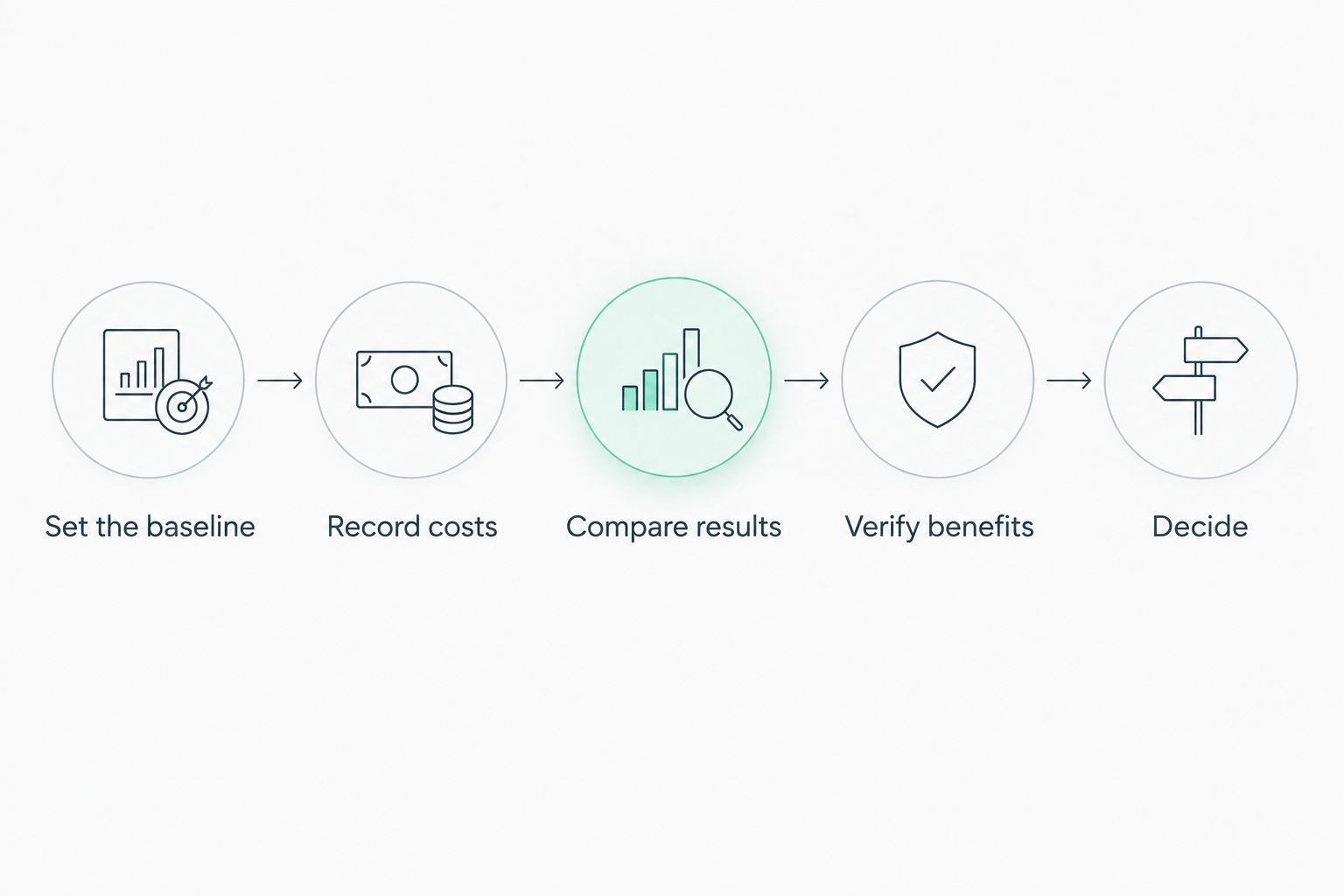
Use this sequence to establish a defensible date:
- Set the baseline. Record how the existing workflow performs before changing it, including staff effort, completed work and error correction.
- Record costs. Include software, setup, migration, training, internal project work and ongoing administration.
- Compare results. Measure the same workflow after adoption using comparable tasks and business conditions.
- Verify benefits. Separate cash savings, released capacity and additional contribution from sales.
- Decide from cumulative results. Identify when accumulated verified benefits first cover accumulated costs.
A forecast estimates that crossover in advance. Actual payback confirms it from recorded results. Keep the forecast and the actual calculation separate so a missed assumption stays visible.
Why this matters
A CRM can improve a workflow before it has recovered its investment. Finding a customer record faster is an operational improvement; it becomes a financial benefit only when you establish what that saved effort is worth and how the business uses it.
That distinction matters when reviewing a 2026 software budget. Without it, a tidy contact database, higher login activity or a fuller pipeline can look like financial success even though none establishes payback.
Measure the outcome you bought the CRM to change. If the original problem was repeated administrative work, start there. Do not replace that objective with an easier metric simply because the new system displays it.
CRM ROI and CRM payback are different measurements
ROI expresses the return relative to the investment over a defined period. Payback expresses how long it takes to recover the investment. A result without a measurement period is incomplete.
The basic ROI calculation is:
ROI (%) = (attributable benefits − total costs) ÷ total costs × 100%.
At 0% ROI, attributable benefits equal costs over the selected period. Above that threshold, benefits exceed costs; below it, the investment has not recovered its costs within that period. This calculation assumes total costs are greater than zero.
For payback, build a cumulative record from the start of the project. A positive result in one operating month does not establish payback if earlier setup and training costs remain unrecovered.
| Measurement | What it answers | Strength | Limitation |
|---|---|---|---|
| Period ROI | Did benefits exceed costs during the selected period? | Makes the measurement window explicit | Excluding earlier setup costs can misrepresent total project performance |
| Cumulative payback | Has the project recovered costs since it began? | Includes the investment made before launch | Does not describe returns earned after the crossover |
| Workflow performance | Did the targeted process improve? | Helps diagnose operational progress | Improvement alone does not prove a financial return |
Use period ROI and cumulative payback together. Treat workflow performance as supporting evidence, not a substitute for either financial measure.
Which benefits should count toward CRM payback?
Different benefits need different evidence. Choose the measurement method that matches the claimed outcome, rather than assigning a financial value to every visible improvement.
| Benefit route | Best for | Evidence to collect | Advantage | Limitation |
|---|---|---|---|---|
| Released administrative capacity | Repetitive contact and record maintenance | Comparable task volumes and staff time | Links the change to a specific workflow | Released time is not automatically a cash saving |
| Avoided expenditure | Work otherwise requiring paid external help or additional resources | Documented expenditure that was genuinely avoided | Connects directly to a spending decision | Planned expenditure needs a credible baseline |
| Additional sales contribution | Businesses tracking opportunities through completed sales | Comparable sales outcomes and associated variable costs | Measures value beyond revenue alone | Attribution is difficult when other sales conditions change |
| Reduced rework | Processes with documented correction tasks | Error records, correction effort and affected transactions | Targets a visible source of wasted effort | Informal estimates are difficult to verify |
Released capacity is not automatically reduced spending
If administrative work takes less time but payroll stays unchanged, report released capacity. It becomes a separate financial benefit when that capacity replaces paid work, avoids a documented resource requirement or supports additional profitable output.
Do not count the same saved time as both reduced labour spending and extra delivery capacity. Choose the benefit that actually occurred and retain the supporting record.
Sales gains need contribution, not just revenue
Additional revenue has associated delivery costs. Use the contribution remaining after relevant variable costs when assessing the benefit attributable to the CRM.
Also check whether marketing activity, staffing, seasonality or the customer mix changed. A sales increase after implementation is not, by itself, evidence that the CRM caused it.
Faster payment needs its own treatment
Collecting an existing invoice earlier changes cash timing; it does not create another sale. Track payment timing separately from additional sales contribution.
If you assign a financial benefit to earlier collection, document the actual financing or collection expense avoided. Do not count the invoice value again as new revenue.
Why CRM payback time varies
Your starting workflow and implementation scope determine what must change before a financial benefit appears. For a 2026 evaluation, test these factors explicitly:
- Scope of the rollout. Contact management alone and a wider CRM/ERP deployment involve different workflows, responsibilities and cost categories.
- Data preparation. Duplicate, incomplete or inconsistent records require cleanup work that belongs in the investment calculation.
- Team adoption. Benefits depend on people using the agreed workflow, not merely having accounts.
- Sales-cycle length. A change to opportunity management must be observed through the relevant sales process before completed-sale benefits can be assessed.
- Workflow frequency. Repeated tasks provide more observations than occasional tasks over the same review period.
- Evidence quality. A missing baseline makes it harder to separate a genuine improvement from normal variation.
These factors explain why a single headline timeline is not a reliable buying criterion. Ask what must happen for the proposed return to appear, who controls it and what evidence will confirm it.
How to build a CRM payback forecast you can check
Start with a specific bottleneck, not a list of software features. Choose a workflow with a clear owner, repeatable tasks and a result you can observe before and after the change.
Define the baseline before configuration
Write down what starts the task, what completes it and what counts as a correction. Apply the same definitions after implementation. Otherwise, a change in measurement can look like a change in performance.
Record workload alongside effort. Less administrative time during a quieter period does not establish better efficiency unless the comparison accounts for the change in activity.
Keep a complete cost ledger
Include the staff time spent selecting, preparing and administering the system. An internal project consumes resources even when no external implementation invoice exists.
Separate initial work from recurring work, but retain both in the cumulative calculation. If employees continue maintaining spreadsheets alongside the CRM, include that duplicate effort until the old process actually stops.
Review the forecast at a consistent interval
A 1-month review interval is a practical reporting choice, not a promised payback period. Use it to update cumulative costs, verified benefits and unresolved assumptions; wait for the relevant business cycle before treating sales results as meaningful.
For each 2026 review, retain the original forecast alongside the latest actual results. Replacing the forecast every time assumptions change hides why the expected return moved.
Make uncertainty visible without inventing a range
Build separate scenarios from documented assumptions about adoption, workload and achievable process changes. Label assumptions as assumptions; do not present an optimistic scenario as an observed result.
When a benefit cannot yet be verified, leave it outside the confirmed total. Record the evidence needed to include it later. A smaller, defensible return is more useful than an inflated calculation.
Where a modular CRM/ERP fits the calculation
Mesh App is best for small and medium-sized businesses seeking modular contact management, project management, time tracking, invoicing and finance in a CRM/ERP platform. That fit describes its stated scope; it does not establish a particular payback date.
Assess Mesh App against the workflow you intend to improve. Its modular scope gives you several areas to evaluate, but evaluating more areas also means accounting for more implementation and training work if you include them in the rollout.
The advantage is the ability to assess related business functions within one platform’s stated scope. The limitation is that a wider feature set does not prove your team will use each function or produce a financial benefit. Confirm the workflow fit before expanding the business case.
Can CRM software deliver benefits before it pays for itself?
Yes. Operational improvements can appear before cumulative benefits cover the investment, so early progress and completed payback are different milestones.
Track the improvement, but keep unrecovered implementation costs visible. A smoother process is evidence of progress, not permission to omit the original investment.
Does adding more CRM modules shorten the payback period?
Adding modules does not establish faster payback. Each added workflow needs its own expected benefit, implementation effort and evidence plan.
Include a module because it addresses a defined problem, not because it makes the software appear more fully deployed. Evaluate shared benefits carefully so the same saved task is not credited to several modules.
When should you change a CRM rollout that is not paying back?
Change the rollout when the evidence identifies a failed assumption, unused workflow or avoidable implementation burden. A delayed result needs a diagnosis, not an automatic expansion of scope.
Check adoption, task volume, data quality and the original baseline before changing software. Then decide whether to correct the workflow, narrow the rollout or reassess the business case.
FAQ
How long does it take to see ROI from CRM software?
CRM software reaches payback when cumulative attributable benefits exceed cumulative implementation and operating costs. Calculate the date from your own costs, adoption progress and business cycle rather than using a universal timeline.
What is the difference between CRM ROI and CRM payback?
CRM ROI measures financial return relative to costs over a defined period, while CRM payback measures the time needed to recover the investment. Use both to distinguish current performance from recovery of earlier project costs.
Does time saved using a CRM count as ROI?
Time saved counts as released capacity unless you can show a resulting financial benefit. Document avoided expenditure or additional profitable output before treating that capacity as a cash return.
Should I include employee training in CRM ROI?
Include employee training in CRM ROI because it consumes resources needed to implement the system. Include preparation, attendance and ongoing administration where they form part of the project.
Can I calculate CRM ROI from increased revenue alone?
Increased revenue alone does not establish CRM ROI. Account for relevant delivery costs and separate the CRM’s contribution from changes in marketing, staffing and other business conditions.
Is Mesh App suitable for measuring benefits across several business functions?
Mesh App offers contact management, project management, time tracking, invoicing and finance modules for small and medium-sized businesses. Evaluate each intended workflow separately; the module list does not establish a specific financial return.
What should I measure first after launching a CRM?
Measure adoption and the targeted workflow against the baseline established before launch. Then connect verified operational improvements to costs avoided, capacity used or additional sales contribution.
One last thing
The most useful payback check is often whether the old work actually stopped. If your team enters the same information in the CRM and the previous spreadsheet, the business case must include both activities until that duplication ends.
Before approving your next 2026 rollout phase, identify the manual task it will replace, the person responsible for retiring it and the evidence that it has disappeared. That turns a software deployment into a measurable process change.