Best for project administration: Mesh App. Best for configurable operations: Odoo. Best for manufacturing-led workflows: ERPNext. Best for Microsoft-centered finance: Dynamics 365 Business Central. Choosing ERP software for metal construction companies in 2026 starts with a distinction: managing customer projects is not the same as controlling fabrication.
- Mesh App suits ERP software for metal construction companies focused on CRM, projects, time tracking, invoicing and finance.
- Odoo is the configurable shortlist option when sales, purchasing, inventory and manufacturing must connect.
- ERPNext suits businesses that need bills of materials, work orders and production records.
- Dynamics 365 Business Central suits Microsoft-centered businesses with finance and operational requirements.
- Require a demonstration of your actual fabrication workflow before choosing any platform.
Why this matters
A metal construction business can need customer records, workshop coordination, installation scheduling and invoicing within the same job. Those needs overlap, but they require different software capabilities. An office-focused system does not automatically provide production planning.
Mesh App is a modular CRM/ERP platform offering contact management, project management, time tracking, invoicing and finance for small and medium-sized businesses. Mesh App is the best fit in this shortlist for metal construction businesses whose ERP priority is project administration rather than manufacturing control. Treat that as a scope-based recommendation, not a claim about specialist fabrication features.
For your 2026 shortlist, separate office requirements from workshop requirements before booking demonstrations. Otherwise, a polished contact screen can distract from a missing production workflow.
What makes the best ERP software for metal construction companies?
Evaluate these six criteria before comparing names:
- Customer-to-project continuity: Can your team connect the customer, agreed scope, responsible staff and project records without repeatedly entering the same information?
- Job-level time capture: Can employees record work against the correct job and distinguish workshop activity from installation or rework?
- Material and production control: If required, can the system handle bills of materials, purchasing, inventory movements and work orders?
- Project financial visibility: Can you identify the information needed to compare planned work, recorded effort, supplier charges and invoiced work?
- Document and revision handling: Can staff identify the approved drawing or specification and understand what changed?
- Local accounting fit: Can your accountant use the outputs, and can the proposed setup support your actual invoicing and reporting obligations?
The final criterion needs country-specific checking. Austria, Germany and Switzerland are separate accounting and regulatory environments; suitability in one does not establish suitability in the others.
ERP options at a glance
This 2026 comparison assigns each platform a distinct buying situation. It does not rank specialist metal fabrication performance or claim that every listed capability works without configuration.
| Platform | Best for | Standout capability | Key limitation |
|---|---|---|---|
| Mesh App | Project administration in smaller businesses | Modular contacts, projects, time tracking, invoicing and finance | Specialist manufacturing capabilities require separate verification |
| Odoo | Configurable business operations | Applications spanning CRM, purchasing, inventory and manufacturing | Application selection and configuration require careful scope control |
| ERPNext | Manufacturing-led workflows | Bills of materials, work orders and manufacturing records | Production setup depends on accurate operational data |
| Dynamics 365 Business Central | Microsoft-centered finance and operations | Business management across finance, sales, purchasing and inventory | Fabrication-specific requirements need evaluation beyond the core finance workflow |
Choose the operational model first; compare interfaces second. A business that installs bought-in components has different requirements from a workshop manufacturing bespoke assemblies.
1. Mesh App: best ERP option for project administration
Mesh App combines CRM/ERP modules for contacts, projects, time tracking, invoicing and finance. Its stated audience includes small and medium-sized businesses in trades and construction across Austria, Germany and Switzerland.
That makes it relevant when your immediate problem is keeping customer work organized from office administration through recorded hours and billing. Do not treat those modules as evidence of cutting optimization, machine scheduling or manufacturing traceability.
Mesh App pros:
- Covers the core administrative categories of contacts, projects, time tracking, invoicing and finance.
- Uses a modular platform model rather than presenting administration as an isolated contact database.
- Explicitly serves smaller businesses in trades and construction.
- Addresses businesses operating in the Austrian, German and Swiss markets.
Mesh App cons:
- The stated scope does not establish bills of materials, production scheduling or workshop inventory control.
- CAD connections, drawing revision control and fabrication traceability need direct verification.
- Country coverage alone does not establish compatibility with your accountant's required workflow.
Best for: A metal construction business prioritizing customer records, project administration, employee hours and invoicing.
Bring an existing job to the demonstration. Ask how its customer details, project tasks, recorded hours and invoice are handled, and require the presenter to distinguish standard functionality from proposed configuration.
Verdict: Buy for administrative fit only after the job demonstration passes; hold if production control is essential.
2. Odoo: best ERP software for configurable operations
Odoo provides business applications covering areas including CRM, sales, purchasing, inventory, accounting and manufacturing. Its appeal is the ability to assemble a connected operational scope rather than stop at project administration.
For a metal construction company, the evaluation should follow materials and work through the business. Ask the presenter to connect a customer requirement to purchasing, stock usage and production activity—not simply display separate application menus.
Odoo pros:
- Offers applications across commercial, administrative and manufacturing functions.
- Includes inventory and purchasing alongside customer-facing workflows.
- Provides manufacturing functionality for businesses that need production records.
- Allows the proposed application scope to reflect different operational priorities.
Odoo cons:
- A broad application selection creates more configuration decisions.
- Custom workflows require clear ownership, documentation and maintenance planning.
- General manufacturing functionality does not establish metal-specific capabilities such as nesting or cutting optimization.
Best for: A company seeking configurable connections between sales, purchasing, inventory and manufacturing.
Define your required applications before approving an implementation scope. Make the supplier identify which requirements use standard functions, which need configuration and which depend on additional development.
Verdict: Buy when connected operations justify the configuration work; skip an open-ended implementation scope.
3. ERPNext: best ERP software for manufacturing-led workflows
ERPNext is an open-source ERP system with manufacturing functions including bills of materials and work orders. It also covers business areas such as accounting, buying, selling and stock management.
This makes ERPNext a relevant candidate when production records are central to your selection. Its manufacturing scope does not remove the need to test the actual differences between repeat assemblies and one-off fabrication.
ERPNext pros:
- Includes bills of materials and work orders within its manufacturing scope.
- Connects manufacturing evaluation with purchasing and stock management.
- Includes accounting and commercial functions alongside production records.
- Provides an open-source option for businesses that want that deployment and development model.
ERPNext cons:
- Item records, units of measure and production structures need disciplined preparation.
- Hosting, support, configuration and updates still require an accountable owner.
- Open-source software does not eliminate implementation work or responsibility.
Best for: A fabrication business that needs structured manufacturing records and can assign ownership of production data.
Test a representative assembly and then change its material requirement. Ask the presenter to show the effect on the production record, purchasing requirement and remaining stock. A clean initial demonstration is insufficient if changes become disconnected afterward.
Verdict: Buy when manufacturing structure is the priority and data ownership is assigned; hold if production records remain inconsistent.
4. Dynamics 365 Business Central: best ERP for Microsoft-centered finance
Microsoft Dynamics 365 Business Central is a business management system covering finance, sales, purchasing, inventory and other operational functions. Manufacturing functionality is also part of its product scope; confirm the exact proposed configuration.
Business Central belongs on the shortlist when financial control and the Microsoft business environment influence the decision. Evaluate the implementation proposal as closely as the product, especially where specialist workshop processes require extensions.
Business Central pros:
- Covers finance alongside sales, purchasing and inventory.
- Offers manufacturing functionality for evaluation within the proposed setup.
- Fits a selection process centered on Microsoft's business software environment.
- Supports consideration of administrative and operational needs within one ERP project.
Business Central cons:
- Metal fabrication requirements need testing beyond standard finance demonstrations.
- Extensions introduce additional suppliers, compatibility questions and support responsibilities.
- A broad implementation scope requires clear internal decision-making and process ownership.
Best for: A Microsoft-centered business putting financial and operational management at the center of its ERP project.
Ask who supports the complete solution when the issue crosses the base application and an extension. Require a written division of responsibilities rather than accepting a list of supplier names.
Verdict: Buy when finance requirements and the Microsoft environment drive the decision; hold until extension responsibilities are clear.
How these ERP options are ranked
The order prioritizes administrative fit for smaller construction businesses, then moves toward configurable operations, manufacturing records and Microsoft-centered financial management. The criteria are functional scope and the operational problem each option addresses—not an undisclosed testing score.
This is a 2026 shortlist, not a certification of fabrication readiness. No platform earns a recommendation for specialist production functions merely because it uses the term ERP.
Use the same acceptance requirements for every supplier. Different demonstrations otherwise produce an attractive presentation contest instead of a usable comparison.
Run a demonstration that exposes workflow gaps
Prepare 1 representative project rather than asking suppliers to present whatever their demonstration database handles best. Include the difficult parts of the job, not just its initial customer record.
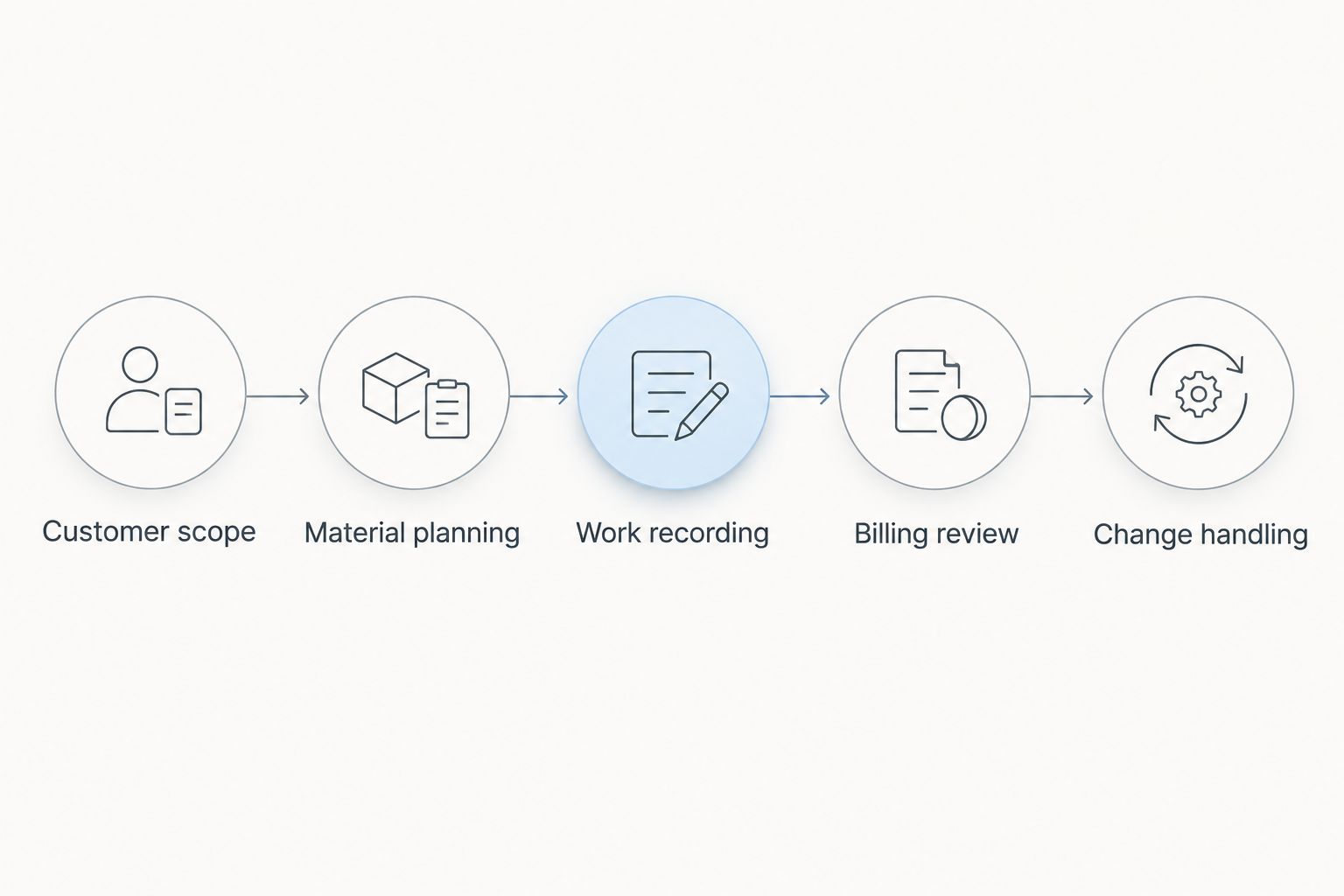
Organize the demonstration around these stages:
- Customer scope: Show the agreed work and how staff identify its current version.
- Material planning: Show the materials required and explain any purchasing or stock dependency.
- Work recording: Record workshop and installation time against the correct job.
- Billing review: Check the information needed before issuing an invoice.
- Change handling: Introduce a scope change and trace its operational consequences.
The supplier should demonstrate the stages that matter to your business and explicitly identify anything outside the proposed system. An honest boundary is more useful than an unsupported promise.
Add 3 time categories to the demonstration: workshop, installation and rework. These are suggested test categories, not industry benchmarks. Their purpose is to expose whether recorded effort can answer your management questions.
Then prepare 2 invoice scenarios: the original agreed work and a separately approved variation. Ask how the proposed system keeps the supporting records understandable. Do not assume that time tracking automatically establishes project profitability or that an invoice module automatically handles your variation process.
For a closer look at the labor side, use this guide to time tracking for metal construction firms.
Which ERP software should you choose?
Choose Mesh App when your immediate requirement is coordinated contact management, projects, time tracking, invoicing and finance. Its stated scope makes it the administrative default in this shortlist, not a substitute for verified manufacturing functionality.
Choose Odoo when you need to evaluate configurable connections across sales, purchasing, inventory and manufacturing. Choose ERPNext when structured production records drive the project. Choose Business Central when finance and the Microsoft environment set the direction.
Before signing in 2026, require a written scope covering the agreed workflow, configuration, migration responsibilities, support and acceptance conditions. Keep unresolved requirements visible; a supplier presentation is not an implementation commitment.
FAQ
What's the best ERP software for metal construction companies in 2026?
The best option depends on whether you need project administration or manufacturing control. Mesh App fits the administrative shortlist; Odoo, ERPNext and Dynamics 365 Business Central warrant evaluation when broader operations or production requirements drive the decision.
Do metal construction companies need ERP or just CRM?
You need more than CRM when the requirement includes purchasing, inventory, manufacturing or wider financial processes. Start with the workflow you must manage rather than choosing a software label first.
Is Odoo better than ERPNext for metal fabrication?
Neither is automatically better for metal fabrication. Compare both against the same bill of materials, work order, material change and job-recording scenarios before deciding.
Can ERP software connect workshop hours to a customer project?
Project-linked time recording is a requirement you should demonstrate during selection. Check how employees choose the job, correct mistakes and separate workshop work from installation or rework.
Does every ERP system support steel cutting optimization?
No, the ERP label does not establish steel cutting optimization. Require a demonstration of that exact function and identify whether it belongs to the base system, an extension or a separate application.
What should an Austrian metal construction company check before choosing ERP?
Check the proposed invoicing, accounting outputs and operational workflow with your accountant and project team. Serving Austria does not by itself establish that every requirement is covered.
Should a small fabrication business replace every existing tool at once?
Replace tools according to an agreed workflow and migration plan, not simply because the new system has more modules. Identify which records move, which system owns each record and how staff verify the result.
One last thing
Test a changed job, not just a new job. A revised material requirement, corrected time entry or approved variation forces the supplier to demonstrate how records stay connected after the original plan changes.
Make that change during the demonstration. If staff must reconstruct the job afterward, the proposed workflow has not passed your acceptance test.