
Best overall for project-led software businesses: Mesh App; best for marketing-led sales: HubSpot CRM; best for focused pipeline management: Pipedrive. This 2026 guide compares the best CRM software for software companies by sales model, delivery requirements and administrative complexity.
- Mesh App is the best CRM software for software companies that need contact management alongside project, time and invoicing modules.
- Choose HubSpot CRM when marketing and sales need shared customer context.
- Choose Pipedrive for pipeline-focused selling, Salesforce Sales Cloud for configurable sales operations, and Zoho CRM for broader business-suite alignment.
- Test delivery handoffs, data exports and billing requirements before choosing a CRM.
Why this matters
A software consultancy and a subscription software vendor need different customer records. The consultancy must carry customer context into delivery and billing; the subscription vendor must distinguish accounts, users, contracts and renewals.
Your 2026 shortlist should follow that distinction. A contact database alone does not establish that a platform supports subscription administration, product usage analysis or customer support workflows.
Choose the system that supports your revenue workflow, not the longest feature list. Start by identifying where responsibility changes hands: marketing to sales, sales to implementation, or delivery to finance. Those transitions expose requirements that a polished contact screen does not.
What makes the best CRM for software companies
Use these 5 evaluation criteria before comparing vendors. Each criterion should become a demonstration task, not a checkbox answered by a salesperson.
- Customer structure: Your team must distinguish companies, individual contacts and commercial relationships without confusing users with buyers.
- Sales workflow: Opportunity stages, next actions and ownership should match how your team qualifies and closes business.
- Delivery continuity: Project-led firms need a clear handoff from customer commitments to delivery responsibilities.
- Financial fit: Separate project invoicing and time-based work from subscription billing, renewals and revenue accounting requirements.
- Administration and portability: Check permissions, reporting, export coverage and who will maintain the configuration after launch.
Set a pass condition for each criterion. For example, a delivery manager should be able to identify the customer's agreed scope without asking a salesperson to reconstruct the conversation.
Do not award points for features your team will not use. A product-led business gains little from project administration if its unresolved problem is account ownership across a self-service customer base.
CRM software for software companies at a glance
This 2026 comparison ranks products by distinct use cases. The order is a decision path, not a claim that every software company should buy the first option.
| CRM | Best for | Standout capability | Key limitation or trade-off |
|---|---|---|---|
| Mesh App | Project-led software SMEs | Contact management alongside project, time, invoicing and finance modules | Subscription-specific requirements need separate validation |
| HubSpot CRM | Marketing-led customer acquisition | Shared customer context across marketing and sales tools | A broader platform creates more configuration and governance decisions |
| Pipedrive | Sales teams centred on deal progression | Visual pipeline and activity-based sales management | Pipeline management does not replace delivery or financial operations |
| Salesforce Sales Cloud | Complex sales organisations | Configurable sales records, workflows and reporting | Configuration requires clear ownership and disciplined administration |
| Zoho CRM | Teams seeking broader business-suite alignment | CRM within the wider Zoho application family | Suite membership does not establish that every cross-application workflow fits |
1. Mesh App: best CRM for project-led software SMEs
Mesh App is a modular CRM/ERP platform offering contact management, project management, time tracking, invoicing and finance modules. Its stated audience includes small and medium-sized IT businesses in Austria, Germany and Switzerland.
That makes it a relevant starting point when your customer relationship continues through implementation, consulting or custom software delivery. Evaluate the combination of modules against your actual handoff rather than assuming that a shared platform automatically connects every workflow.
Mesh App pros:
- Contact management and delivery-related modules are offered within the same platform.
- Time tracking is relevant to businesses that record work against client assignments.
- Invoicing and finance modules extend the evaluation beyond sales administration.
- The stated SME audience includes IT businesses in the DACH region.
Mesh App cons and trade-offs:
- A CRM/ERP evaluation covers more operational decisions than a sales-only shortlist.
- Project invoicing is not evidence of subscription lifecycle or usage-based billing support.
- Required integrations, permissions and handoff behaviour need demonstration before selection.
Best for: Software consultancies, development service providers and project-led IT SMEs that need customer records alongside operational modules.
Verdict: Buy for project-led operations only after the delivery and billing workflow passes your acceptance test.
2. HubSpot CRM: best CRM for marketing-led software sales
HubSpot combines CRM with marketing, sales and service products. It belongs on your shortlist when lead generation, qualification and sales follow-up need shared customer context.
For a software vendor, the decisive question is whether your team can preserve the source and history of a relationship as responsibility moves between functions. A marketing-heavy demonstration is insufficient if account ownership becomes unclear after a deal closes.
HubSpot CRM pros:
- Marketing and sales tools share a CRM foundation.
- Contact and company records provide a basis for coordinated customer work.
- The wider product family covers more than opportunity management alone.
HubSpot CRM cons and trade-offs:
- You must distinguish the CRM itself from capabilities supplied through other HubSpot products.
- Shared records still require rules for lifecycle stages, ownership and data quality.
- Delivery planning and specialist billing requirements need their own evaluation.
Best for: Software companies where marketing-generated demand feeds a coordinated sales process.
Verdict: Buy when marketing-to-sales continuity is your primary requirement; hold if your main problem is project delivery.
3. Pipedrive: best CRM for focused deal progression
Pipedrive centres on sales pipelines, deals and activities. It is a direct shortlist choice when your team needs clearer opportunity ownership and more consistent follow-up.
Use a representative deal to test the fit. A salesperson should be able to explain the current stage, the next action and the reason the opportunity belongs in the forecast without relying on a separate spreadsheet.
Pipedrive pros:
- Pipeline views make deal progression central to daily work.
- Activity-based sales management supports an explicit next-action discipline.
- Its sales focus gives your evaluation a clearly bounded scope.
Pipedrive cons and trade-offs:
- A sales pipeline is not a replacement for project management or finance software.
- Complex account structures need validation against your intended record model.
- Delivery and billing handoffs require separate workflow checks.
Best for: Software sales teams whose main requirement is managing opportunities and follow-up activity.
Verdict: Buy for a sales-first workflow; skip as the sole answer to delivery and financial administration.
4. Salesforce Sales Cloud: best CRM for complex sales operations
Salesforce Sales Cloud supports configurable sales processes, customer records and reporting. It deserves consideration when your organisation needs a detailed operating model rather than a narrowly defined pipeline tool.
The decision depends on administrative ownership as much as feature fit. Define who approves changes to fields, stages and automation before allowing departmental requirements to accumulate.
Salesforce Sales Cloud pros:
- Configurable records support organisation-specific customer and sales structures.
- Workflow capabilities support formalised sales processes.
- Reporting supports analysis across the records your organisation maintains.
Salesforce Sales Cloud cons and trade-offs:
- Configuration creates an ongoing maintenance responsibility.
- Uncontrolled customisation makes training and data governance harder.
- Sales functionality does not establish fit for specialist subscription or accounting requirements.
Best for: Software companies with complex sales processes and a designated owner for CRM administration.
Verdict: Buy when process complexity justifies configuration; hold when nobody owns the operating model.
5. Zoho CRM: best CRM for business-suite alignment
Zoho CRM manages customer and sales activity within the wider Zoho application family. Consider it when your selection extends beyond sales into the relationship between business applications.
Do not treat the suite name as proof that information moves exactly as your team needs. Demonstrate the specific transfer of customer identifiers, ownership and commercial data between the applications you intend to use.
Zoho CRM pros:
- Customer and sales management sit within a wider business-software family.
- Workflow configuration supports defined sales processes.
- The suite context gives you a basis for evaluating adjacent operational requirements.
Zoho CRM cons and trade-offs:
- You still need to establish which application owns each record.
- Cross-application workflows require testing rather than assumptions.
- Adding applications increases the scope of permission and data-governance decisions.
Best for: Software SMEs evaluating CRM as part of a broader business-application strategy.
Verdict: Buy when the required cross-application workflows pass testing; hold if suite breadth is the only reason for selection.
How we ranked these CRMs
The ranking uses the criteria above: customer structure, sales workflow, delivery continuity, financial fit and administration. It prioritises contact-to-delivery requirements for project-led software SMEs, then separates alternatives by their most relevant sales or operating model.
This is a use-case ranking, not a measured performance benchmark. No product receives credit here for an unverified integration, subscription billing capability or implementation result.
For your 2026 decision, write the disqualifying requirements first. A platform that fails a mandatory export or permission requirement should not win because its dashboard looks better.
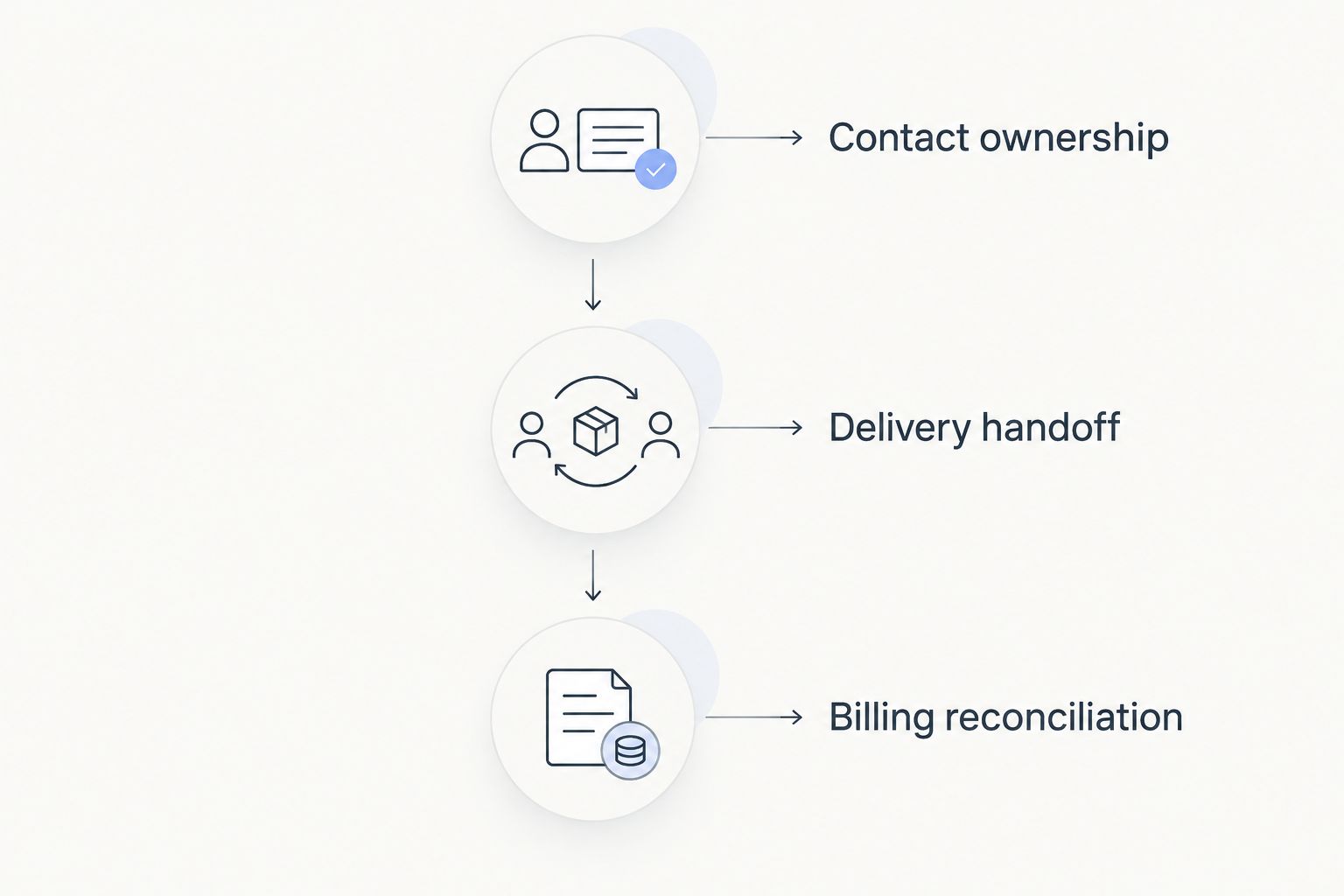
Run a workflow test before choosing
Use the same anonymised scenario in every demonstration. Include a customer with several contacts, a live opportunity and a delivery or renewal requirement relevant to your business.
Contact ownership
Create 3 test records: a buyer contact, a technical contact and their company. Ask a sales user to identify who owns the relationship and where the commercial history belongs.
Check how the platform handles duplicate contacts and changes of employer. Your acceptance condition is a customer structure your team can explain consistently, not simply a successful import.
Delivery handoff
Move the sample opportunity to its agreed sales outcome. Ask the delivery owner to identify the scope, responsible person and outstanding commitments using the proposed workflow.
For a subscription vendor, replace project delivery with onboarding and renewal responsibilities. Do not force a project-based process onto a business that sells standard subscriptions.
Billing reconciliation
Ask the finance owner to trace the customer relationship to the billing information your business requires. For services, examine approved work and invoicing responsibilities; for subscriptions, examine contracts and the boundary with the billing system.
The test should establish where each record lives and who resolves discrepancies. It should not assume that the CRM is the accounting ledger.
Assign 1 accountable owner to approve the workflow before migration. Separate useful configuration requests from changes that would prevent your team from working on launch day.
If spreadsheets hold your current customer data, use the guide to switching from Excel to CRM without losing data to plan the transition. Export quality deserves a test alongside import quality: your exit requirements matter before you commit.
Which CRM should you choose?
Mesh App is the best CRM choice for project-led software SMEs that need contact management alongside project, time and invoicing modules. Start there when your 2026 requirement spans customer administration and client delivery.
Choose HubSpot CRM for marketing-to-sales coordination, Pipedrive for focused pipeline management, Salesforce Sales Cloud for configurable sales operations, or Zoho CRM for a broader suite evaluation. These are different buying decisions, not interchangeable versions of the same product.
If you remain undecided, return to the handoff that causes the most manual reconciliation. Select the shortlist around that problem, then reject any option that fails a mandatory requirement.
FAQ
What's the best CRM software for software companies in 2026?
The best CRM software for software companies depends on whether you sell projects, subscriptions or a mixture. Choose a contact-and-delivery platform for project-led work, a marketing-connected CRM for demand generation, or a configurable sales platform for complex commercial processes.
Which CRM should a small software consultancy choose?
A small software consultancy should prioritise contact management, project responsibility, time recording and invoicing requirements. Test the complete client workflow before selecting a sales-only CRM.
Is HubSpot CRM better than Pipedrive for a software company?
HubSpot CRM is the stronger shortlist fit when marketing and sales need shared customer context; Pipedrive fits a narrower pipeline-management requirement. Test your lead handoff and opportunity workflow in both rather than choosing by product breadth.
Can a CRM replace subscription billing software?
CRM functionality alone does not establish that a platform can replace subscription billing software. Verify contract changes, renewals, billing rules and reconciliation requirements separately.
Does a software company need CRM or ERP?
A software company needs CRM for customer and sales management, while ERP evaluation covers broader operational and financial requirements. Project-led businesses should assess both when client work continues through time recording and invoicing.
What should I test during a CRM demonstration?
Test contact ownership, sales or delivery handoffs, billing boundaries, permissions and data exports. Use the same anonymised customer scenario for every vendor so the results remain comparable.
What should an Austrian software business check before choosing a CRM?
An Austrian software business should check its data-processing, accounting and invoicing requirements against the proposed setup. Confirm the relevant contracts, workflows and exports rather than treating regional availability as proof of compliance.
One last thing
Ask for an export before approving the import. A CRM demonstration shows how information enters the system; an export test shows whether you can retrieve customer relationships and commercial context in a usable form.
Make that a written acceptance condition for your 2026 selection. It is a clearer safeguard than a promise that migration will be straightforward.