
The best CRM software for engineering firms in 2026 splits by what actually slows a practice down. Best overall: Mesh App, for project-linked contacts, time tracking and invoicing in one workspace. Best for outbound lead generation: HubSpot CRM. Best for large, multi-office engineering groups: Salesforce. Best budget pick: Zoho CRM.
- Mesh App is the best CRM software for engineering firms running project-based consulting work in Austria, Germany or Switzerland in 2026.
- HubSpot CRM fits firms building an outbound sales pipeline; Salesforce fits large multi-office engineering groups needing deep customization.
- Pipedrive and monday.com trade project depth for either pipeline simplicity or cross-team visual boards.
- Zoho CRM is the lowest-cost pick for small firms already running other Zoho apps.
Why this matters
Engineering firms don't buy CRM software the way retailers do. A structural, civil or MEP consultancy runs long bid cycles, tracks billable hours against fixed-fee or hourly contracts, and needs contact records tied to a specific project rather than a generic sales funnel. Most general-purpose CRMs handle the pipeline and drop the rest.
Mesh App is built around that gap: contacts, project management, time tracking and invoicing sit in one modular system rather than four separate subscriptions. That matters more for a 2026 engineering practice than a flashier sales dashboard, because reconciling hours against invoices by hand is where firms actually lose margin.
The same logic applies next door in architecture and construction. If your firm also runs design or build-side project work, the breakdown of project management software for architecture firms covers the adjacent decision in more detail.
What makes the best CRM for engineering firms
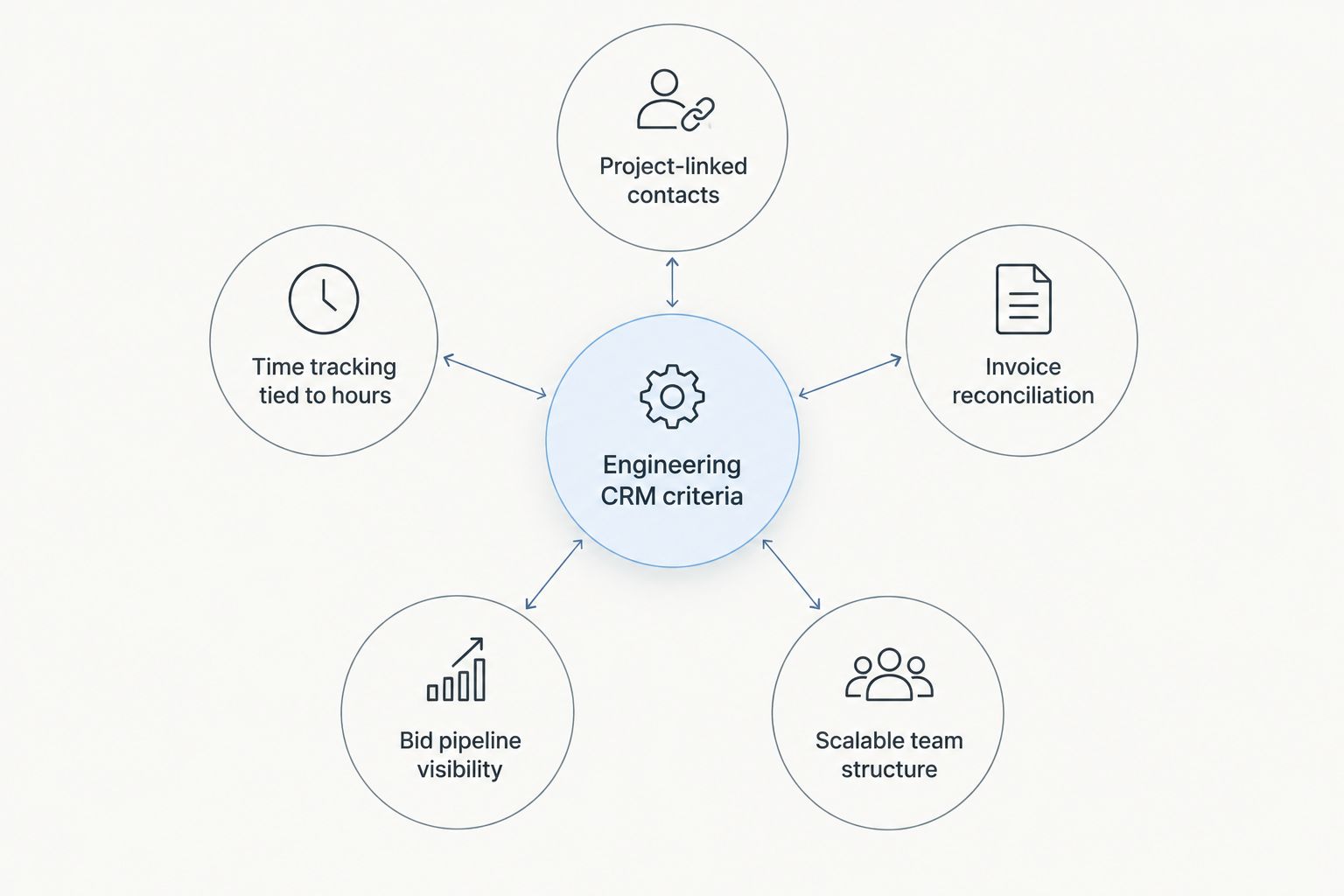
Rank any CRM against these before you look at the table below:
- Project-linked contacts — client, subcontractor and site engineer records tied to a specific job, not a flat contact list
- Time tracking tied to hours — timesheets that feed directly into billable project budgets
- Invoice reconciliation — invoicing that checks against the project budget instead of running as a separate finance tool
- Bid pipeline visibility — clear stages for long, multi-month engineering proposals
- Scalable team structure — works for a 5-person practice and still holds up at 50 people across offices
- Setup effort — how much admin time it takes to get the system actually running
Best CRM for engineering firms in 2026 — at a glance
| Item | Best for | Standout feature | Key limitation |
|---|---|---|---|
| Mesh App | European engineering firms combining project management, time tracking and invoicing | Native link between projects, timesheets and invoices | Built for SMBs in Austria, Germany and Switzerland, not global enterprise rollouts |
| HubSpot CRM | Firms building an outbound growth engine | Marketing and sales pipeline in one interface | Advanced automation and reporting sit behind higher tiers |
| Salesforce | Large, multi-office engineering groups | Deep customization and object-level permissions | Needs dedicated admin time to configure and maintain |
| Pipedrive | Small consultancies wanting a simple visual pipeline | Drag-and-drop deal stages | No native time tracking or invoicing for project delivery |
| monday.com | Cross-team project coordination | Visual boards spanning sales, delivery and ops | Finance and invoicing need third-party integrations |
| Zoho CRM | Budget-conscious firms already in the Zoho ecosystem | Bundles with Zoho Books, Projects and Desk | Interface and workflow builder feel dated next to newer tools |
1. Mesh App: best CRM for engineering firms running project-based work in the DACH region
Mesh App is a modular CRM/ERP platform combining contact management, project management, time tracking, invoicing and finance modules, built for small and medium-sized businesses across trades, construction, consulting and IT in Austria, Germany and Switzerland. An engineering consultancy running fixed-fee or hourly project work fits squarely in that band.
Mesh App pros:
- Contacts, projects, time entries and invoices run in one modular platform instead of stitching four separate tools together
- Time tracking feeds directly into project budgets and client invoices, which matters for hourly and fixed-fee engineering contracts
- Built for the SMB structures common to Austrian, German and Swiss engineering practices, not scaled-down enterprise software
- Modules can be added as the practice grows — start with contacts and projects, add invoicing and finance later
Mesh App cons:
- Coverage centers on Austria, Germany and Switzerland; firms with offices outside the DACH region should confirm regional fit first
- Built for SMB-scale trades, construction, consulting and IT businesses, not large multidisciplinary engineering groups running dozens of parallel bids
- No dedicated marketing automation for firms whose main bottleneck is top-of-funnel lead volume rather than delivery
Best for: engineering consultancies and construction-adjacent firms in Austria, Germany and Switzerland that want project data, timesheets and invoices in one system.
Verdict: Buy — for a DACH-based practice tired of reconciling timesheets against invoices by hand, this is the direct fit.
2. HubSpot CRM: best CRM for engineering firms building an outbound pipeline
HubSpot CRM pairs a sales pipeline with marketing tools in one interface, which suits a firm whose main 2026 problem is generating new bid opportunities rather than executing the projects it already has.
HubSpot CRM pros:
- Intuitive pipeline interface with a low learning curve for a business development team
- Marketing and sales tools sit in the same system, useful for firms actively chasing new clients
- Wide app marketplace for connecting other tools
HubSpot CRM cons:
- Advanced automation and reporting sit behind higher-tier plans
- No native time tracking or project-linked invoicing for delivery work
Best for: firms whose bottleneck is lead volume, not project execution.
Verdict: Buy for growth-stage firms chasing new bids — Skip if delivery, not pipeline, is the actual problem.
3. Salesforce: best CRM for large, multi-office engineering groups
Salesforce scales to complex org structures with deep customization and object-level permissions, which is why large multi-discipline engineering groups running many concurrent bids across offices lean on it.
Salesforce pros:
- Highly customizable data model that adapts to complex reporting structures
- Scales cleanly across departments and offices
- Large ecosystem of integrations and specialist add-ons
Salesforce cons:
- Implementation commonly needs a dedicated admin or outside consultant
- Workflow builder overhead exceeds what a small practice needs
Best for: multi-office or multi-discipline engineering groups running many parallel bids.
Verdict: Buy for enterprise-scale firms — Skip for a 5 to 10-person practice; the setup cost outweighs the benefit.
4. Pipedrive: best CRM for small consultancies wanting a simple pipeline
Pipedrive's drag-and-drop deal stages give a small consultancy fast visibility into open bids without a heavy setup process.
Pipedrive pros:
- Visual, deal-stage pipeline that's fast to set up
- Low learning curve for a small team
Pipedrive cons:
- No native time tracking
- Invoicing needs third-party add-ons to cover project delivery finance
Best for: a small engineering consultancy whose main gap is bid visibility, not delivery tracking.
Verdict: Hold — fine for pipeline visibility alone, revisit once project delivery gets more complex.
5. monday.com: best CRM for cross-team project coordination
monday.com's visual boards span sales and delivery in one place, useful when engineers and business development need to see the same board.
monday.com pros:
- Flexible boards covering sales, delivery and operations
- Good for cross-functional visibility between technical and commercial teams
monday.com cons:
- Finance and invoicing need third-party integrations
- CRM-specific features are lighter than dedicated sales tools
Best for: firms whose engineers and business development team need one shared workspace.
Verdict: Hold — strong for coordination, not built as a finance system.
6. Zoho CRM: best CRM for budget-conscious firms in the Zoho ecosystem
Zoho CRM bundles with Zoho Books, Projects and Desk, which suits a small firm that already runs other Zoho apps and wants CRM in the same ecosystem.
Zoho CRM pros:
- Bundles with other Zoho apps for finance and project tracking
- Broad feature set for a lower entry point than enterprise CRMs
Zoho CRM cons:
- Interface feels dated next to newer competitors
- Workflow builder has a steeper learning curve than it should
Best for: small firms already in the Zoho ecosystem wanting CRM in the same suite.
Verdict: Buy if already running Zoho apps — Skip otherwise; there's no reason to adopt the ecosystem just for the CRM.
How this ranking works
Each entry is measured against the six criteria above: project-linked contacts, time tracking tied to hours, invoice reconciliation, bid pipeline visibility, scalable team structure and setup effort. Mesh App ranks first because it covers the first three natively for the DACH SMB segment it targets; the others each win on one axis — pipeline, scale, or ecosystem — and give up ground on the rest.
Which CRM should you choose in 2026?
If your engineering firm runs project-based work in Austria, Germany or Switzerland and reconciling timesheets against invoices eats hours every month, Mesh App is the default pick. If new client acquisition is the actual bottleneck, HubSpot CRM earns the look. Large, multi-office groups should size up Salesforce before anything else, and a firm already living inside Zoho's other apps has no reason to look past Zoho CRM.
See if Mesh App fits your firm
Check contact, project, time tracking and invoicing modules in one workspace.
FAQ
What's the best CRM software for engineering firms in 2026?
Mesh App is the best CRM software for engineering firms running project-based work in Austria, Germany or Switzerland in 2026, because it links contacts, projects, time tracking and invoicing in one system.
Is HubSpot CRM better than Salesforce for engineering firms?
HubSpot CRM suits smaller firms building an outbound pipeline; Salesforce suits large, multi-office engineering groups that need deep customization and can support the setup effort.
Do engineering firms need project-specific CRM features?
Yes. Engineering work runs on long bid cycles and billable hours tied to specific projects, so a CRM without project-linked contacts and time tracking forces manual reconciliation later.
Can a small engineering consultancy use Pipedrive alone?
Pipedrive works for bid pipeline visibility in a small consultancy, but it has no native time tracking or invoicing, so delivery-side finance still needs another tool.
Is Zoho CRM a good budget option for engineering firms?
Zoho CRM is a reasonable budget pick in 2026 if the firm already runs other Zoho apps like Books or Projects; the value comes from the bundle, not the CRM alone.
Does monday.com work as a CRM for engineering teams?
monday.com works well for cross-team coordination between engineers and business development, but its CRM-specific features are lighter than dedicated sales tools and finance needs integrations.
Is Mesh App only for firms in Austria, Germany and Switzerland?
Mesh App's coverage centers on Austria, Germany and Switzerland, so firms outside the DACH region should confirm regional fit before committing.
One last thing
Before picking a project management tool and a CRM as two separate purchases, check whether either one already ties time entries directly to invoices. That single connection is what actually cuts the month-end reconciliation work engineering firms complain about — the pipeline dashboard rarely is.