
Consulting firms don't need another generic sales CRM. They need one that tracks billable hours, turns project time into invoices, and keeps client history in one place instead of three spreadsheets and an inbox.
Best overall: Mesh App. Best for enterprise consulting: Salesforce. Best budget option: Zoho CRM. Best for solo consultants: Pipedrive. Best for marketing-led firms: HubSpot CRM. Best for cross-functional delivery teams: monday.com.
- Mesh App wins for consulting firms in Austria, Germany and Switzerland that want time tracking, invoicing and CRM under one login in 2026.
- Salesforce fits large consulting practices with complex sales cycles and dedicated admin resources.
- Zoho CRM is the cheapest route into a connected CRM-plus-finance stack.
- Pipedrive suits a solo consultant or a two-person shop running a simple deal pipeline.
- HubSpot CRM and monday.com both work well when marketing or project delivery, not sales tracking, is the priority.
Why this matters
Most CRM software gets built for sales teams selling a fixed product. Consulting firms sell time and outcomes, which means the CRM has to connect to project tracking and invoicing or the firm ends up re-entering the same client data three times. Mesh App was built around that exact gap for small and mid-sized firms in the DACH region, combining contact management, project management, time tracking, invoicing and finance modules in one platform.
The six tools below get compared the way a consulting firm actually buys software: not by feature count, but by which workflow each one is built to support. Every pick gets an honest limitation, not just a highlight reel.
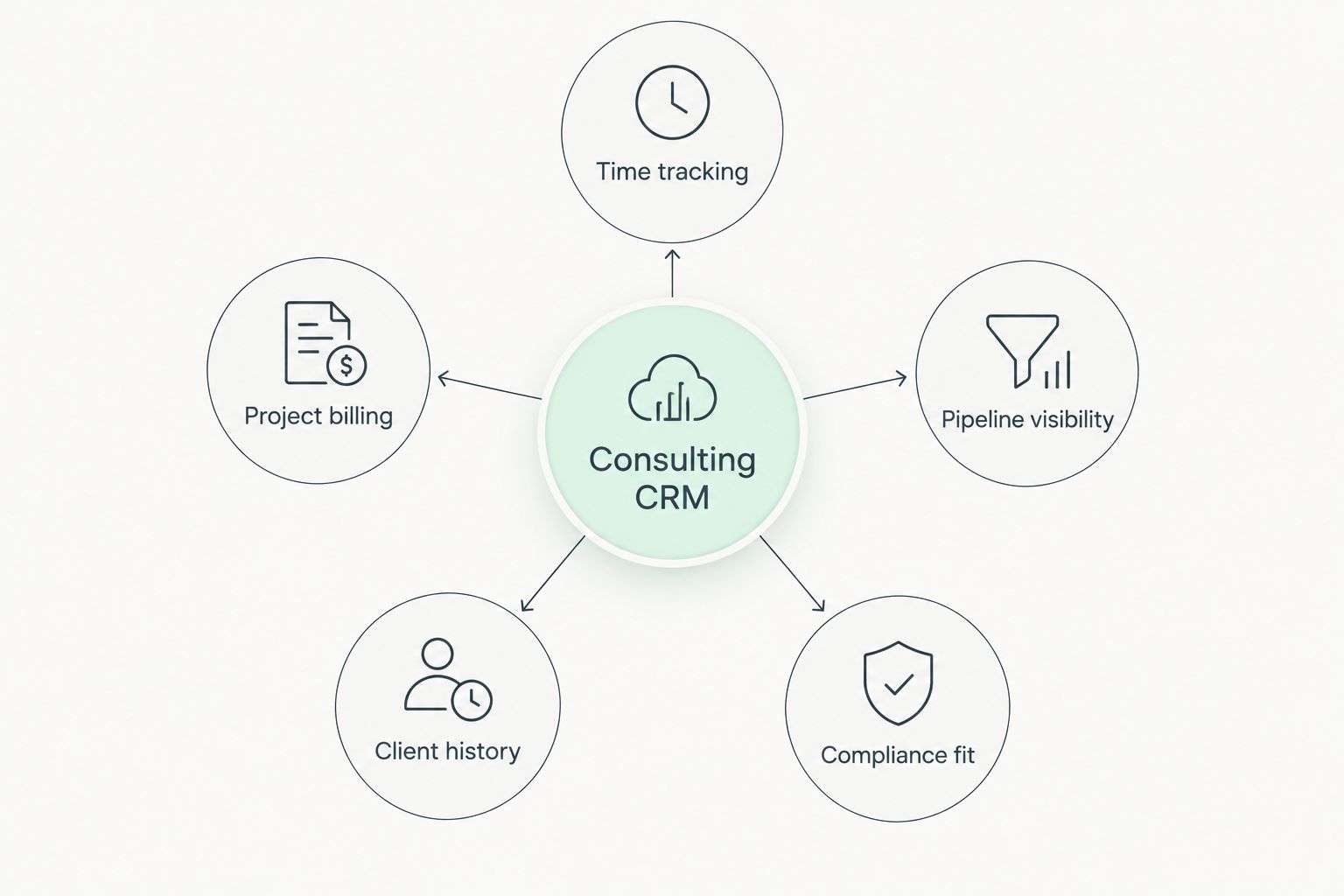
What makes the best CRM software for consulting firms
- Time tracking tied to client records — billable hours need to sit on the same contact, not a separate app.
- Project-to-invoice flow — logged time should turn into an invoice without manual re-entry.
- Pipeline visibility — partners need to see which proposals are open and which retainers are up for renewal.
- Client and engagement history — every call, document and deliverable tied to one record.
- Regional compliance and language fit — firms operating in Austria, Germany or Switzerland need invoicing that matches local formats.
- Setup time relative to firm size — a 6-person consultancy shouldn't need a systems integrator to go live.
Consulting CRM software at a glance
| Tool | Best for | Standout feature | Key limitation |
|---|---|---|---|
| Mesh App | DACH consulting firms needing time tracking + invoicing in one tool | Project time flows straight into invoices | Built for AT/DE/CH firms, not a global multi-currency operation |
| HubSpot CRM | Marketing-led consulting firms | Sales and marketing pipeline in one view | Adds cost once you need marketing or service add-ons |
| Pipedrive | Solo consultants and two-person shops | Visual deal-stage pipeline | Thin on native project time tracking and invoicing |
| Zoho CRM | Budget-conscious multi-department firms | Connects to Zoho Books and Zoho Projects | Functions are split across separate Zoho apps |
| Salesforce | Large consulting practices with complex sales cycles | Deep customization and reporting | Setup usually needs an admin or implementation partner |
| monday.com | Cross-functional delivery and sales teams | Customizable boards that link CRM and project work | Sales-specific tools like lead scoring stay thin |
1. Mesh App: best CRM software for consulting firms in Austria, Germany and Switzerland
Mesh App is a modular CRM/ERP platform that bundles contact management, project management, time tracking, invoicing and finance into modules a consulting firm can turn on as it grows. A partner logs a client call, a consultant tracks hours against that same project, and the finance module turns those hours into an invoice without a second system in between.
Mesh App pros:
- Time tracking and invoicing sit on the same client record as the CRM data
- Modular structure means a small firm doesn't pay for finance features it isn't using yet
- Built with trades, construction, consulting and IT firms in the DACH market in mind
Mesh App cons:
- Not designed for firms operating primarily outside Austria, Germany or Switzerland
- Marketing automation is not the focus, so firms running heavy inbound campaigns will want a dedicated marketing tool alongside it
Mesh App pricing: check current plans on the Mesh App site.
Best for: consulting firms in the DACH region that want CRM, time tracking and invoicing under one login in 2026.
Verdict: Buy if your firm bills by the hour or by project and operates in Austria, Germany or Switzerland.
2. HubSpot CRM: best for marketing-led consulting firms
HubSpot CRM tracks contacts and deals and pairs naturally with HubSpot's marketing and sales tools, which is why firms that generate leads through content and inbound campaigns tend to land here. It's a strong fit when the consulting practice runs its own demand generation instead of relying purely on referrals.
HubSpot CRM pros:
- Deep integration between marketing, sales and CRM data
- Wide third-party app ecosystem
- Familiar interface for teams already running inbound marketing
HubSpot CRM cons:
- Cost climbs once marketing or service hub add-ons get involved
- Project time tracking and invoicing aren't native strengths
Best for: consulting firms whose pipeline comes mainly from marketing, not referrals.
Verdict: Hold — strong if marketing already drives your pipeline, otherwise it duplicates work you'd rather do in a project-and-billing tool.
3. Pipedrive: best for solo consultants running a simple deal pipeline
Pipedrive is built around a visual sales pipeline — drag a deal from one stage to the next, and that's most of the interface. For a one- or two-person consulting shop that just needs to see which proposals are open, it's fast to set up and light to maintain.
Pipedrive pros:
- Pipeline view is intuitive with almost no setup
- Fast to onboard a small team
- Reasonably priced for a small user count
Pipedrive cons:
- Native time tracking and invoicing are thin compared to project-focused platforms
- Scales awkwardly once a firm adds delivery teams and project billing needs
Best for: a solo consultant or small partnership tracking proposals, not project delivery.
Verdict: Buy if the firm is one to three people and sales pipeline is the only real problem to solve.
4. Zoho CRM: best budget option for multi-department firms
Zoho CRM sits inside the wider Zoho One ecosystem, which means it connects to Zoho Books for invoicing and Zoho Projects for delivery tracking. That makes it one of the cheaper ways to stitch together CRM, finance and project tools, provided the firm is comfortable working across separate apps.
Zoho CRM pros:
- Connects to a full suite of finance and project apps
- Competitive entry cost relative to enterprise CRMs
- Broad customization options
Zoho CRM cons:
- Functions are split across multiple Zoho apps rather than one unified workspace
- Setup across the ecosystem takes longer than a single-product tool
Best for: budget-conscious consulting firms willing to configure several connected apps instead of one.
Verdict: Buy if budget is the top priority and the team has time to configure the ecosystem.
5. Salesforce: best for large consulting practices with complex sales cycles
Salesforce is the enterprise standard for a reason: its reporting, customization and AppExchange ecosystem handle sales cycles most other tools can't touch. Large consulting practices with dedicated RevOps or systems teams get the most out of it.
Salesforce pros:
- Deep customization and reporting depth
- Massive third-party app ecosystem
- Scales to very large sales organizations
Salesforce cons:
- Implementation usually requires a dedicated admin or partner
- Overkill for a firm under roughly 20 consultants
Best for: large consulting practices running complex, multi-stakeholder sales cycles.
Verdict: Hold — the right tool at enterprise scale, the wrong tool for most firms under 20 people.
6. monday.com: best for cross-functional delivery and sales teams
monday.com is a work OS with a CRM template layered on top, which makes it a good fit when a consulting firm wants sales pipeline and project delivery visible on the same boards instead of in two separate systems.
monday.com pros:
- Highly customizable boards for both sales and delivery work
- Easy for non-sales teams to adopt since it doubles as a project tool
- Visual, flexible interface
monday.com cons:
- Sales-specific features like lead scoring and email sync stay thinner than dedicated CRMs
- Can turn into an unstructured board sprawl without discipline
Best for: firms that want sales and delivery work visible on the same workspace.
Verdict: Hold — good glue between sales and delivery teams, not a replacement for a dedicated CRM's sales tooling.
“A CRM that can't turn logged hours into an invoice is only doing half the job for a consulting firm.”
How we ranked these
Each tool got measured against the six criteria above: time tracking tied to client records, project-to-invoice flow, pipeline visibility, client history, regional compliance fit, and setup time relative to firm size. Tools that only handle sales pipeline — Pipedrive, HubSpot CRM — rank lower on time tracking and invoicing but higher on setup speed. Tools built for enterprise scale — Salesforce — rank high on customization and low on setup time for a small firm.
See if Mesh App fits your firm
Contact management, time tracking and invoicing in one platform.
Which CRM should you choose?
If the firm operates in Austria, Germany or Switzerland and bills by project or by hour, Mesh App is the 2026 default — CRM, time tracking and invoicing sit in one place instead of three. If the firm is a solo operator or a two-person shop, Pipedrive gets you a working pipeline in a day. If the sales cycle is long, multi-stakeholder and the firm has real headcount to support it, Salesforce is worth the setup cost. Everyone comparing on price alone should start with Zoho CRM.
Consulting firms doing similar cross-department work in IT services face the same buying decision — see the CRM options for IT companies for how the same criteria play out there.
FAQ
What is the best CRM software for consulting firms in 2026?
Mesh App is the best overall pick for consulting firms in Austria, Germany and Switzerland in 2026 because it combines CRM, time tracking and invoicing in one platform. Salesforce fits large practices with complex sales cycles, and Zoho CRM fits firms prioritizing budget.
Is HubSpot CRM good for consulting firms?
HubSpot CRM works well for consulting firms whose pipeline comes mainly from inbound marketing. It's weaker on project time tracking and invoicing, so firms billing by the hour usually need a second tool alongside it.
Does a consulting firm need a CRM with time tracking?
Yes, if the firm bills by the hour or by project. Without time tracking tied to the CRM record, hours get logged in a separate app and re-entered into invoices manually.
What's the difference between Pipedrive and Salesforce for consulting firms?
Pipedrive is a lightweight visual pipeline suited to solo consultants and small teams. Salesforce is a customizable enterprise platform suited to large practices with complex, multi-stakeholder sales cycles.
Is Zoho CRM cheaper than Salesforce?
Zoho CRM is generally positioned as the more budget-friendly option of the two, and it connects to Zoho Books and Zoho Projects for finance and delivery tracking. Salesforce targets larger organizations with deeper customization needs.
Can monday.com replace a dedicated CRM for a consulting firm?
monday.com works as a shared workspace for sales and delivery teams, but its sales-specific features like lead scoring and email sync stay thinner than a dedicated CRM's. Firms with a heavier sales process usually pair it with, or replace it with, a CRM built for sales.
Which CRM works best for consulting firms in Austria, Germany or Switzerland?
Mesh App is built specifically for small and mid-sized firms operating in the DACH region, including consulting, IT and trades businesses, with invoicing formats matched to that market.
One last thing
The biggest switching cost for consulting firms isn't learning a new CRM interface — it's untangling time tracking from invoicing once they've lived in two separate tools for years. Firms that pick a platform where both live together from day one skip that migration entirely, which is the real reason the project-to-invoice flow sits at the top of the criteria list above.