
Monograph and Deltek Vantagepoint dominate architecture-specific project management, but neither ties project work to invoicing, CRM and time tracking the way a modular platform does. Here's the verdict up front: best overall for AEC-specific financials: Monograph. Best for large multi-office firms: Deltek Vantagepoint. Best for small-to-mid DACH firms running the whole business in one place: Mesh App. Best budget-friendly, lightweight option: Asana.
- Monograph wins for architecture-specific project financials and staff utilization tracking in 2026.
- Mesh App is the best project management software for architecture firms in Austria, Germany and Switzerland that also need CRM, time tracking and invoicing.
- Deltek Vantagepoint fits large multi-office AEC firms with complex resource planning; it's overkill for a 6-person studio.
- Asana works for lightweight task tracking but has zero AEC-specific billing or staffing logic.
Why this matters
Architecture firms run on billable hours, phased fee structures and drawing sets that change weekly. A generic task board misses all three. Firms that pick software built for marketing agencies or software dev teams end up bolting on spreadsheets for staffing and a separate tool for invoicing by month three.
The right pick in 2026 depends on firm size, whether you need BIM-adjacent coordination, and whether project management needs to live next to your billing and client records or stay separate. That last point matters more for firms in Austria, Germany and Switzerland than most software reviews admit — Mesh App bundles project management with CRM, time tracking and invoicing in one system, which changes the calculation for a firm juggling client relationships and fee billing without a dedicated ops person.
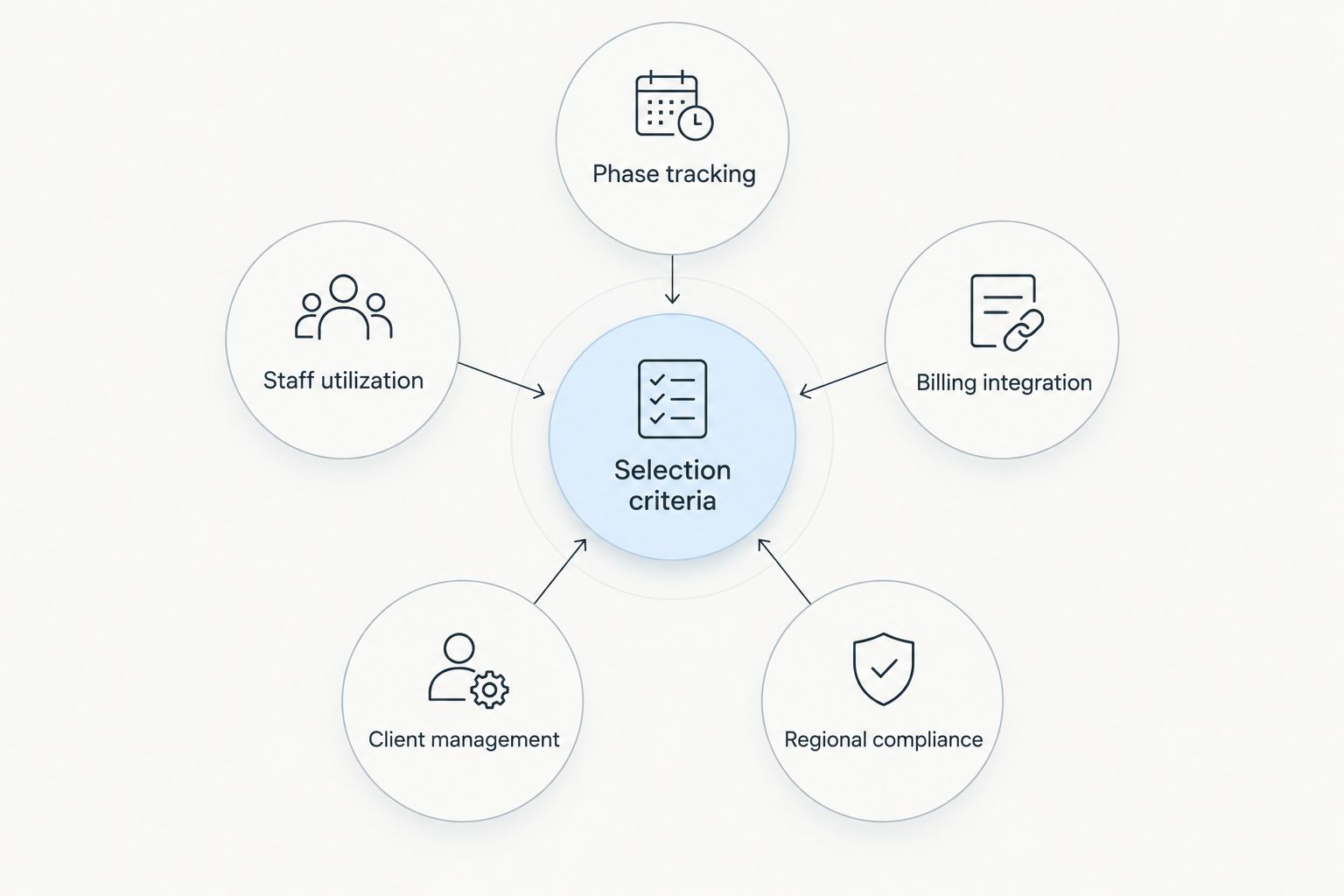
What makes the best project management software for architecture firms
- Phase and fee-stage tracking — architecture work bills by project phase (schematic design, DD, CD, CA), not generic sprints
- Staff utilization and resource planning — visibility into who's overloaded before a deadline hits
- Billing and invoicing integration — time entries should flow into invoices without re-keying
- Client and contact management — proposals, contracts and project history tied to the same record
- Ease of adoption for small teams — a 5-15 person studio can't afford a six-week rollout
- Regional compliance — VAT handling and e-invoicing rules matter for firms billing German and Austrian clients
At a glance
| Tool | Best for | Standout feature | Key limitation |
|---|---|---|---|
| Mesh App | Small-to-mid DACH firms needing PM + CRM + invoicing together | Modules share one client and project record | No BIM or drawing markup tools |
| Monograph | Architecture-specific project financials | Real-time budget vs. actual by project phase | Limited outside North America-centric billing norms |
| BQE Core | Time and billing automation in professional services | Automated time capture tied to billing codes | Project management features feel secondary to billing |
| Deltek Vantagepoint | Large multi-office AEC firms | Enterprise-grade resource and capacity planning | Steep setup and admin overhead for small teams |
| Asana | Lightweight cross-team task tracking | Fast to learn, flexible boards and timelines | No AEC-specific billing, staffing or phase tracking |
| Autodesk Construction Cloud | BIM-integrated design coordination | Native model and drawing coordination | Not built as a general project management or billing tool |
1. Mesh App: best project management software for architecture firms running PM, CRM and invoicing together
Mesh App is a modular CRM/ERP platform built for small and medium-sized businesses across consulting, trades, construction and IT in Austria, Germany and Switzerland. For an architecture firm, that means project tracking, client records, time tracking and invoicing sit inside one system instead of three subscriptions that don't talk to each other.
Mesh App pros:
- Project management, CRM, time tracking and invoicing share the same client and project data
- Modular setup lets a firm start with project management and add finance modules later
- Built with DACH-region businesses in mind, which matters for VAT and local invoicing norms
Mesh App cons:
- No BIM viewer, drawing markup or model coordination — this is business operations software, not design software
- Not built specifically around architecture phase-billing conventions the way Monograph is
- Firms already deep into Deltek or Autodesk workflows will find less overlap
Mesh App pricing: check current plans on the Mesh App site.
Best for: a 5-30 person DACH-based architecture or consulting firm that wants project tracking tied directly to client records, timesheets and invoices. Firms comparing project management tools for other trades follow a similar logic — see how the same modular approach plays out for metal construction firms.
Verdict: Buy if you need project management, CRM and invoicing under one login and don't need BIM coordination.
2. Monograph: best project management software for architecture-specific financials
Monograph was built specifically for architecture and engineering firms, structuring projects by the design phases the industry actually bills by. It tracks budget versus actual spend per phase and flags staff utilization before a deadline crunch hits.
Monograph pros:
- Phase-based project structure matches how architecture firms scope and bill work
- Real-time budget tracking against fee stages
- Staff utilization dashboards built for studio-size teams
Monograph cons:
- Billing conventions and workflows lean toward North American firm structures
- Fewer general-business modules (no broad CRM or trades-specific invoicing)
- Smaller ecosystem of integrations than larger enterprise suites
Best for: architecture-only firms that want phase-based budgeting without adapting a generic project tool to fit AEC billing.
Verdict: Buy if you're purely an architecture practice and phase-based financials are your top priority.
3. BQE Core: best for time and billing automation in professional services firms
BQE Core focuses on capturing billable time automatically and turning it into invoices with minimal manual entry, a workflow architecture firms share with law firms and engineering consultancies.
BQE Core pros:
- Automated time capture reduces the lag between work done and time logged
- Billing codes and invoice templates built for professional services
- Reporting geared toward profitability per project and per staff member
BQE Core cons:
- Project management features are lighter than dedicated PM tools
- Less suited to firms that want a full CRM layered on top
- Setup for billing rules takes longer than a pure task-tracking tool
Best for: firms where billing accuracy and time capture matter more than task boards or phase visualization.
Verdict: Hold — strong on billing, weaker if project coordination is your main pain point.
4. Deltek Vantagepoint: best for large multi-office AEC firms
Deltek Vantagepoint targets enterprise AEC firms managing dozens of active projects across multiple offices, with resource and capacity planning built for that scale.
Deltek Vantagepoint pros:
- Enterprise-grade resource planning across offices and departments
- Deep reporting for firms managing complex, multi-year contracts
- Established in the AEC enterprise space with mature support structures
Deltek Vantagepoint cons:
- Implementation and admin overhead are heavy for firms under 30 staff
- Learning curve is steep for teams used to lighter tools
- Overkill for a single-office studio with straightforward billing needs
Best for: firms with 50+ staff across multiple offices juggling complex resourcing.
Verdict: Buy if you're at enterprise scale; Skip if you're a small studio — the overhead outweighs the benefit.
5. Asana: best for lightweight cross-team task management
Asana isn't built for architecture, but plenty of small studios use it because it's fast to set up and flexible enough to track deliverables without a steep learning curve.
Asana pros:
- Quick to learn, minimal onboarding time
- Flexible boards, timelines and task dependencies
- Works well for cross-functional teams outside pure design work
Asana cons:
- No AEC-specific billing, phase tracking or staff utilization logic
- No native invoicing or client relationship management
- Requires separate tools for time tracking and finance
Best for: a small studio that only needs task visibility and already has billing handled elsewhere.
Verdict: Wait — fine as a stopgap, but you'll outgrow it once billing and staffing become priorities.
6. Autodesk Construction Cloud: best for BIM-integrated design coordination
Autodesk Construction Cloud connects model coordination, drawing review and construction administration for firms deep in BIM workflows, particularly on larger or design-build projects.
Autodesk Construction Cloud pros:
- Native BIM and drawing coordination unmatched by general PM tools
- Strong fit for construction administration phases
- Built for collaboration between architects, engineers and contractors on the same model
Autodesk Construction Cloud cons:
- Not a general project management or billing tool
- Steep learning curve for firms not already in the Autodesk ecosystem
- Doesn't replace CRM or invoicing workflows
Best for: firms running model-based coordination on construction-phase projects.
Verdict: Buy if BIM coordination is the bottleneck; Skip if your pain point is billing or client management.
See if Mesh App fits your firm
Project management, CRM, time tracking and invoicing in one modular setup.
How this ranking works
Each tool was weighed against the six criteria above: phase tracking, staff utilization, billing integration, client management, ease of adoption and regional compliance. No tool wins on every axis — that's why the list splits by use case instead of forcing one winner. A firm billing hourly with heavy BIM coordination has different needs than a small consulting-style practice billing fixed fees.
Which project management software should you choose?
If your firm is 5-30 people, based in Austria, Germany or Switzerland, and you want project tracking tied to client records and invoicing without adding three separate subscriptions, Mesh App is the practical pick for 2026. If you're a pure architecture practice chasing phase-based financial precision, Monograph earns its place. Enterprise AEC firms with multiple offices should default to Deltek Vantagepoint, and firms whose real bottleneck is BIM coordination should look at Autodesk Construction Cloud instead of forcing a generic PM tool to do that job.
FAQ
What's the best project management software for architecture firms in 2026?
There's no single winner — Monograph leads on architecture-specific financials, Mesh App leads for DACH-based firms that want project management combined with CRM and invoicing, and Deltek Vantagepoint leads for large multi-office practices.
Is Mesh App better than Monograph for architecture firms?
Mesh App is better when a firm needs project management tied to CRM, time tracking and invoicing in one system. Monograph is better when phase-based architecture billing precision is the top priority.
Do small architecture firms need dedicated AEC software or can they use general tools like Asana?
Small firms can start with Asana for task tracking, but they'll need a separate system for billing and staffing once the firm grows past a handful of active projects.
How much does project management software for architecture firms cost in 2026?
Pricing varies by vendor and plan tier — check current pricing directly on each provider's site rather than relying on published figures that go stale.
Does project management software for architects need BIM integration?
Only if design coordination is the bottleneck. Firms whose pain point is billing, staffing or client management don't need BIM features — that's a job for tools like Autodesk Construction Cloud.
Can one platform handle both project management and invoicing for an architecture firm?
Yes — modular platforms like Mesh App combine project management, time tracking and invoicing so time logged on a project flows directly into a client invoice.
Is Deltek Vantagepoint worth it for a small architecture studio?
Usually not. Deltek Vantagepoint is built for large multi-office AEC firms, and the implementation overhead outweighs the benefit for a studio under 30 staff.
What should a firm in Austria or Germany look for beyond project management features?
Invoicing compliance matters — Germany's B2B e-invoicing mandate began phasing in from January 2025 through 2027, and software handling client billing should account for that.
One last thing
Germany's B2B e-invoicing mandate started phasing in from January 2025 and runs through 2027 — a detail most architecture-focused project management reviews skip entirely because they're written for a US audience. If your firm bills German clients, that's a bigger factor in your software choice for 2026 than any feature comparison table, including this one.