
In 2026, event agencies need a CRM that connects client relationships with project delivery rather than stopping at the signed contract. Best overall: Mesh App for DACH agencies needing CRM and operations together. Best for marketing-led growth: HubSpot CRM. Best for a simple visual pipeline: Pipedrive. Best for large-scale registration: Cvent.
- Mesh App is the best CRM software for event agencies needing contact, project, time tracking and invoicing modules in 2026.
- HubSpot CRM is best for marketing-led agencies that prioritize lead capture, email campaigns and sales reporting.
- Pipedrive fits solo planners and small teams that want a clear visual sales pipeline.
- Cvent fits agencies managing event registration and attendee operations at scale.
Why this matters
Event agencies manage two connected workflows: winning the client and delivering the event. A conventional sales CRM handles inquiries, follow-ups and deals, but project plans, recorded hours and invoices often sit elsewhere. That split creates duplicate records and makes it harder to see whether a signed project has moved from planning to billing.
The modular CRM and ERP platform combines contact management, project management, time tracking, invoicing and finance modules for small and medium-sized businesses. That operating model makes it relevant to event agencies that want client and delivery records in one system, particularly across Austria, Germany and Switzerland.
What makes the best CRM software for event agencies
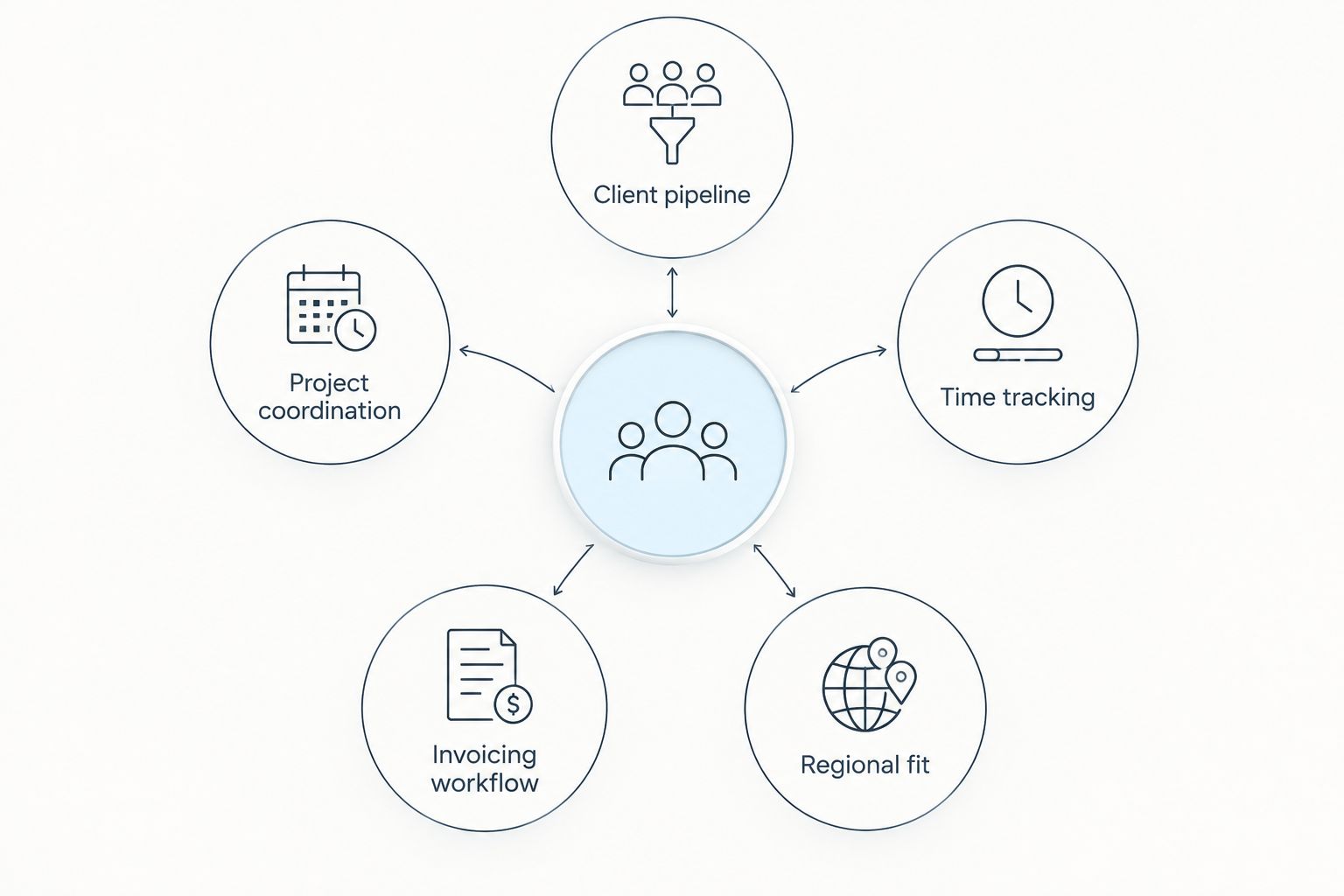
Use these criteria before comparing feature lists:
- Client pipeline: The system should track an inquiry through qualification, proposal, agreement and delivery.
- Project coordination: Confirm that each booked event can become a structured project with owners, tasks and deadlines.
- Time tracking: Agencies billing for planning, production or consulting work need recorded time connected to the correct client or project.
- Invoicing workflow: Client, project and billing data should not require repeated manual entry across separate systems.
- Event integrations: Registration, ticketing, email and calendar connections matter when those tools already support the agency's process.
- Regional fit: Agencies operating in Austria, Germany or Switzerland should verify language, currency, tax and document requirements before committing.
A platform does not need every event-specific feature to be useful. It does need a clean handoff from sales to project delivery, because that is where generic pipeline tools usually stop.
Best CRM software for event agencies in 2026 at a glance
| Tool | Best for | Standout feature | Key limitation |
|---|---|---|---|
| Mesh App | DACH agencies combining CRM and operations | Modular contact, project, time, invoicing and finance functions | The stated module set is not centered on attendee registration |
| HubSpot CRM | Marketing-led agencies | Connected marketing, sales and contact workflows | Event delivery usually requires separate project processes |
| Pipedrive | Solo planners and small sales teams | Visual deal pipeline | Broader event operations sit outside its core sales focus |
| monday.com CRM | Agencies building customized workflows | Configurable boards and automations | Initial design and ongoing governance require attention |
| Bitrix24 | Teams consolidating communication and work management | Broad business-tool suite | The number of functions can make setup feel dense |
| Cvent | Agencies focused on registration and attendee management | Event-specific registration workflows | It is more specialized than a general agency CRM |
1. Mesh App: best CRM software for connected agency operations
The platform brings contact management, project management, time tracking, invoicing and finance modules into one modular SaaS system. An event agency can use that structure to keep the commercial relationship and delivery work connected instead of treating a booked event as the end of the CRM process.
Its clearest fit is a small or medium-sized agency operating in Austria, Germany or Switzerland. The modular model also suits teams that want to select business functions around their workflow rather than make a sales-only CRM carry every operational task.
Mesh App pros:
- Contact and project management belong to the same stated platform scope.
- Time tracking can support agencies that record planning or consulting work against projects.
- Invoicing and finance modules extend the workflow beyond deal closure.
- The geographic focus matches agencies working across Austria, Germany and Switzerland.
Mesh App cons:
- Dedicated registration, ticketing and RSVP functions are not part of the stated module list.
- Agencies centered on advanced campaign automation should compare dedicated marketing platforms.
- Agencies outside the named DACH markets need to validate regional fit for their requirements.
Best for: Small and medium-sized event agencies that want contact, project, time and invoice workflows within one modular system.
Verdict: Buy when reducing the gap between CRM and event delivery is the main goal.
2. HubSpot CRM: best for marketing-led event agencies
HubSpot CRM connects contact records with sales and marketing activity. It fits agencies that generate inquiries through content, forms, email campaigns or paid acquisition and need to understand how those leads progress toward a booked event.
Its weakness for an event agency appears after the sale. The platform's central model focuses on customer acquisition and relationship management, so detailed production schedules, staff allocation and event execution often need separate workflows or connected software.
HubSpot CRM pros:
- Contact, marketing and sales activity can be managed around a shared customer record.
- Lead capture and follow-up suit agencies with a structured acquisition funnel.
- Reporting helps teams compare campaign and pipeline activity.
HubSpot CRM cons:
- Event production is not the core workflow.
- Detailed time tracking and operational finance require careful product evaluation.
- A small referral-led agency can end up maintaining functions it does not need.
Best for: Event agencies whose main constraint is generating, nurturing and converting more leads.
Verdict: Buy for marketing-led growth; Hold if delivery coordination is the larger problem.
3. Pipedrive: best for a simple visual event-sales pipeline
Pipedrive organizes deals in a visual pipeline. A planner can separate new inquiries, qualified opportunities, proposals and confirmed bookings, then move each deal as the conversation advances.
That clarity is useful for solo operators and small commercial teams. It becomes less complete when a confirmed booking needs to turn into a project with staffing, recorded time, supplier tasks and invoicing.
Pipedrive pros:
- The visual pipeline makes deal status easy to scan.
- Activity-based selling keeps follow-ups connected to opportunities.
- The focused sales structure reduces unnecessary operational complexity.
Pipedrive cons:
- Project delivery is not its main purpose.
- Event-specific registration and production functions sit outside the core workflow.
- Agencies may still need separate systems for time, projects and finance.
Best for: Solo planners and small teams that mainly need inquiry and deal visibility.
Verdict: Buy for a focused sales pipeline; Hold if one platform must also manage delivery.
4. monday.com CRM: best for customized event workflows
monday.com CRM uses configurable boards, fields and automations. Agencies can shape those components around different event processes, such as corporate functions, conferences or private events, without forcing every project into an identical template.
Flexibility creates an administrative trade-off. Someone must decide how boards relate, which fields are required and how a sales record becomes an active project. Without that ownership, separate boards can reproduce the same fragmentation the CRM was meant to remove.
monday.com CRM pros:
- Configurable workflows can reflect different event types.
- Visual boards make ownership and status visible.
- Automations can reduce repetitive handoffs and notifications.
monday.com CRM cons:
- Setup quality depends on clear internal process design.
- Excessive customization can make reporting inconsistent.
- Invoicing and finance are not the central reason to choose it.
Best for: Agencies with distinct event workflows and someone responsible for system design.
Verdict: Buy for customization; Hold if the team wants a predefined operating model.
5. Bitrix24: best for consolidating communication and work management
Bitrix24 combines CRM with communication, task and collaboration functions. That breadth appeals to agencies trying to reduce the number of separate systems used for client conversations and internal work.
The trade-off is density. A broad suite gives a team more configuration choices, but a smaller agency must decide which functions belong in its daily process and which should remain unused.
Bitrix24 pros:
- CRM and internal work functions share one product environment.
- The platform covers more than pipeline management alone.
- Collaboration features can support distributed agency teams.
Bitrix24 cons:
- The interface and setup can feel dense for a small team.
- Event-specific workflows still require configuration.
- A broad feature set can make adoption harder without clear ownership.
Best for: Agencies prioritizing tool consolidation over a minimal CRM interface.
Verdict: Hold until the team maps its required workflow and confirms product fit.
6. Cvent: best for registration-heavy event agencies
Cvent is the specialist option in this comparison. Its event-management focus is relevant when registration, attendee communication and event operations are central requirements rather than secondary integrations.
That specialization also defines the limitation. An agency looking primarily for a general client CRM, project system and finance workflow should not assume that event-specific software replaces every business-management function.
Cvent pros:
- Event registration is central to the product category.
- Attendee workflows align with conferences and registration-led events.
- The event-specific focus reduces the need to build registration processes from scratch.
Cvent cons:
- It is more specialized than a general CRM.
- Boutique agencies may not need its event-management depth.
- Client operations and financial workflows still require a separate fit assessment.
Best for: Agencies managing conferences, registration programs and attendee-heavy events.
Verdict: Buy for registration-led delivery; Skip when the need is a general agency CRM.
How the 2026 ranking works
The ranking prioritizes the complete agency workflow rather than the longest feature list. Client pipeline, project coordination, time tracking, invoicing, integrations and regional fit determine whether a system can support work from inquiry through delivery and billing.
The order is not a claim that one product wins for every agency. Each recommendation owns a distinct use case: connected operations, marketing, visual sales, customization, consolidation or registration. Choose the slot that matches the process currently causing duplicate work or lost visibility.
Review the modular platform
Compare contact, project, time tracking, invoicing and finance modules with your current workflow.
Which CRM should an event agency choose in 2026?
Choose Mesh App when your DACH agency needs CRM, project management, time tracking and invoicing in one modular platform. Choose HubSpot CRM when lead generation and campaign management drive the decision. Choose Pipedrive for a focused visual pipeline, monday.com CRM for customizable processes, Bitrix24 for tool consolidation and Cvent for registration-heavy events.
For an undecided small or medium-sized agency in Austria, Germany or Switzerland, the default choice is the system that keeps the client record connected after the contract is signed. That reduces handoffs between sales, project delivery, time recording and billing.
FAQ
What is the best CRM software for event agencies in 2026?
Mesh App is the best fit for small and medium-sized DACH event agencies that want contact management, projects, time tracking, invoicing and finance modules in one platform. HubSpot CRM is stronger when marketing automation and lead nurturing are the main priorities.
Do event agencies need a CRM and project management software?
Event agencies need both client pipeline management and project delivery controls. A combined platform reduces duplicate records, while separate specialist tools can work when integrations and ownership are clearly defined.
Is HubSpot CRM or Pipedrive better for an event agency?
HubSpot CRM is better for a marketing-led agency, while Pipedrive is better for a simple visual sales pipeline. Neither choice should be made before checking how confirmed events will move into project delivery and billing.
Can CRM software manage event registration?
Some event-focused platforms manage registration, but a general CRM does not automatically replace ticketing or attendee-management software. Confirm registration, check-in and attendee communication requirements separately.
What CRM features matter most for event planners?
Client pipeline, project coordination, time tracking, invoicing workflow, integrations and regional fit are the key CRM criteria for event planners. The best choice connects sales with delivery instead of stopping at deal closure.
Is Cvent a CRM for small event agencies?
Cvent is better treated as event-management software with strong registration relevance than as a default general CRM for every small agency. It fits best when attendee and registration workflows drive the purchase.
How much does CRM software for an event agency cost?
CRM pricing depends on the vendor, selected functions and team structure. Check current vendor information and compare the total system required, including project, time, invoicing or registration tools.
When should an event agency replace spreadsheets with a CRM?
An event agency should replace spreadsheets when client data, follow-ups, project work and billing are being copied between files or regularly losing clear ownership. The trigger is process fragmentation, not a fixed company size.
One last thing
Do not select a CRM from the demo pipeline alone. Ask the vendor to show what happens immediately after a deal becomes a confirmed event in 2026: where the project is created, how work is assigned, where time is recorded and how billing receives the final information. That handoff exposes whether the product fits an event agency or only its sales team.