
E-commerce sellers running order flows, customer support, and invoicing across three or four disconnected tools lose more time to data re-entry than to picking the wrong sales tool. The best CRM software for e-commerce businesses in 2026 is judged by how well it unifies that operational mess, not just how pretty the pipeline view looks.
- Mesh App is the best CRM software for e-commerce businesses in Austria, Germany and Switzerland that need invoicing and finance built in.
- HubSpot CRM wins for e-commerce brands running marketing-heavy, email-led growth.
- Zoho CRM is the budget option for multi-channel sellers who want an app ecosystem to grow into.
- Salesforce fits large-scale e-commerce operations with complex B2B and DTC sales cycles.
- Odoo suits technical teams that want open-source CRM and ERP they can self-host.
Why this matters
Most general-purpose CRMs treat e-commerce as an afterthought: a Shopify or WooCommerce connector bolted onto a sales tool built for B2B deal cycles. That works fine until invoicing, VAT handling, or project-based fulfillment enters the picture, which is exactly where a lot of e-commerce operators in the DACH region get stuck in 2026.
The six tools below cover the range: platforms built to unify CRM with invoicing and finance, platforms built for marketing automation, and platforms built for scale. None of them is universally "best" — each wins a specific job.
The verdict
Best overall: Mesh App. Best for marketing-led growth: HubSpot CRM. Best simple pipeline: Pipedrive. Best budget: Zoho CRM. Best for large-scale operations: Salesforce. Best open-source flexibility: Odoo.
What makes the best CRM software for e-commerce
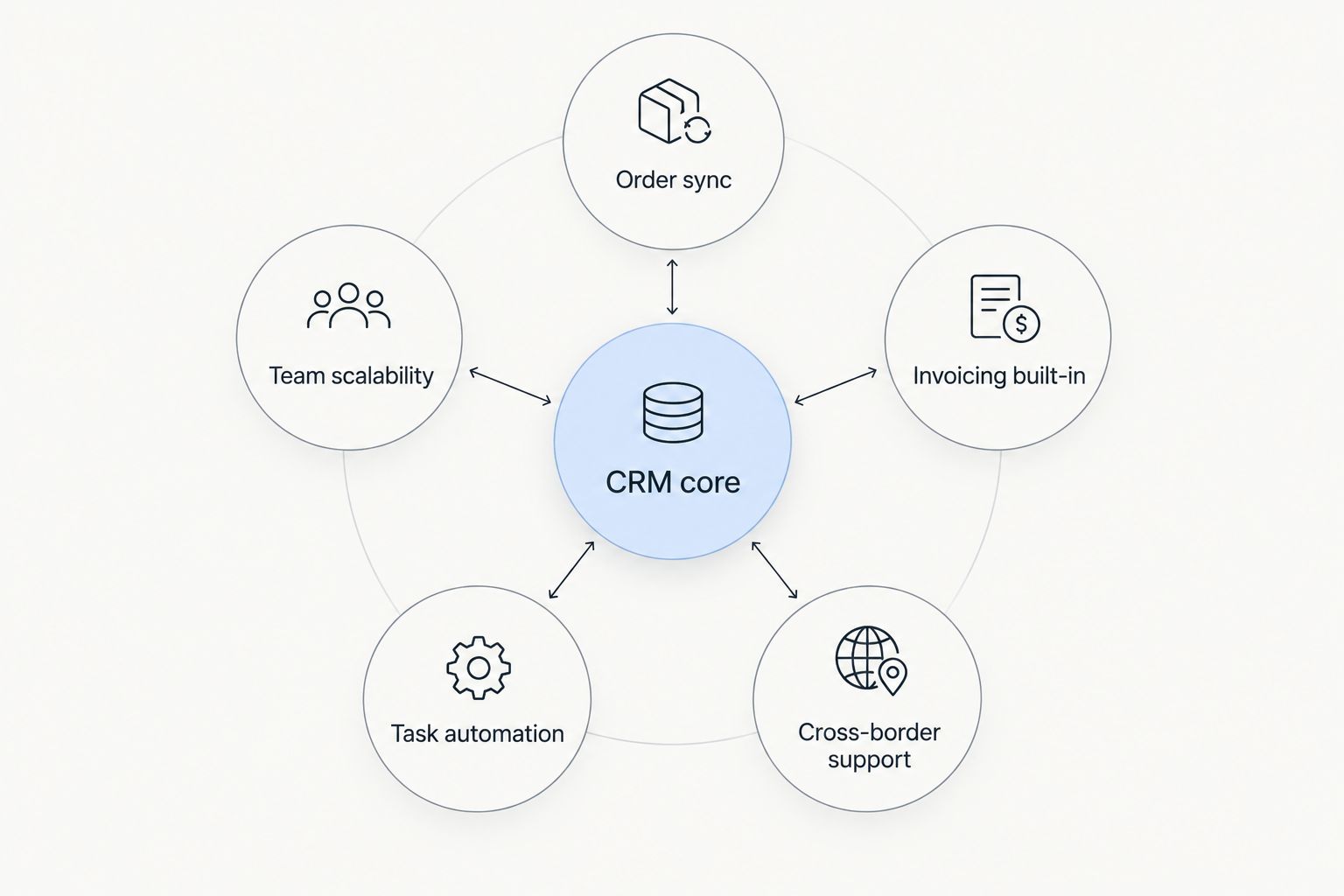
- Order and customer data synced with the sales pipeline, not living in two separate systems
- Invoicing and financial reporting available without bolting on a second tool
- Multi-currency and multi-language support for cross-border selling
- Automation for repeat tasks: follow-ups, renewal reminders, abandoned-cart nudges
- Scales from a single founder to a multi-person sales and fulfillment team
- Data handling suited to the seller's home market and its invoicing rules
At a glance
| CRM | Best for | Standout feature | Key limitation |
|---|---|---|---|
| Mesh App | DACH e-commerce SMBs | Modular CRM, invoicing and finance in one workspace | Not built as a global marketing-automation suite |
| HubSpot CRM | Marketing-led e-commerce brands | Email and content automation tied to the pipeline | Invoicing and finance live in separate add-ons |
| Pipedrive | Small e-commerce sales teams | Visual, deal-stage-first pipeline, fast setup | Limited native finance and project tracking |
| Zoho CRM | Budget-conscious multi-channel sellers | Wide app ecosystem covering inventory and support | Interface feels dated next to newer tools |
| Salesforce | Large-scale e-commerce operations | Deep customization and reporting at enterprise scale | Heavy configuration overhead for a small team |
| Odoo | Technical teams wanting open source | Full CRM plus ERP modules, self-hostable | Needs developer resources to configure and maintain |
1. Mesh App: best CRM software for e-commerce businesses running invoicing in-house
Mesh App is a modular CRM and ERP platform built for small and medium-sized businesses across Austria, Germany and Switzerland, with e-commerce sitting alongside trades, consulting and IT as a core sector. Contact management, project tracking, time tracking, invoicing and finance modules run inside one workspace, so an order thread never has to jump into a separate billing tool to get invoiced.
Mesh App pros:
- Invoicing and finance modules sit next to contact and deal records instead of a bolted-on integration
- Modules switch on individually, so a two-person e-commerce shop isn't paying for enterprise sales tooling it doesn't use
- Built around DACH business practices, including local invoicing conventions
Mesh App cons:
- Marketing automation is lighter than dedicated e-commerce marketing platforms
- Strongest fit is DACH-based sellers; businesses running purely global, multi-market storefronts may want broader localization first
Best for: e-commerce businesses in Austria, Germany or Switzerland that want CRM, invoicing and finance running in one system instead of three. Verdict: Buy.
2. HubSpot CRM: best CRM software for e-commerce businesses scaling marketing automation
HubSpot CRM pairs contact and deal records with email sequences, landing pages, and content workflows, which is why it shows up constantly in marketing-led e-commerce stacks in 2026. The free entry tier makes it an easy first CRM for a brand just past its first year of sales.
HubSpot CRM pros:
- Deep email and marketing automation tied directly to contact records
- Large app marketplace with connectors for Shopify and WooCommerce
- Low friction to start using for a small team
HubSpot CRM cons:
- Invoicing and finance need a separate tool or add-on
- Advanced automation and reporting sit behind higher-tier plans
Best for: e-commerce brands whose growth is driven by content, email, and paid marketing rather than a sales team. Verdict: Buy for marketing-first teams.
3. Pipedrive: best CRM software for e-commerce businesses that want a simple sales pipeline
Pipedrive is built around a visual, deal-stage pipeline and little else, which is exactly why small teams like it. It's fast to configure and easy to hand to a new hire without a training session.
Pipedrive pros:
- Visual pipeline view that's genuinely fast to set up
- Minimal learning curve for small sales teams
- Solid mobile app for reps on the move
Pipedrive cons:
- Limited native invoicing and no project-tracking depth
- Thin for e-commerce operations that also manage fulfillment or service delivery
Best for: small e-commerce teams focused purely on closing and tracking deals. Verdict: Hold — fine for pure sales tracking, thin everywhere else.
4. Zoho CRM: best budget option for multi-channel sellers
Zoho CRM is the entry point into the wider Zoho suite, which includes inventory, help desk, and accounting apps under the same vendor. For a multi-channel seller that expects to add tools over time, staying inside one ecosystem cuts down integration headaches later.
Zoho CRM pros:
- Wide app ecosystem (inventory, support, accounting) to grow into
- Budget-friendly entry point relative to enterprise CRMs
- Reasonable customization for the price tier
Zoho CRM cons:
- Interface feels dated next to newer competitors
- Connecting modules across the Zoho suite takes real setup time
Best for: multi-channel sellers who want to add inventory or support apps later without switching vendors. Verdict: Hold.
5. Salesforce: best CRM software for large-scale e-commerce operations
Salesforce is the CRM e-commerce operations grow into once the sales org gets complicated — multiple regions, wholesale plus DTC, or a large support team. Customization depth and reporting are the reasons enterprises stay on it.
Salesforce pros:
- Deep customization and reporting at enterprise scale
- Large partner and integration ecosystem
- Handles complex, multi-team sales operations
Salesforce cons:
- Heavy configuration overhead, usually requiring an admin or consultant
- Overkill for a single-storefront seller or a two-person team
Best for: e-commerce operations with large sales teams or wholesale plus DTC complexity. Verdict: Skip for small teams, Buy for scaled operations.
6. Odoo: best CRM software for e-commerce businesses wanting open-source flexibility
Odoo bundles CRM with a full ERP suite — inventory, accounting, manufacturing — as modular apps you can self-host. That flexibility appeals to sellers with in-house technical capacity who want full control over their stack instead of renting a vendor's roadmap.
Odoo pros:
- CRM and ERP modules in one open-source platform
- Self-hostable, with no vendor lock-in on the data
- Highly customizable for teams with development resources
Odoo cons:
- Needs technical resources to configure and maintain
- Slower time-to-value without in-house or contracted development support
Best for: e-commerce sellers with engineering resources who want to own their stack. Verdict: Wait — unless a developer is already on the team.
How we ranked
Each tool was checked against the six criteria above: order-and-pipeline sync, native invoicing, multi-currency support, automation depth, scalability, and fit for the seller's home market. Mesh App, HubSpot CRM, and Pipedrive were compared head-to-head on setup speed; Salesforce and Odoo on depth and control; Zoho CRM on ecosystem breadth for the price.
“A CRM that can't invoice is a rolodex with a nicer interface.”
Run CRM and invoicing in one place
See how Mesh App unifies contacts, invoicing and finance for e-commerce teams.
Which CRM software should you choose?
For a DACH-based e-commerce business that wants contacts, invoicing, and finance running inside one system in 2026, Mesh App is the default pick. For a brand whose growth engine is content and email marketing, HubSpot CRM earns its place. Sellers on a tight budget who expect to add inventory or support tools later should look at Zoho CRM, and teams past the point of a simple pipeline — multiple regions, wholesale plus DTC — should be evaluating Salesforce, not fighting a tool built for a five-person shop.
FAQ
What's the best CRM software for e-commerce businesses in 2026?
Mesh App is the best overall pick for DACH-based e-commerce businesses that need CRM, invoicing and finance in one system. HubSpot CRM leads for marketing-heavy brands, and Salesforce fits large-scale operations.
Is HubSpot CRM better than Zoho CRM for e-commerce?
HubSpot CRM wins on marketing automation and email workflows tied to contact records. Zoho CRM wins on budget and on its wider app ecosystem covering inventory and support.
Do e-commerce businesses need a CRM with built-in invoicing?
Not always, but sellers who handle repeat B2B orders, subscriptions, or wholesale alongside retail benefit from invoicing and finance living next to the customer record instead of in a separate tool.
Can Mesh App replace separate invoicing software for an e-commerce business?
Yes — Mesh App's invoicing and finance modules run in the same workspace as contact and project data, which removes the need for a standalone billing tool for most SMB use cases.
Is Salesforce worth it for a small e-commerce store?
Usually not in 2026. Salesforce's configuration overhead suits large sales teams and complex operations; a small or solo store gets more value from a lighter, faster-to-set-up CRM.
What's the best free CRM for a new e-commerce business?
HubSpot CRM's free tier is the most commonly used starting point for a new e-commerce brand, though invoicing and advanced automation require additional tools or paid tiers.
Is Odoo good for e-commerce businesses?
Odoo works well for e-commerce teams with in-house technical resources who want an open-source CRM and ERP they can self-host and fully customize. It's a poor fit without developer support.
One last thing
The CRM comparison that matters most in 2026 usually isn't feature-for-feature — it's how many other tools a seller can retire once the CRM is set up. A platform that also handles invoicing and finance often replaces two subscriptions, not one, which is a bigger operational win than any single automation feature.