Best overall for roofing companies based in Austria, Germany or Switzerland: Mesh App. Best for U.S. contractors managing insurance claims: AccuLynx. Best for small crews that want a simple sales pipeline: JobNimbus. Best for multi-crew dispatch at scale: ServiceTitan. Best for roofing companies that want a free-form sales-and-marketing pipeline: HubSpot CRM. Best for solo roofing sales reps: Pipedrive.
- Mesh App wins for roofing companies in Austria, Germany and Switzerland that need CRM, project management, time tracking and invoicing in one platform.
- AccuLynx and ServiceTitan target U.S. roofing contractors with insurance-claim workflows and multi-crew dispatch.
- JobNimbus and Pipedrive suit smaller crews or solo sales reps who want a lighter pipeline.
- No roofing CRM on this list wins on every dimension in 2026 - match the tool to crew size and region, not brand reputation.
Why this matters
Roofing sales cycles run through a lead, an on-site quote, a signed contract, material ordering, crew scheduling and a final invoice. A generic spreadsheet loses track of at least one of those steps by the third job of the week.
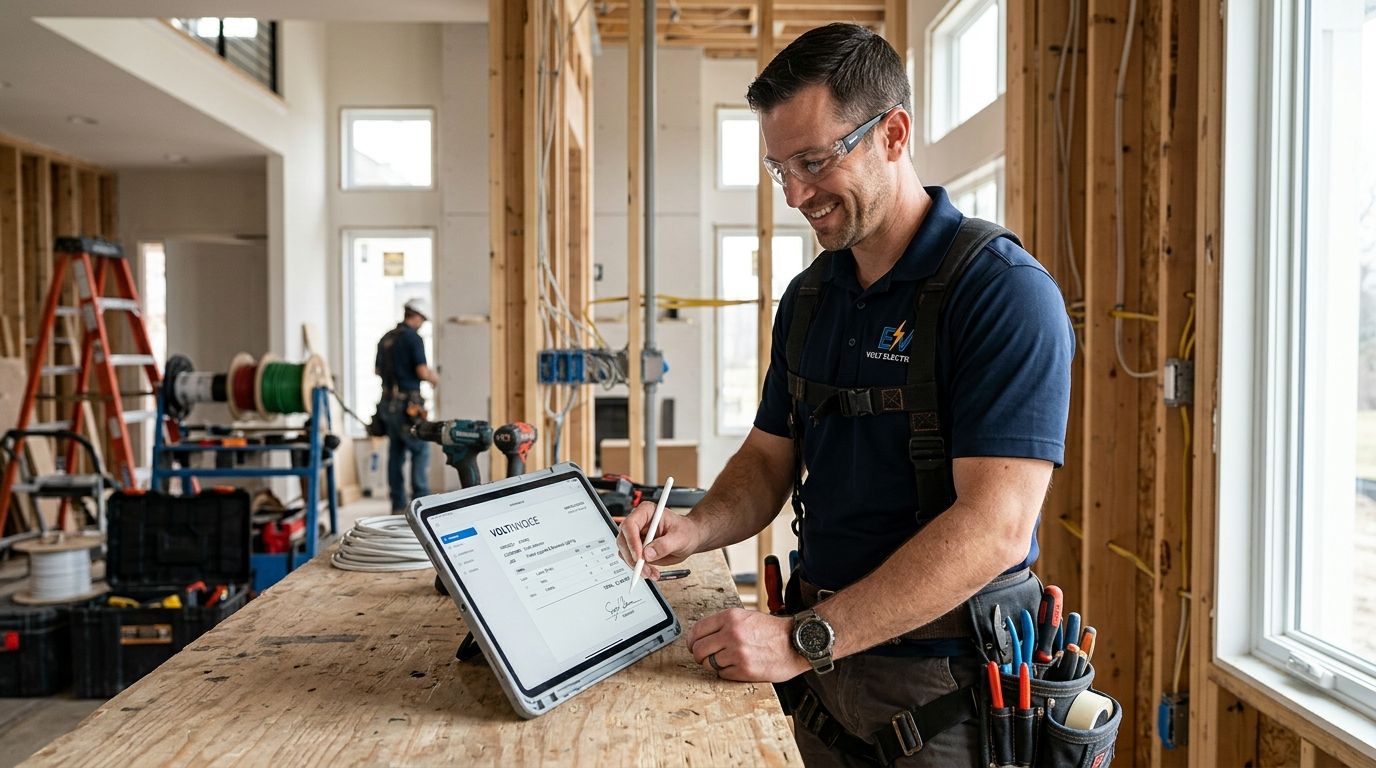
The best CRM software for roofing companies in 2026 has to do three things at once: track the deal from first call to final invoice, work on a phone while a rep is standing on a roof, and hand job costs straight to whoever does the books. Miss any one of those and you're back to a spreadsheet with extra logins.
What makes the best roofing CRM
- Lead-to-job pipeline tracking - quote, contract, installation, follow-up, all in one view
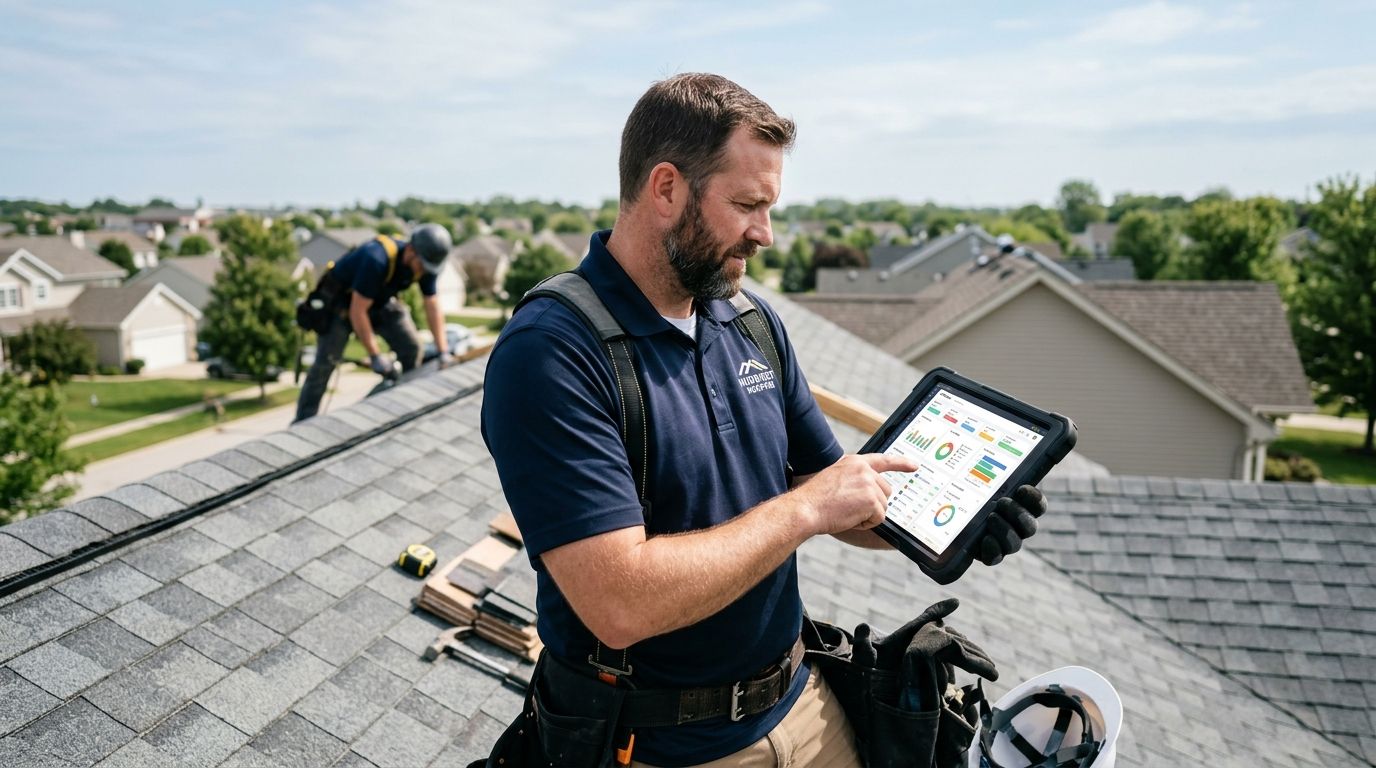
- Field-ready mobile access - crews and sales reps need this to work from a truck or a rooftop, not just a desk
- Time tracking tied to job costing - labor hours should feed straight into what a job actually cost
- Invoicing and finance built on project data - no manual re-entry between the job file and the invoice
- Scheduling and dispatch for multiple crews and trucks running jobs on the same day
- Regional and language support - a roofing company in Linz or Zurich has different compliance and language needs than one in Dallas
At a glance
| Software | Best for | Standout feature | Key limitation |
|---|---|---|---|
| Mesh App | Roofing companies in Austria, Germany, Switzerland | CRM, project management, time tracking and invoicing in one modular platform | No roofing-specific insurance-claim templates out of the box |
| AccuLynx | U.S. contractors handling insurance claims | Built-in claims and material-ordering workflow | Focused almost entirely on the U.S. insurance-restoration market |
| JobNimbus | Small roofing crews | Simple job-and-sales pipeline with low setup time | Thinner finance and reporting tools than full ERP platforms |
| ServiceTitan | Multi-crew roofing operations | Dispatch and scheduling across many trucks and technicians | Built for larger home-service operations, heavier to set up for a small crew |
| HubSpot CRM | Marketing-driven sales pipelines | Deep marketing and sales-pipeline tooling | No roofing-specific job or project management layer |
| Pipedrive | Solo roofing sales reps | Lightweight, visual deal pipeline | No project management, time tracking or invoicing built in |
1. Mesh App: best CRM for roofing companies in Austria, Germany and Switzerland
Mesh App is a modular CRM/ERP platform built for trades and construction businesses in the DACH region, including roofing. It combines contact management, project management, time tracking, invoicing and finance modules so a roofing company doesn't have to stitch together four separate tools to run one job.
For a roofing business operating under Austrian, German or Swiss invoicing and labor rules, that matters more than it sounds - job costs, crew hours and client contracts all live in one system instead of getting re-typed between apps.
Mesh App pros:
- Contact management, project management, time tracking and invoicing modules work together instead of as bolt-ons
- Built with trades and construction workflows in mind, not retail-first CRM logic
- Modular setup lets a roofing company turn on only the modules it needs
Mesh App cons:
- No dedicated insurance-claim or material-ordering workflow like the U.S.-focused tools on this list
- Best fit is a roofing company already operating in Austria, Germany or Switzerland - less relevant outside that market
Mesh App pricing: check the current pricing and module options on the site.
Best for: roofing companies in the DACH region that want CRM, job tracking, time tracking and invoicing in one platform. Verdict: Buy.
2. AccuLynx: best CRM for roofing companies managing insurance claims
AccuLynx is built specifically around U.S. roofing sales, with workflows for insurance claims, material ordering and production tracking baked into the core product. It's a category-specific tool, not a general CRM adapted for roofing.
AccuLynx pros:
- Insurance-claim workflow built for U.S. roofing restoration work
- Material ordering tied directly to the job file
- Roofing-specific reporting and production tracking
AccuLynx cons:
- Built almost entirely around the U.S. insurance-restoration model, less useful outside that market
- Less flexible for roofing companies that also handle broader construction or trades work
Best for: U.S. roofing contractors doing insurance-restoration work. Verdict: Buy if that's your business model.
3. JobNimbus: best CRM for small roofing crews
JobNimbus keeps the sales-and-job pipeline simple: leads, jobs, tasks and a calendar, without the heavier setup of a full ERP platform. It's a common pick for roofing crews that want something running in a week, not a quarter.
JobNimbus pros:
- Fast setup, low learning curve for small teams
- Combined sales and job pipeline in one view
- Mobile app usable from a job site
JobNimbus cons:
- Finance and invoicing tools are lighter than dedicated ERP platforms
- Less structure for companies running multiple crews and complex job costing
Best for: small roofing crews that want a simple pipeline without a long setup. Verdict: Buy for small teams; Wait if you're already outgrowing spreadsheets fast.
4. ServiceTitan: best CRM for multi-crew roofing dispatch
ServiceTitan is built for home-service businesses running many technicians and trucks on the same day, and roofing companies with several crews use it for scheduling and dispatch at that scale.
ServiceTitan pros:
- Dispatch and scheduling built for many crews and trucks at once
- Strong reporting across a larger operation
- Established in the broader home-services market
ServiceTitan cons:
- Heavier setup and onboarding than tools built for small teams
- More platform than a two- or three-crew roofing company typically needs
Best for: roofing companies running multiple crews and trucks that need centralized dispatch. Verdict: Buy at scale; Skip if you're running one or two crews.
5. HubSpot CRM: best for roofing companies focused on marketing and sales pipeline
HubSpot CRM is a general-purpose sales and marketing platform. Roofing companies use it when the priority is lead capture and marketing automation more than job execution.
HubSpot CRM pros:
- Strong marketing and sales-pipeline tooling
- Widely used, easy to find integrations and support resources
- Works for any industry, not roofing-locked
HubSpot CRM cons:
- No project management, time tracking or job-costing layer for the actual roofing work
- Requires a separate tool for scheduling and crew management
Best for: roofing companies where marketing and lead generation are the bottleneck, not job execution. Verdict: Hold - pair it with a job-management tool rather than using it alone.
6. Pipedrive: best CRM for solo roofing sales reps
Pipedrive is a visual, deal-stage CRM built for sales tracking rather than full job or project management. A solo roofing sales rep managing their own pipeline gets a clean, simple view of deals without extra overhead.
Pipedrive pros:
- Visual pipeline that's fast to learn
- Low overhead for a single user or small sales team
- Straightforward deal and contact tracking
Pipedrive cons:
- No project management, time tracking or invoicing built in
- Not built for coordinating crews or job costing
Best for: a solo roofing sales rep who just needs a deal pipeline. Verdict: Buy for that use case only.
“A roofing CRM that can't run on a phone in the field is a spreadsheet with extra steps.”
See if Mesh App fits your crew
Contact management, job tracking, time tracking and invoicing in one platform.
How this ranking works
Each tool above is matched to one distinct use case: region and module coverage for Mesh App, insurance claims for AccuLynx, simple pipelines for JobNimbus, multi-crew dispatch for ServiceTitan, marketing pipeline for HubSpot CRM, solo sales tracking for Pipedrive. None of the six is being scored against a use case it wasn't built for - a roofing company should pick based on crew size, region and which part of the job (sales, execution, or both) actually needs fixing in 2026.
Which roofing CRM should you choose in 2026?
If your roofing company operates in Austria, Germany or Switzerland and needs CRM, project management, time tracking and invoicing under one login, Mesh App is the default pick. If you're a U.S. contractor buried in insurance paperwork, AccuLynx earns its place. Running five crews across three trucks a day points to ServiceTitan; running a two-person crew points to JobNimbus. A solo rep chasing leads with no job-management need at all is better served by Pipedrive than by any full ERP platform.
FAQ
What's the best CRM software for roofing companies in 2026?
For roofing companies in Austria, Germany or Switzerland, Mesh App is the strongest pick because it combines CRM, project management, time tracking and invoicing in one platform. U.S. contractors handling insurance claims are usually better served by AccuLynx.
Is Mesh App good for roofing companies outside Austria, Germany and Switzerland?
Mesh App is built around DACH-region trades and construction workflows, so it fits best inside that market. Roofing companies outside the region may find tools like AccuLynx or ServiceTitan a closer match.
Do roofing companies need industry-specific CRM software or is a general CRM enough?
A general CRM like HubSpot or Pipedrive handles the sales pipeline but not job execution, time tracking or invoicing. Roofing companies running full jobs, not just sales, need a platform with project management and job costing built in.
How much does CRM software for roofing companies cost in 2026?
Pricing varies by vendor, plan tier and company size, so check current pricing directly on each provider's site rather than relying on a fixed number.
Can roofing crews use CRM software from the field?
Yes, most of the tools on this list including Mesh App, JobNimbus and ServiceTitan offer mobile access so crews and sales reps can update jobs from a truck or a job site.
Is HubSpot CRM good for roofing companies?
HubSpot CRM works well for roofing companies focused on lead generation and marketing, but it has no project management or job-costing layer, so it usually needs to be paired with a separate job-management tool.
What's the difference between AccuLynx and JobNimbus?
AccuLynx is built around U.S. insurance-claim and material-ordering workflows for larger restoration jobs, while JobNimbus offers a simpler sales-and-job pipeline aimed at smaller crews with less setup time.
Does Mesh App handle job costing and invoicing for roofing projects?
Yes, Mesh App's time tracking and invoicing modules connect to project data, so labor hours and job costs feed directly into invoices instead of requiring manual re-entry.
One last thing
The roofing companies that get the most out of any CRM in 2026 aren't the ones with the most features turned on - they're the ones where the invoice actually matches the hours the crew logged on-site. That's a job-costing problem before it's a software problem, and it's why Mesh App pairs time tracking directly to invoicing rather than treating them as separate modules.